
EN 16404: Boosting European Rail Resilience & Safety
Discover EN 16404: the vital standard ensuring safe, efficient railway vehicle re-railing and recovery. It mandates design, lifting points, and manuals for operational resilience.
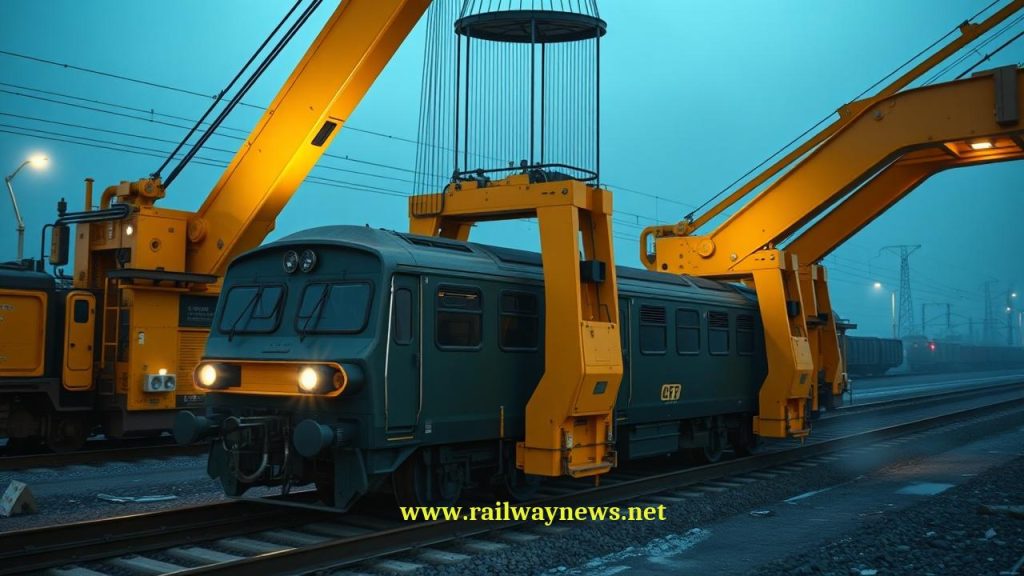
Understanding EN 16404: The Standard for Railway Vehicle Re-railing and Recovery
EN 16404 is a European standard that specifies the technical requirements for the safe and efficient re-railing and recovery of railway vehicles following a derailment or other incident. Its primary purpose is to ensure that rolling stock is designed and constructed in a way that facilitates its recovery, minimizing further damage to the vehicle, infrastructure, and ensuring the safety of recovery personnel.
This standard is critical for railway interoperability and operational resilience. By defining standardized interfaces, lifting points, and structural strength requirements, EN 16404 allows recovery teams to use common equipment and procedures across different networks and vehicle types, significantly reducing incident response times and associated costs.
Core Objectives of EN 16404
The standard is built around several key principles aimed at creating a prepared and standardized approach to railway incidents. These objectives are:
- Safety: To establish design criteria that protect recovery staff, the public, and the vehicle itself from further harm during lifting and recovery operations.
- Vehicle Integrity: To prevent secondary damage to the vehicle’s structure, bogies, and key components by defining approved lifting points and load cases.
- Efficiency: To reduce the time required to clear a railway line after an incident, thereby minimizing operational disruption and its economic impact.
- Interoperability: To ensure that recovery equipment from different operators or infrastructure managers can be used on any vehicle compliant with the standard.
- Clarity: To require manufacturers to provide clear, unambiguous documentation (a Recovery Manual) detailing the specific procedures for their vehicles.
Key Technical Requirements of the Standard
EN 16404 outlines specific design and documentation requirements that manufacturers must adhere to. These are the technical cornerstones of the standard.
Lifting and Jacking Points
Perhaps the most critical aspect of the standard is the specification of dedicated lifting and jacking points. These are reinforced locations on the vehicle’s underframe or body designed to withstand the immense forces of lifting and re-railing.
- Location: The standard defines the permissible zones where these points can be located, typically near the bogie pivots or at the ends of the vehicle. This ensures stability during lifting.
- Design and Strength: Each point must be designed to handle specific vertical and lateral loads without causing permanent deformation to the vehicle structure. The standard defines the load cases that these points must endure.
- Marking: All lifting and jacking points must be clearly marked with standardized pictograms. This allows recovery crews to immediately identify the correct and safe points to attach their equipment, even under poor visibility or stressful conditions.
Structural Strength and Load Cases
A vehicle’s body shell must be strong enough to be lifted without buckling or failing. EN 16404 specifies structural integrity requirements for the car body when subjected to recovery-specific loads. It defines exceptional load cases that go beyond normal operational loads, simulating the stresses of being lifted from one or both ends or being moved with specialized recovery gear.
Recovery Manual and Documentation
Compliance is not just about physical design; it is also about providing crucial information. The standard mandates that the vehicle manufacturer must produce a detailed Recovery Manual. This document is essential for the incident response team and must contain:
- Diagrams showing the exact location of all lifting, jacking, and hauling points.
- The vehicle’s key characteristics, including its total mass, the mass of the car body and bogies, and the position of the center of gravity.
- Detailed step-by-step procedures for re-railing and recovery operations specific to that vehicle model.
- Information on any parts that need to be removed before lifting (e.g., specific pipework, fairings).
- Specifications for the required recovery equipment and interfaces.
Comparison of EN 16404 Requirements for Different Vehicle Types
The standard recognizes that different types of rolling stock have unique characteristics. The table below outlines some of the key differences in the application of EN 16404.
| Vehicle Type | Key Considerations for Lifting & Recovery | Structural Requirements | Documentation Specifics |
|---|---|---|---|
| Locomotives | Extremely high weight and concentrated mass. Lifting points must be robustly integrated into the main frame. Access may be restricted by heavy equipment. | The underframe must withstand massive compressive and tensile forces during lifting from its ends. The structural integrity of the main frame is paramount. | Manual must detail the center of gravity with high precision and provide instructions for disconnecting traction motors or other heavy components if necessary. |
| Passenger Coaches (EMU/DMU/Trams) | Lighter than locomotives but often part of a fixed-rake trainset. Inter-car connections (gangways, couplers) are a key concern. Risk of damage to sensitive electronics and interiors. | Car body must resist torsion and bending when lifted, especially for long, articulated units. Focus on preventing damage to windows and door frames. | Must include procedures for managing articulated sections and semi-permanent couplers. Details on protecting passenger-facing components are required. |
| Freight Wagons | Vary widely in design (e.g., flatbeds, tankers, container carriers). The nature and stability of the cargo are critical factors. Lifting points are typically standardized on the solebar. | The underframe is the primary load-bearing structure. The design must account for the vehicle being empty or fully laden, as this significantly changes its dynamics. | Documentation needs to be straightforward and robust, often relying on pictograms due to the international nature of freight. Must specify procedures for securing or offloading cargo if required. |
| On-Track Machines (OTM) | Often have irregular shapes, asymmetrical weight distribution, and sensitive machinery (e.g., cranes, tamping units). | The chassis must be strong enough to support the attached machinery during a lift. The interaction between the main frame and auxiliary equipment is a key design challenge. | Recovery manual is highly specialized, detailing how to secure moving parts (like booms or ploughs) before recovery and providing very specific lift orientations. |
Conclusion: A Foundation for Railway Resilience
EN 16404 is a fundamental standard for the modern railway industry. It moves the process of incident recovery from an improvised, high-risk activity to a planned, engineered, and predictable procedure. By embedding recovery considerations directly into the vehicle design phase, the standard ensures that when an incident occurs, operators are equipped with the vehicles, information, and standardized interfaces needed to restore service safely and swiftly. This proactive approach is essential for maintaining the reliability and safety of Europe’s rail network.

Railway infrastructure, rolling stock and transport technologies specialist focused on global rail industry developments, high-speed rail systems, signaling technologies and freight transportation. Covering railway investments, public transport modernization, rail operations and international mobility projects across Europe, Asia and North America.