
EN 15085-4: Boosting European Rail Safety & Quality
Unlock railway welding excellence with EN 15085-4. This vital standard mandates production requirements, ensuring unparalleled safety, quality, and reliability for all components.
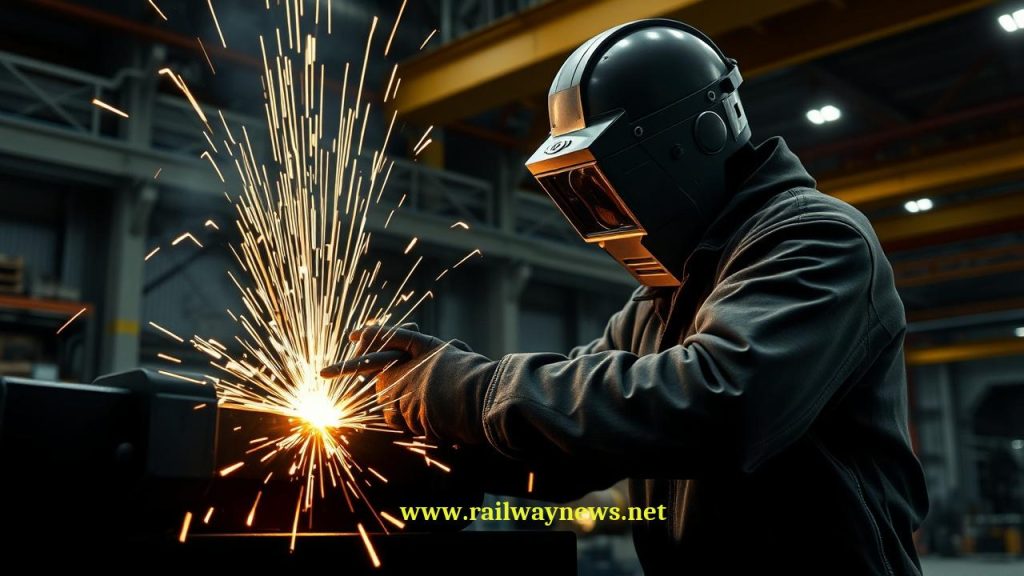
Understanding EN 15085-4: Production Requirements for Railway Welding
EN 15085-4 is a critical European standard that specifies the production requirements for the welding of railway vehicles and their components. As part of the detailed EN 15085 series, this particular section focuses on the practical execution of welding activities, ensuring that the final products meet the stringent safety, quality, and reliability standards demanded by the railway industry.
The primary goal of EN 15085-4 is to provide a unified framework for manufacturers. It outlines the necessary steps and controls from the planning phase through to final inspection, ensuring that all welding operations are performed consistently and correctly. Compliance with this standard is essential for any organization involved in manufacturing or repairing welded railway parts, as it directly impacts component integrity and operational safety.
Key Pillars of EN 15085-4: Ensuring Quality in Production
The standard is built upon several core principles that govern the entire welding production process. These pillars ensure that every welded joint is traceable, meets design specifications, and is fit for purpose.
Welding Plan and Documentation
Before any welding begins, a detailed welding plan must be established. This is a foundational requirement that ensures all activities are properly managed and controlled. The documentation package typically includes:
- Welding Procedure Specifications (WPS): Detailed documents providing the required variables for a specific welding application to assure repeatability. Each WPS is qualified through a Welding Procedure Qualification Record (WPQR).
- Welding Sequence Plan: A plan that defines the order in which welds are to be made to control distortion and residual stresses, which is especially critical for complex assemblies.
- Inspection and Test Plan: Outlines the type, frequency, and extent of inspections and tests (both non-destructive and destructive) to be carried out before, during, and after welding.
- Traceability Records: Systems to track materials, welders, and welding parameters used for each specific weld joint.
Welding Personnel and Supervision
The competence of the personnel involved is paramount. EN 15085-4 mandates specific requirements for everyone involved in the welding process:
- Welders and Welding Operators: Must be qualified in accordance with ISO 9606 (for manual welding) or ISO 14732 (for operators of welding machines). Their qualifications must be valid and appropriate for the materials, processes, and positions they are working on.
- Welding Coordinators: A suitably qualified Welding Coordinator, certified according to ISO 14731, must oversee all welding-related activities. The required level of the coordinator (e.g., IWE, IWT, IWS) depends on the Certification Level (CL) of the manufacturer.
Materials and Consumables
The standard places strict controls on the materials used in production. This includes base materials (plates, profiles, etc.) and welding consumables (filler wires, electrodes, shielding gases).
- Material Certification: All base materials must have appropriate inspection certificates (e.g., 3.1 according to EN 10204) to verify their chemical and mechanical properties.
- Consumable Control: Welding consumables must be stored, handled, and conditioned according to the manufacturer’s recommendations to prevent moisture absorption or contamination, which could lead to weld defects.
- Traceability: A robust system must be in place to ensure full traceability from the raw material to the final welded component.
The Role of Certification Levels (CL) in Production
EN 15085 defines Certification Levels (CL 1 to CL 3) based on the safety relevance of the welded components. EN 15085-4 links these levels to specific production, inspection, and personnel requirements. A manufacturer must be certified to the appropriate level for the components they produce.
| Requirement | CL 1 | CL 2 | CL 3 |
|---|---|---|---|
| Component Criticality | High safety relevance. Welds on components whose failure could directly lead to catastrophic accidents (e.g., bogie frames, bolsters). | Medium safety relevance. Welds on components whose failure would not lead to a direct accident but could affect the vehicle’s operational integrity (e.g., roof structures, gangways). | Low safety relevance. Welds on basic components with no direct impact on safety or operational integrity (e.g., handrails, non-structural equipment boxes). |
| Welding Coordinator | Detailed technical knowledge required (e.g., IWE/European Welding Engineer at Level A). Full-time supervision necessary. | Specific technical knowledge required (e.g., IWT/European Welding Technologist at Level B). Can be internal or external depending on production scope. | Basic technical knowledge required (e.g., IWS/European Welding Specialist at Level C). Supervision requirements are less stringent. |
| Welder Qualification | Strict adherence to ISO 9606 / ISO 14732. Qualifications must be fully relevant to production welds. | Adherence to ISO 9606 / ISO 14732. Requirements are still high but may allow for some flexibility in scope. | Qualification according to relevant standards is required, but the scope of testing might be less extensive. |
| Inspection & Testing | Extensive Non-Destructive Testing (NDT) is mandatory (e.g., 100% volumetric testing like UT/RT on critical joints). Detailed documentation required. | A defined percentage of welds require NDT (e.g., visual, surface, and some volumetric testing). | Primarily relies on visual testing (VT). NDT is generally not required unless specified by the designer. |
Verification and Traceability: Inspection and Testing
EN 15085-4 mandates a systematic approach to verifying the quality of welded joints. This is a crucial step to identify any potential defects before a component enters service.
Non-Destructive Testing (NDT)
NDT is used to evaluate the integrity of a weld without damaging the component. The standard requires NDT personnel to be qualified according to ISO 9712. Common methods specified include:
- Visual Testing (VT): The most fundamental method, used on 100% of welds to check for surface imperfections.
- Penetrant Testing (PT) & Magnetic Particle Testing (MT): Used to detect surface-breaking defects that may not be visible to the naked eye.
- Ultrasonic Testing (UT) & Radiographic Testing (RT): Volumetric methods used to detect internal defects such as lack of fusion, porosity, or cracks within the weld.
Final Documentation
Upon completion of all production and inspection activities, a final documentation package is compiled. This serves as a permanent record proving that the component was manufactured in full compliance with EN 15085-4 and the design specifications. This record is vital for traceability, maintenance, and future repairs throughout the component’s lifecycle.
The Impact of EN 15085-4 on the Railway Industry
By standardizing production requirements, EN 15085-4 plays a fundamental role in elevating the safety and reliability of railway transport across Europe and beyond. It creates a level playing field for manufacturers, fosters interoperability between different national rail systems, and provides vehicle operators with the confidence that critical welded components are built to the highest possible quality standards. Adherence is not just a matter of compliance; it is a commitment to the safety of passengers and the longevity of railway assets.

Railway infrastructure, rolling stock and transport technologies specialist focused on global rail industry developments, high-speed rail systems, signaling technologies and freight transportation. Covering railway investments, public transport modernization, rail operations and international mobility projects across Europe, Asia and North America.