
CPKC Grain Transport: Investments & Supply Chain Impact
CPKC railway to boost grain transport, investing heavily in new equipment. Record volumes projected for 2025-26.
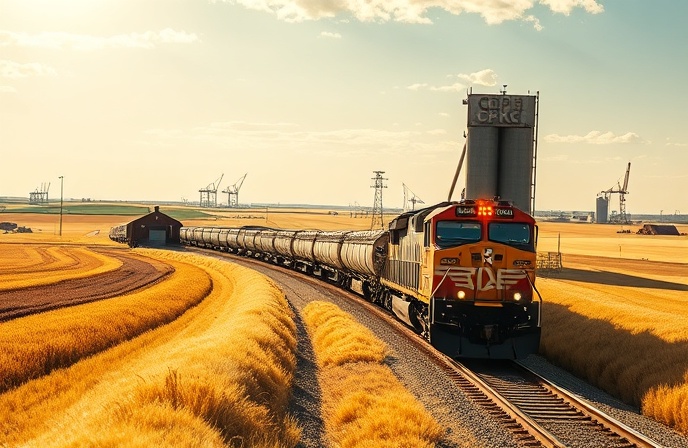
CPKC Gears Up for Record Grain Movement with Strategic Investments
Canadian Pacific Kansas City (CPKC) is poised to significantly increase its grain transportation capacity in the coming years, according to the recent release of its 2025-2026 grain report and data from the 2024-2025 season. The railway, a key player in North American grain transport, is forecasting record volumes driven by strategic investments in rolling stock and locomotives. This article explores CPKC’s projected grain movement, examines its operational strategies, and explores the implications of these developments for the broader agricultural supply chain. This news article will analyze CPKC’s current achievements, ambitious future goals, and associated infrastructure investments.
Record-Breaking Grain Transportation in 2024-2025
CPKC anticipates concluding the 2024-2025 crop year with the transport of 27 million metric tons (MMT) of Canadian grain and grain products. This marks the highest volume transported by the railroad in a crop year since 2020-2021, when it operated solely as Canadian Pacific. This achievement underscores CPKC’s significant role in connecting Canadian grain producers with domestic and international markets, showcasing a strong recovery after some challenging years influenced by market fluctuations and operational bottlenecks. These transport numbers reflect the company’s growing efficiency and the increasing demand for the company’s services in this important area.
Projected Capacity and Operational Strategies
Looking ahead to the 2025-2026 crop year, CPKC is aiming for even greater throughput. The company plans to move up to 34 MMT of grain and grain products, contingent on market demand. CPKC’s operational strategy is carefully calibrated to match seasonal variations and port availability. When the Port of Thunder Bay, a crucial hub for Great Lakes grain shipments, is open (August through January and April through July), CPKC intends to provide capacity for up to 685,000 metric tons of Canadian agricultural products weekly. During the winter months when the port is closed due to ice conditions, CPKC will maintain a robust capacity of 525,000 metric tons per week. These plans demonstrate CPKC’s commitment to maintaining a reliable supply chain for Canadian grain producers throughout the year.
Strategic Investments in Rolling Stock and Locomotives
To facilitate its ambitious goals, CPKC is making a substantial capital expenditure in infrastructure. For the 2025-2026 grain year, the company is investing C$500 million in high-capacity hopper cars and 100 new Tier 4 diesel-electric locomotives. These new Tier 4 locomotives are designed to meet strict emission standards and will enhance fuel efficiency, reducing the environmental impact of the railway’s operations. The high-capacity hopper cars are engineered to improve efficiency and throughput, contributing to the faster movement of grain. These investments are critical to ensuring transportation reliability and further solidifying CPKC’s ability to meet growing demand.
Market Implications and Supply Chain Impact
CPKC’s planned increase in grain transport capacity has significant implications for the agricultural supply chain. The efficient movement of grain is critical for ensuring that Canadian farmers can access both domestic and international markets. The increased capacity will assist in moving the harvest quickly, thus reducing storage costs and minimizing potential losses. Additionally, a more reliable and efficient transportation system can enhance the competitiveness of Canadian grain exports on the global stage, promoting economic growth in the agricultural sector. This boost in productivity could also benefit the wider economy through an increase in supporting jobs.
Conclusion
CPKC’s strategic investments and ambitious goals for grain transportation reflect a confident outlook for the agricultural sector. The company’s plans to move record volumes of grain in 2025-2026, supported by significant investments in rolling stock and locomotives, highlight a commitment to operational excellence and a proactive approach to meeting market demands. These efforts will likely contribute to a more resilient and competitive agricultural supply chain, benefiting both producers and consumers. This will be especially important in the long term, as global demand for food increases. CPKC’s commitment to increasing efficiency will also have positive environmental effects through the adoption of modern locomotives. The industry will be keenly monitoring CPKC’s progress and its impact on the broader North American rail network and grain market.
Company Summary: Canadian Pacific Kansas City (CPKC)
Canadian Pacific Kansas City (CPKC) is a Class I freight railway operating on approximately 20,000 route miles across Canada, the United States, and Mexico. Formed through the merger of Canadian Pacific Railway and Kansas City Southern, CPKC is the first single-line railway connecting Canada, the U.S., and Mexico, thereby offering a unique transportation network. Its operations include the transport of agricultural products, energy products, industrial products, and intermodal traffic. CPKC’s investments in infrastructure and its focus on operational efficiency are critical for its long-term growth and the efficient movement of goods across its extensive network.

Railway infrastructure, rolling stock and transport technologies specialist focused on global rail industry developments, high-speed rail systems, signaling technologies and freight transportation. Covering railway investments, public transport modernization, rail operations and international mobility projects across Europe, Asia and North America.
RELATED POSTS

October 1, 2026 7:09 am
United States regulators confirmed a September 30 deadline for the...

October 4, 2026 5:14 pm
Alstom secured a CA$4.7 billion order from VIA Rail Canada...

October 6, 2026 2:14 am
Union Pacific launched export rail shipments with Ferromex to deliver...

October 1, 2026 12:13 am
Illinois approved $1.5 billion annually for the Northern Illinois Transit...

October 8, 2026 1:15 pm
Alstom secured a €1bn contract to build 13 automated trains,...

October 1, 2026 6:10 am
Amtrak approved a System Expansion Committee on July 30 to...