
California High Speed Rail: 2026 Route, Map, Speed & Latest Updates
Comprehensive guide on California High Speed Rail. Explore current construction status, high speed rail map, top speeds, funding, and completion timeline.
⚡ In Brief
- California High-Speed Rail (CAHSR) is the United States’ first true high-speed rail project — a 800 km (500-mile), 320 km/h (200 mph), fully electrified, grade-separated system connecting San Francisco to Los Angeles — but in early 2026 not a single kilometre of track has been laid despite $18+ billion spent since construction began in 2013.
- Original cost estimate: $33 billion (2008 voter approval). Current estimate: $89–$128 billion for Phase 1. Original San Francisco–Los Angeles completion: 2028. Current estimate: no earlier than 2033 for the 171-mile Merced–Bakersfield initial segment only; full SF–LA date unconfirmed.
- The Trump administration terminated approximately $4.2 billion in federal funding in July 2025, citing nine compliance failures including a $7 billion funding shortfall and failure to procure a trainset vendor. California sued, then dropped its lawsuit in December 2025.
- Congress permanently rescinded $929 million in the Consolidated Appropriations Act 2026 (February 2026). The project lost roughly $5 billion in federal commitments within seven months.
- California secured $1 billion per year in cap-and-trade programme funding through 2045 — but the Authority itself says this level of funding is insufficient to complete the system, and in December 2025 launched a formal process to attract private investors and developers by summer 2026.
In November 2008, California voters approved Proposition 1A — a $9.95 billion bond measure to fund construction of a high-speed rail system connecting San Francisco and Los Angeles at up to 220 mph. The ballot measure promised a $33 billion total project cost, a San Francisco–Los Angeles journey time of 2 hours 40 minutes, and a completion date of 2028. It passed with 52.7% of the vote on the same night Barack Obama was elected president.
Sixteen years later, in early 2026, the California High-Speed Rail Authority has spent more than $18 billion in public funds. Not a single kilometre of track has been laid. The cost estimate has grown to $89–$128 billion. The federal government has withdrawn $4.2 billion in grants. The project has no confirmed trainset supplier. Its CEO was removed from day-to-day operations in February 2026, weeks before a critical business plan deadline. California dropped its federal funding lawsuit without recovering a dollar.
CAHSR is simultaneously the most ambitious infrastructure project in US history and the most scrutinised infrastructure failure in recent American public policy. Understanding both what it is trying to build and why it has struggled this severely requires engaging with the technical, financial, and institutional dimensions of the project in full.
Project Fact Sheet (March 2026)
| Attribute | Details |
|---|---|
| Project name | California High-Speed Rail (CAHSR) |
| Managing authority | California High-Speed Rail Authority (CHSRA), a state agency |
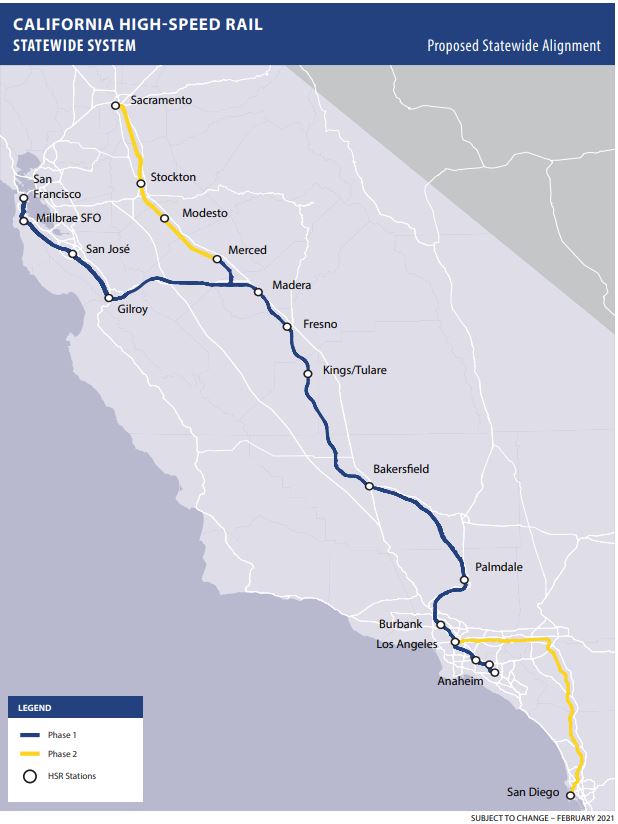
| Phase 1 corridor | San Francisco – Merced – Fresno – Bakersfield – Los Angeles – Anaheim: ~800 km (500 miles) |
| Initial Operating Segment | Merced to Bakersfield: 171 miles (275 km) — under construction in Central Valley |
| Maximum design speed | 320 km/h (200 mph) |
| Target journey time (SF–LA) | 2 hours 40 minutes (original promise); currently unconfirmed |
| Original cost (2008) | $33 billion |
| Current cost estimate (2026) | $126.3 billion (bottom-up reassessment) |
| Funds spent to date | >$18 billion |
| IOS opening (Merced–Bakersfield) | 2033 at earliest (original promise: 2028) |
| SF–LA opening | No earlier than 2038; date not confirmed |
| Federal funding status | ~$5.1 billion terminated or rescinded (July 2025 – February 2026) |
| Trainset | Vossloh AG supplying sleepers & fastenings; Trainset procurement ongoing |
Technical Specifications: What Is Being Built
CAHSR is engineered as a genuine high-speed rail system benchmarked against the Shinkansen and TGV networks. The technical specifications are ambitious and uncompromised compared to most “higher-speed rail” alternatives discussed in the US context:
- Full grade separation: No at-grade crossings at any point on the route — the entire alignment is on elevated viaduct, in retained cut, or in tunnel. This is the primary safety and speed requirement that differentiates true HSR from upgraded conventional rail.
- Electrification: 25 kV AC overhead catenary across the full route — the standard for all high-speed rail networks globally. There is no diesel operation on any section.
- Maximum speed: 320 km/h (200 mph) — higher than any current US intercity rail operation.
- Train length and capacity: Trains specified at approximately 400 metres (1,300 feet) with capacity for up to 1,300 passengers — double-deck or high-density single-deck formations.
- Ruling gradient: 3.0% maximum — requiring extensive tunnelling through the Pacheco Pass (San José to Merced) and Tehachapi Mountains (Bakersfield to Los Angeles), the two most technically challenging sections of the route.
- Signalling: ERTMS/ETCS-equivalent Communications-Based Train Control with in-cab signalling and no lineside signals at operating speed.
- Seismic design: All structures are designed to California seismic Zone 4 standards — significantly more demanding than European or East Asian standards.
Construction Progress by Segment (Early 2026)
| Segment | Length | Key Contractor | Status (Early 2026) |
|---|---|---|---|
| CP1 — Madera Viaduct area | ~13 km | Tutor Perini/Zachry/Parsons JV | Structures substantially complete; no track |
| CP2–3 — Fresno River Viaduct | ~47 km | Dragados/Flatiron JV | Structures ongoing; Hanford Viaduct progressing |
| CP4 — Kings/Tulare area | ~37 km | Ferrovial Construction | Construction active |
| Bakersfield–Merced (full IOS) | 275 km | Multiple JVs | Partial civil works; no track laid on any section |
| Pacheco Pass Tunnel (SF–Merced) | ~45 km tunnel | TBD | Environmental review; not yet funded for construction |
| Tehachapi Crossing (Bakersfield–LA) | Major tunnel section | TBD | Not yet in procurement; funding unconfirmed |
The Federal Funding Crisis: Timeline
| Date | Event | Financial Impact |
|---|---|---|
| 2019 (Trump 1st term) | Trump administration revokes $929 million in federal grants | −$929M (later restored by Biden) |
| 2021 (Biden) | Settlement restores $929M; Biden IIJA provides additional funding commitment | +$929M restored; total federal commitment ~$9.3B |
| June 2025 | FRA releases 315-page compliance review citing 9 failures: $7B funding shortfall, missed trainset procurement deadline, delayed construction milestones | Warning of termination |
| 16 July 2025 | Transportation Secretary Sean Duffy terminates ~$4.2 billion in federal grants. Trump calls it a “train to nowhere.” California sues. | −$4.2B |
| September 2025 | California Governor Newsom signs legislation committing $1B/year from cap-and-trade programme through 2045 | +$20B committed (state, long-term) |
| 23 December 2025 | California drops federal funding lawsuit without recovering any funds. Authority pivots to private investment strategy. | $4.2B effectively written off |
| February 2026 | Congress permanently rescinds $929M in Consolidated Appropriations Act 2026 | −$929M additional |
| March 2026 | Draft 2026 Business Plan due (statutory deadline). No confirmed SF–LA completion date or funding gap solution. | Total federal loss: ~$5.1B |
The Cost Escalation: From $33 Billion to $128 Billion
The scale of CAHSR’s cost escalation — from $33 billion in the 2008 voter approval to $89–$128 billion in 2025 estimates — is one of the most extreme in modern infrastructure history. Several factors explain it:
Initial underestimation: The 2008 $33 billion estimate has been widely criticised by independent reviewers as politically motivated — calibrated to pass the ballot measure rather than reflect realistic construction costs. The project’s peer review panel noted within two years of approval that the estimate was implausibly low for the scope of work.
Right-of-way costs: Acquiring land through the densely settled Bay Area and Los Angeles Basin proved far more expensive and legally complex than projected. Thousands of individual property acquisitions, each subject to litigation, drove costs well above estimates.
California construction cost environment: Labour costs, environmental compliance, permitting delays, and prevailing wage requirements make California one of the most expensive construction environments in the world — a factor not adequately reflected in initial estimates benchmarked against European or Asian construction costs.
Scope decisions: The choice to maintain full 320 km/h capability throughout, requiring complete grade separation and demanding tunnel crossings through the Pacheco Pass and Tehachapi Mountains, added billions compared to the “blended system” approach that would use upgraded existing Caltrain and Metrolink tracks at lower speed in the urban bookends.
Inflation and schedule slippage: Every year of delay adds inflation-adjusted costs to future construction packages. A project that was originally expected to be substantially complete by 2020 is now constructing its initial segment, with construction inflation having significantly increased unit costs.
Current Funding Position and Gap
| Funding Source | Amount | Status |
|---|---|---|
| Proposition 1A state bonds | $9.95 billion (voter approved 2008) | Largely committed/spent |
| Federal grants (spent) | ~$8 billion (various ARRA, FRA grants) | Spent on construction to date |
| Cap-and-trade programme | $1 billion/year through 2045 (~$20B total) | Committed; legislation signed Sept 2025 |
| Federal funding (terminated) | ~$5.1 billion | Lost — July 2025 + February 2026 |
| Private investment (sought) | Unknown — process launched Dec 2025 | In progress; target: summer 2026 |
| Estimated funding gap (IOS only) | ~$7 billion minimum | Unresolved |
CAHSR vs HS2: A Comparison of Megaproject Difficulties
| Parameter | CAHSR (California) | HS2 (United Kingdom) |
|---|---|---|
| Original cost estimate | $33B (2008) | £37B (2013) |
| Current cost estimate | $89–$128B | £66–98B (Phase 1 only, after Phase 2 cancellation) |
| Cost escalation factor | 3–4× | 2–3× |
| Track laid to date | Zero | Tunnelling and civil works substantially advanced |
| Opening date slip | 10+ years (2028 → 2038+) | ~5 years (2026 → 2033 for London–Birmingham) |
| Political commitment | Federal government hostile; state government committed | Phase 2 cancelled; Phase 1 continuing under Labour |
Editor’s Analysis
The California High-Speed Rail project in early 2026 faces a question that goes beyond cost overruns and schedule slippage: whether it has passed the point at which a rational cost-benefit assessment would support continuation, and whether it is being sustained partly by state-federal political dynamics that have little to do with the merits of the railway. The facts are stark. More than $18 billion has been spent. No track has been laid. The only section under construction — Merced to Bakersfield — traverses 275 kilometres of California’s Central Valley, connecting two mid-sized cities that generate limited intercity travel demand on their own. Even when complete, this segment will be a demonstration line serving a market that does not need a 320 km/h railway, because the cities it connects are not where the traffic is. The traffic is in the San Francisco Bay Area and the Los Angeles Basin — and those are precisely the sections that are most expensive, most politically contested, most technically challenging, and most distant from construction. The Authority’s decision to drop its federal funding lawsuit in December 2025, and to simultaneously launch a private investor process, signals that it understands the federal funding path is closed for the foreseeable future. The question is whether private investors — who will demand returns, governance rights, and risk allocation — can be attracted to a project with this cost and schedule history, at a moment when its institutional leadership is in flux. The $1 billion per year cap-and-trade funding is real and bankable but represents perhaps one-fifth of what annual spending needs to be to make meaningful progress toward completion. The March 2026 Business Plan will be the most consequential document in the project’s history. If it presents a credible, independently verified path to the Merced–Bakersfield opening and a realistic plan to fund the Bay Area and LA extensions, it could restore investor confidence. If it defers those questions, California’s leadership must honestly ask whether continuing serves the public interest. — Railway News Editorial
🚄 2026 Business Plan: A Pivot to Private Investment
In March 2026, the California High-Speed Rail Authority released its Draft 2026 Business Plan, marking a significant strategic shift. The plan projects the total cost for Phase 1 (San Francisco to Anaheim) at approximately $126.3 billion, a bottom-up reassessment of the project’s scope. For the first time, the authority outlined a clear revenue strategy, which includes completing the Merced-Bakersfield segment, expanding to major population centers, and commercializing assets early to generate additional income. A key component of this new approach is a formal process to bring private investors and developers on board by summer 2026, aiming to deliver the project “faster and smarter”.
🏗️ Construction Milestones: From Guideway to Track Laying
After years of planning, 2026 has become a landmark year for construction. The authority reports that nearly 80 miles of guideway are now complete, along with 58 structures like bridges and viaducts, with 29 more under construction. In a major step forward, the project awarded a contract worth over $45 million to Vossloh AG to supply 335,000 concrete sleepers and rail fastening systems for the initial 192-kilometer segment, with deliveries expected to begin in Q3 2026. Furthermore, the authority has begun the formal process of track laying and electrification along the corridor, signaling a transition from earthworks to the final stages of rail infrastructure.
🏛️ Leadership Shifts and Legal Battles
The project’s leadership also saw a major change in February 2026, when CEO Brian Kelly was removed from day-to-day operations just weeks before a critical business plan deadline. On the legal front, the Authority’s decision to drop its lawsuit against the federal government marked the end of a contentious chapter. The state had sued after the Trump administration terminated approximately $4.2 billion in federal grants in July 2025. This loss was compounded when Congress permanently rescinded another $929 million in the Consolidated Appropriations Act 2026, bringing the total withdrawn federal commitments to over $5 billion within seven months. The decision to drop the lawsuit signaled the state’s new strategy to move forward by seeking private investment rather than relying on an uncertain federal partnership.
Frequently Asked Questions
- Q: Why has California’s high-speed rail cost increased from $33 billion to $128 billion?
- The escalation reflects a combination of initial underestimation, genuine project complexity, and the extraordinary cost of construction in California. The $33 billion figure in the 2008 ballot measure has been widely criticised by independent reviewers as optimistically low — potentially designed to secure voter approval rather than reflect realistic costs. Since then, land acquisition costs across the Bay Area and Los Angeles have exceeded projections by billions; construction labour and materials in California are among the world’s most expensive; permitting and environmental compliance add cost and time unavailable to European or Asian comparators; and every year of delay adds inflation to future construction costs. The project’s peer review panel has consistently found the estimates to be understated relative to comparable international projects of equivalent complexity.
- Q: Why did Trump terminate $4.2 billion in federal funding and can it be recovered?
- The Federal Railroad Administration conducted a compliance review of CAHSR in 2025 and identified nine areas where the California High-Speed Rail Authority had failed to meet its grant commitments, including a $7 billion funding shortfall just for the initial operating segment, a failure to procure a trainset vendor (a contractually required milestone), and delays that made the promised 2033 opening date implausible. On these grounds, Transportation Secretary Sean Duffy terminated approximately $4.2 billion in remaining federal commitments in July 2025. California filed a lawsuit challenging the termination, won an early procedural victory when a federal judge rejected the Trump administration’s motion to dismiss, but then dropped the lawsuit in December 2025, citing the federal government’s lack of good faith. With the lawsuit dropped and Congress separately rescinding $929 million in the February 2026 appropriations act, the funds are effectively lost for the current administration’s term. Recovery would require a future administration’s willingness to re-commit federal funds — a scenario that depends on both the 2028 presidential election outcome and the project’s demonstrated progress by that point.
- Q: What will the Merced–Bakersfield segment actually connect when it opens?
- The 171-mile Initial Operating Segment connects Merced (population ~90,000) and Bakersfield (population ~420,000) in California’s Central Valley, with stations at Fresno (~550,000), Madera, Kings/Tulare, and Hanford. These are agricultural and logistics cities rather than major tourism or business destinations. The segment was selected as the first construction priority because it involves less complex terrain than the mountain crossings and less expensive right-of-way than urban areas — not because it represents the highest-ridership market. When it opens (currently projected 2033 at earliest), it will operate as a standalone segment without direct connection to San Francisco or Los Angeles, as those extensions require the Pacheco Pass and Tehachapi tunnel crossings that are not yet funded for construction. Passengers wishing to travel between the Bay Area and the IOS will connect via the Capitol Corridor Amtrak service in Merced; passengers connecting to Los Angeles will use Amtrak’s San Joaquin service from Bakersfield.
- Q: Could private investment realistically fill the funding gap?
- Private investment in the project is theoretically possible but faces significant challenges. In December 2025, the Authority launched a formal procurement process to attract private investors and developers by summer 2026. However, private investors in transport infrastructure typically require either a revenue guarantee from government (underwriting ridership risk) or a concession structure that gives them control over fares and service. Neither is straightforward for a politically sensitive state project. International HSR projects that have attracted private capital — Japan’s Shinkansen privatisation, some PPP models in Europe — have generally done so after the infrastructure was built and ridership established. A private investor entering CAHSR at this stage would be taking construction risk on a project with a history of cost overruns, in addition to demand risk on an unproven US intercity rail market. The terms required to attract that capital could be politically unacceptable to California legislators who approved the project as a public infrastructure investment.
- Q: What is the “blended system” approach and would it be faster to build?
- The “blended system” concept — first formally introduced into CAHSR planning around 2012 — proposes using upgraded existing Caltrain tracks between San Francisco and San José, and upgraded Metrolink/Union Pacific tracks in the Los Angeles Basin, rather than building entirely new dedicated HSR alignment through these urban areas. High-speed trains would operate at reduced speed (160–200 km/h) on the shared urban sections, achieving full 320 km/h only on the dedicated Central Valley and mountain segments. A blended approach would be significantly cheaper and faster to complete — avoiding the most expensive urban tunnel and viaduct construction — but would produce a slower San Francisco–Los Angeles journey time, probably 3–3.5 hours rather than 2 hours 40 minutes. Critics argue it would undermine the project’s core proposition. Supporters argue that a working blended system in 15 years is more valuable than a perfect dedicated system in 30 years. The Authority’s 2026 Business Plan is expected to address blended system options as part of its revised delivery strategy.
🔄 Content Freshness: This project status report was last verified on .
Next scheduled review: Q3 2026 (post-2026 Business Plan publication and private investor procurement update).
Next scheduled review: Q3 2026 (post-2026 Business Plan publication and private investor procurement update).
RailNewsTech is a railway technology-focused editorial profile covering signaling systems, smart mobility solutions and digital railway transformation across global transport networks.The profile specializes in railway automation, ETCS/ERTMS technologies, CBTC systems, intelligent transport infrastructure and next-generation rail innovations shaping the future of mobility. Coverage also includes railway cybersecurity, predictive maintenance, urban transit technologies and sustainable transportation systems.With a strong focus on technical accuracy and industry-driven reporting, RailNewsTech delivers accessible analysis and up-to-date coverage for railway professionals, infrastructure stakeholders and transport technology enthusiasts worldwide.
RELATED POSTS

October 1, 2026 7:09 am
United States regulators confirmed a September 30 deadline for the...

October 8, 2026 12:18 pm
Siemens Mobility signed an agreement with VinSpeed to supply 350...

October 1, 2026 12:13 am
Illinois approved $1.5 billion annually for the Northern Illinois Transit...
October 5, 2026 1:13 pm
New York MTA confirmed a late 2026 DEIS release for...
October 6, 2026 9:17 am
Illinois approved $1.1M in state funds to upgrade two McHenry...

October 1, 2026 6:10 am
Amtrak approved a System Expansion Committee on July 30 to...