
Caen Tramway Project: France, Modern Urban Transit
Caen’s new tramway system is a success story for the railway sector, boosting accessibility and economic growth. The modern tram network revitalizes the city with efficient, integrated transport.
This article examines the Caen Tramway project in France, a successful example of integrated urban transport planning and implementation. The project’s aims extended beyond simply providing a new mode of transport; it sought to revitalize the city, improve accessibility for all citizens, and stimulate economic growth. The analysis will explore the project’s design, construction, operation, and socio-economic impact, highlighting key technological choices and their implications. The evaluation will focus on the effectiveness of the system in achieving its stated goals, its sustainability features, and its potential for replication in other urban settings. The project’s success serves as a valuable model for other cities planning similar infrastructure projects, demonstrating how careful integration of different transport modes and a focus on accessibility can lead to significant positive outcomes.
Project Overview and Design
The Caen Tramway system, operated by Twisto Transports Urbains, opened with two lines, designated ‘A’ and ‘B’, serving the northern and northeastern districts and connecting to the southern and southwestern parts of Caen via the city center. The lines converge for a significant portion of their routes, diverging near their respective termini. The system comprises 34 stations, spaced approximately 300-400 meters apart, offering full wheelchair accessibility. The total travel time between the furthest termini is 30 minutes, with a 15-minute journey from any terminus to the Saint-Pierre city center. A key design feature is the use of a reserved street section, preventing car traffic and enabling an average tram speed of 20 km/h (12.4 mph), 30% faster than buses.
The system utilizes Bombardier GLT (Guided Light Transit) “tram-on-tyre” vehicles, three-car articulated units with a capacity of nearly 200 passengers each (154 seated, 41 standing). These vehicles are powered by Alstom 300kW traction motors, supplemented by a 200kW auxiliary diesel engine for depot operations and off-route movement. The use of rubber tires allows for a maximum gradient of 13% (1 in 8), enabling access to challenging terrain in the city center and older parts of Caen.
Implementation and Integration
The Caen Tramway project was developed through a three-way agreement involving a licensor and two concessionaires. Viacités (Syndicat Mixte des Transports en Commun de l’Agglomération Caennaise), the public transport authority, oversaw the project. STVR (Société de Transport sur Voie Réservée) acted as the public works concessionaire, responsible for design, financing, construction, and maintenance. Twisto, the public service concessionaire, manages the commercial operation of the tram and bus network. Spie Batignolles TPCI, with assistance from SGTE Construction, completed the civil engineering works. The project demonstrates a successful partnership between public authorities and private sector companies.
Crucially, the tramway’s implementation was integrated with a broader urban transport plan. This included tripling the size of the city’s cycle network and expanding the bus network to provide complementary services. Intermodal integration is facilitated through park-and-ride facilities, improved connections between tram and bus platforms to minimize walking distances, and the sale of combined tram/bus tickets.
Technological Choices and Operational Efficiency
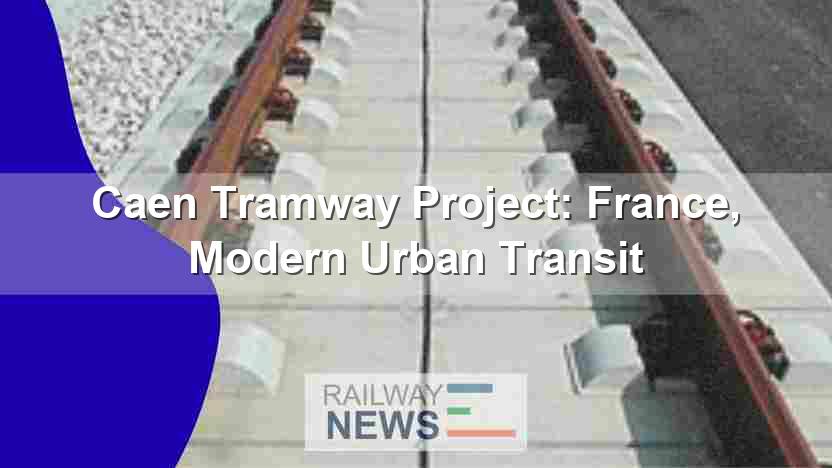
The Caen tramway employs a hybrid system, combining rubber tires with a guided center rail for steering and power return. This approach offers flexibility in navigating urban environments, while maintaining operational efficiency. The use of conventional traffic signals and driver cab radio communication demonstrates an effective integration with existing urban infrastructure. The system’s online journey planner, timetable, and fare guide promotes seamless multi-modal travel for passengers.
Socio-economic Impact and Future Prospects
The Caen Tramway has significantly impacted the city. It has improved accessibility, particularly for disabled individuals (a 90cm movable platform aids passenger access). The enhanced mobility has stimulated economic activity, revitalized districts, and fostered the development of new business communities along the route. The system’s success has attracted attention from other potential tramway operators, showcasing the viability of this integrated approach to urban transport. Future extensions are possible depending on ongoing performance and demand. The project provides a compelling case study for the positive socio-economic benefits of investing in modern, accessible, and integrated public transportation systems.
Conclusions
The Caen Tramway project stands as a successful model for modern urban transit planning. Its achievements extend beyond the provision of a new transport mode; it has demonstrably revitalized parts of Caen, significantly improved accessibility for all citizens, and spurred economic growth. The project’s integration of various transport modes, combined with a commitment to accessibility, offers a compelling blueprint for other urban centers.
The project’s success rests on several key factors: a well-defined plan integrating the tramway with existing and expanded bus services and cycling infrastructure; a strong public-private partnership facilitating efficient construction and management; and the implementation of a technologically advanced yet operationally straightforward system. The adoption of the “tram-on-tyre” technology, while innovative, is proven to be suitable and efficient for the Caen environment. The emphasis on intermodal integration through integrated ticketing, improved station connectivity, and park-and-ride facilities have demonstrably increased ridership and encouraged multimodal journeys.
The socio-economic benefits are notable: revitalization of previously underserved areas, increased accessibility for the disabled, and the stimulation of economic activity along the tramway route. This exemplifies how careful transport planning can create positive ripple effects throughout a city. The future success of similar projects will hinge on the lessons learned in Caen, particularly the necessity for detailed planning that considers accessibility, intermodal integration, and the wider socio-economic impact of transport systems.
The long-term sustainability of the Caen Tramway, its potential for future expansion, and the keen interest shown by other operators are powerful testaments to the project’s success. This success is ultimately a result of thorough planning, strategic partnerships, and a commitment to delivering a high-quality, accessible transport system integrated into the wider urban fabric of Caen.
| Project Details | Information |
|---|---|
| Project Name | Caen Tramway |
| Lines | 2 (A & B) |
| Stations | 34 |
| Total Length | Not specified in the article |
| Travel Time (End-to-End) | 30 minutes |
| Travel Time (Terminus to City Center) | 15 minutes |
| Rolling Stock | Bombardier GLT trams (3-car articulated units) |
| Operator | Twisto Transports Urbains |
| Public Transport Authority | Viacités |
| Public Works Concessionaire | STVR |
| Civil Engineering | Spie Batignolles TPCI, SGTE Construction |
Company Information:
- Twisto Transports Urbains: Public transport operator in Caen, France.
- Viacités: Public transport authority for the Caen urban area.
- STVR (Société de Transport sur Voie Réservée): A French company involved in public works concessions, specializing in transport infrastructure.
- Spie Batignolles TPCI & SGTE Construction: French civil engineering and construction companies.
- Bombardier Transportation: A global manufacturer of rail equipment, including the GLT trams used in the Caen project.
- Alstom: A multinational company supplying traction motors for various railway systems, including those in Caen.

Railway infrastructure, rolling stock and transport technologies specialist focused on global rail industry developments, high-speed rail systems, signaling technologies and freight transportation. Covering railway investments, public transport modernization, rail operations and international mobility projects across Europe, Asia and North America.