
CN Launches 115-Car Grain Unit Train in Lis Illinois
Canadian National launched a 115-car grain unit train from the new TGM loop track in Lis, Illinois, on Sept. 16, cutting load times to eight hours.
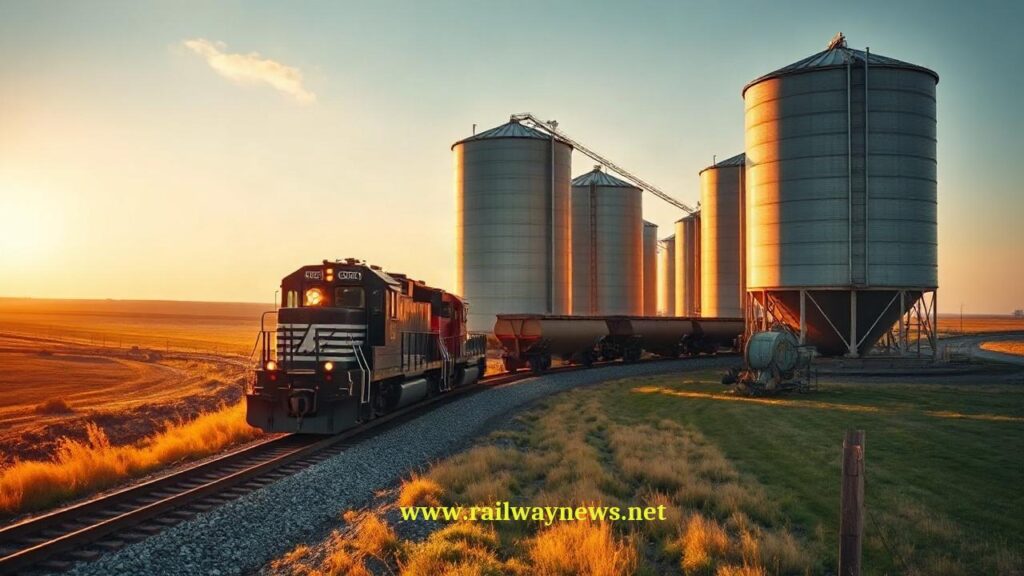
⚡ In Brief: Canadian National moved its first unit train from Total Grain Marketing’s newly expanded Lis, Illinois facility following the installation of a 115-car loop track that cuts loading cycles to eight hours.
LIS, United States – Canadian National (CN) operated the inaugural unit train from Total Grain Marketing’s (TGM) expanded rail terminal in Lis, Illinois, on Sept. 16. The capital works program upgraded rail car staging from a 25-car siding to a 115-car loop track served by 3.1 million bushels of new storage. Fast-fill equipment at the terminal now loads complete export-bound trains within eight hours.
What Is the Full Scope of This Project?
The Lis terminal expansion increases on-site railcar handling capacity by 360% alongside massive bulk intake improvements. TGM, a joint venture founded in 2006 by Southern Central FS, Growmark Inc., and Wabash Valley Service Co., integrated three high-capacity truck dump pits capable of processing 85,000 bushels of grain per hour. The aggregate project combines 3.1 million bushels of vertical grain storage directly linked to CN’s Southern Region main line, bypassing regional rail-switching bottlenecks. Capital investment totals for the facility expansion were not disclosed by either party.
Note: Independent verification of the inaugural train departure date was not available across secondary trade records at time of publication.
Key Project Data
| Parameter | Value |
|---|---|
| Project / Contract Name | TGM Lis Elevator Rail Expansion |
| Total Value | Not disclosed |
| Parties Involved | Canadian National (CN), Total Grain Marketing (TGM) |
| Timeline / Completion | Operational September 16 |
| Country / Corridor | United States / CN Southern Region (Illinois) |
How Does This Compare to Similar Projects?
Loop tracks designed for 115 cars represent the Class I standard for export grain trains, shifting operational dwell times from multi-day switching maneuvers to same-day turnarounds. Comparable data for dedicated private elevator track expansions was not publicly available for the 2024–2025 period in central Illinois. However, the capital allocation mirrors broader investments in supply-chain velocity across North America as operators target truck-to-rail conversion to offset volatile highway freight rates (Source: Trains.com, 2024). Worldwide rail infrastructure investment hit USD 101.11 billion in 2025, driven heavily by throughput enhancements at intermodal and bulk handling nodes (Source: Mordor Intelligence, 2025).
Editor’s Analysis
Upgrading from manifest-car switching to dedicated loop tracks provides CN with guaranteed asset velocity along its north-south corridor connecting Midwest grain belts to Gulf of Mexico export ports. By slashing loading times to eight hours, CN reduces locomotive idle time while capturing volume that previously moved via short-haul trucking to river barges. With global rail infrastructure spending projected to reach USD 126.54 billion by 2030, primary rail carriers are increasingly requiring private shippers to absorb terminal loop construction costs to secure mainline unit train service (Source: Mordor Intelligence, 2025).
FAQ
Q: How many railcars can the new TGM Lis facility accommodate?
A: The expansion added a dedicated 115-car loop track, increasing total train capacity from the previous 25-car manifest siding.
Q: What is the total storage and intake capacity of the facility?
A: The terminal features 3.1 million bushels of grain storage capacity supported by three truck dump pits receiving up to 85,000 bushels per hour.
Q: How fast can a complete unit train be loaded on the new track?
A: High-speed mechanical loading systems allow a full 115-car train to be loaded in eight hours.

Railway infrastructure, rolling stock and transport technologies specialist focused on global rail industry developments, high-speed rail systems, signaling technologies and freight transportation. Covering railway investments, public transport modernization, rail operations and international mobility projects across Europe, Asia and North America.
RELATED POSTS

October 1, 2026 7:09 am
United States regulators confirmed a September 30 deadline for the...

October 4, 2026 5:14 pm
Alstom secured a CA$4.7 billion order from VIA Rail Canada...

October 6, 2026 2:14 am
Union Pacific launched export rail shipments with Ferromex to deliver...

October 1, 2026 12:13 am
Illinois approved $1.5 billion annually for the Northern Illinois Transit...

October 1, 2026 6:10 am
Amtrak approved a System Expansion Committee on July 30 to...
October 1, 2026 3:12 am
Greenbrier confirmed Brian Comstock as new president and CEO effective...