
PLK Signs EUR 302.7M Contract for New Vistula Rail Bridge
PLK signed a EUR 302.7 million contract to build a 630.5-metre double-track Vistula rail bridge and modernize 32 km of Line No. 12 in Poland by 2029.
⚡ In Brief: Polskie Linie Kolejowe (PLK) signed a EUR 302.7 million contract with an INTOP-Trakcja-WKS Grybów consortium to construct a new double-track railway bridge over the Vistula River at Góra Kalwaria and modernize 32 km of Line No. 12, funded through EU CEF2 and Military Mobility instruments, with completion scheduled for 2029.
WARSAW, POLAND – Poland’s infrastructure manager PLK awarded a EUR 302.7 million (PLN 1.3 billion) contract on 9 July 2026 to a four-member consortium for the modernization of Railway Line No. 12 between Czachówek Wschodni and Pilawa, anchored by construction of a new 630.5-metre double-track bridge over the Vistula River. The investment, funded through the European Union’s Connecting Europe Facility (CEF2) and its Military Mobility package, will restore passenger service along the entire corridor and raise line speeds to 120 km/h for both freight and passenger operations.
What Is the Full Scope of This Project?
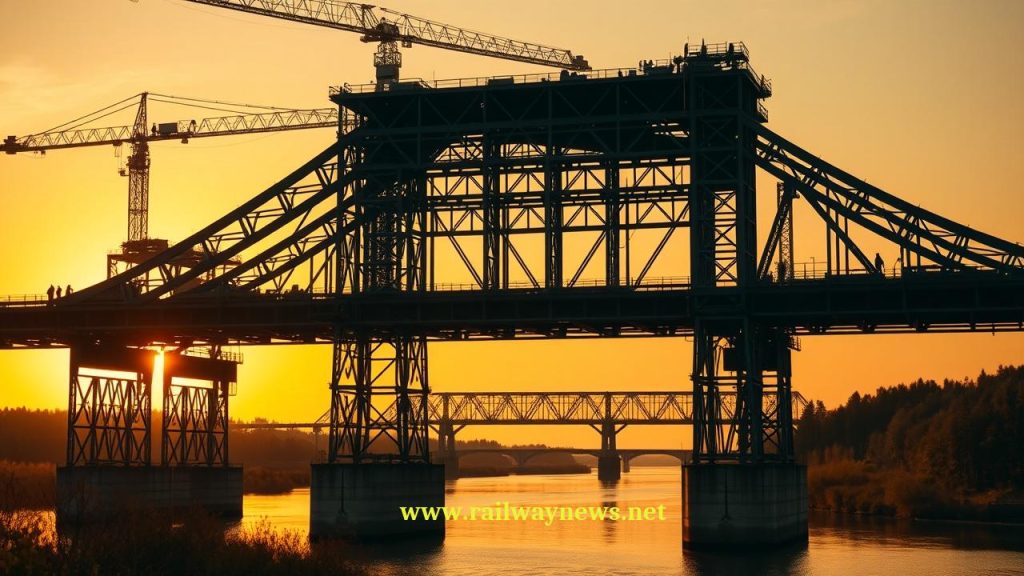
The contract covers a 32-kilometre section of Railway Line No. 12 on the Czachówek Wschodni–Pilawa segment, encompassing track replacement, switch modernization, overhead line upgrades, and installation of new rail traffic control systems to modern operational management standards. A new signal control centre will be built in Góra Kalwaria, and 50 engineering structures—including bridges, culverts, and underpasses—will be rebuilt or newly constructed along the corridor. The signature element is a replacement railway bridge over the Vistula River: a double-track structure 630.5 metres long and 18.26 metres wide, positioned approximately 14 metres north of the existing single-track crossing, which will remain in service until the new bridge becomes operational. An expanded pedestrian and bicycle path is integrated into the bridge design. All station platforms along the route will be rebuilt with step-free access, shelters, benches, energy-efficient lighting, tactile guide strips, and updated passenger information displays.
Key Project Data
| Parameter | Value |
|---|---|
| Project / Contract Name | Modernization of Railway Line No. 12, Czachówek Wschodni–Pilawa Section, with New Vistula River Bridge |
| Total Value | EUR 302.7 million (PLN 1.3 billion) |
| Parties Involved | Consortium: INTOP Infrastruktura, INTOP, Trakcja, WKS Grybów; Client: PLK; Funding: CEF2 and CEF 2 Military Mobility |
| Timeline / Completion | 2029 (design phase followed by construction) |
| Country / Corridor | Poland; Railway Line No. 12, Warsaw freight ring (Mazowieckie Voivodeship) |
How Does This Compare to Similar Projects?
This contract forms part of a broader EU military mobility push along NATO’s eastern flank, where Poland has received CEF 2 Military Mobility allocations exceeding EUR 600 million since 2021 for dual-use rail infrastructure. By comparison, the Rail Baltica project—linking Poland, Lithuania, Latvia, and Estonia—carries a total estimated cost of EUR 5.8 billion for 870 km of new standard-gauge line, putting per-kilometre costs at roughly EUR 6.7 million, while the Line No. 12 modernization averages EUR 9.5 million per kilometre, reflecting the high cost of the major Vistula bridge replacement. Within Poland, PLK’s parallel modernization of the Skierniewice–Czachówek segment of Line No. 12—for which a separate contract is expected within weeks, according to Investment Director Marcin Mochocki—will create a contiguous upgraded freight corridor serving Warsaw’s southern bypass. The military mobility dimension is reinforced by Poland’s 2025 allocation under the EU’s revised TEN-T regulation, which prioritizes dual-use infrastructure along corridors extending toward Ukraine’s border crossings at Medyka and Dorohusk. (Source: European Commission CEF Transport Dashboard, 2025; Rail Baltica Global Project, 2024)
Editor’s Analysis
The Góra Kalwaria bridge contract arrives at a moment when Poland’s rail freight market faces demand-side pressure from KGHM’s $8.55 billion investment programme, with nearly 80% channelled into domestic Polish operations. That capital injection—announced in early July 2026—will intensify demand for rail capacity on routes serving the Lower Silesian copper belt and connections to Baltic ports, making Line No. 12’s freight ring function more critical than the passenger restoration narrative alone suggests. The decision to fund this project through the Military Mobility envelope rather than exclusively from cohesion funds signals Warsaw’s successful pivot toward securitized infrastructure financing, a strategy that may accelerate disbursement timelines but also ties the project’s political justification to NATO readiness metrics. Industry observers should watch whether the 2029 completion date holds given Poland’s tightening construction labour market and simultaneous absorption of multiple large-scale rail tenders under the 2021–2027 EU budgetary period. (Source: KGHM Investment Plan Announcement, July 2026; IndexBox Poland Rail Freight Market Outlook, 2025)
FAQ
Q: When will passenger trains resume on the full Czachówek–Pilawa route?
A: Passenger services currently terminate at Góra Kalwaria and will resume along the entire modernized 32 km section only after project completion, which is scheduled for 2029. No interim partial reopening for passenger traffic has been announced.
Q: What happens to the existing single-track bridge during construction?
A: Trains will continue operating on the existing bridge until the new double-track structure is commissioned. The current bridge is approximately 14 metres south of the new crossing and will remain in service throughout the construction period to avoid disrupting freight traffic on the Warsaw ring.
Q: Is this project connected to military logistics requirements?
A: Yes. Part of the funding comes from the EU’s CEF 2 Military Mobility Package, which specifically targets dual-use infrastructure enabling rapid movement of military equipment across member states. Poland’s location on NATO’s eastern flank makes Line No. 12 strategically relevant for both civilian freight and defence logistics corridors.

Railway infrastructure, rolling stock and transport technologies specialist focused on global rail industry developments, high-speed rail systems, signaling technologies and freight transportation. Covering railway investments, public transport modernization, rail operations and international mobility projects across Europe, Asia and North America.
RELATED POSTS

October 8, 2026 1:15 pm
Alstom secured a €1bn contract to build 13 automated trains,...

October 1, 2026 7:09 am
United States regulators confirmed a September 30 deadline for the...

October 8, 2026 12:18 pm
Siemens Mobility signed an agreement with VinSpeed to supply 350...

October 4, 2026 5:14 pm
Alstom secured a CA$4.7 billion order from VIA Rail Canada...

October 5, 2026 6:12 pm
AECOM and Jacobs secured a contract in September 2026 to...

October 1, 2026 12:13 am
Illinois approved $1.5 billion annually for the Northern Illinois Transit...