
ÖBB Opens First 16.7 Hz Agrovoltaic Plant in Austria
ÖBB inaugurated a 6.6 MWp agrovoltaic plant in Austria in July feeding 16.7 Hz railway traction power while still preserving seven hectares of organic farmland.
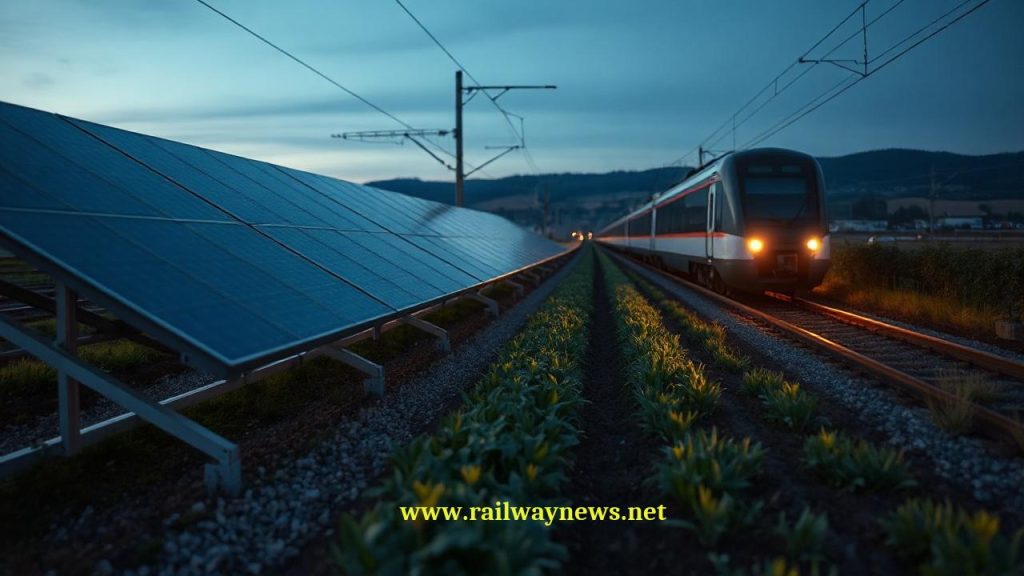
⚡ In Brief: ÖBB and Burgenland Energie inaugurated a 6.6 MWp agrovoltaic plant with solar tracking in Donnerskirchen, Austria—the world’s first to feed 16.7 Hz railway traction power directly while preserving seven hectares of organic farmland.
DONNERSKIRCHEN, Austria – Austrian Federal Railways (ÖBB) and Burgenland Energie inaugurated the world’s first agrovoltaic photovoltaic plant with solar tracking designed for railway frequency power generation on 4 July 2026. The 6.6 MWp facility generates 8.3 GWh annually—enough for 32,500 train trips between Vienna and Eisenstadt—while the land beneath the mobile panels remains fully cultivated by the Esterhazy Ecological Estate for organic farming.
What Are the Technical Specifications?
The Donnerskirchen plant converts solar energy at 16.7 Hz—the dedicated traction frequency of Austria’s railway network—eliminating the need for frequency conversion before grid injection. Mobile photovoltaic panels automatically adjust orientation to follow the sun’s path, increasing yield compared to fixed-tilt installations. The 7-hectare site sits adjacent to the Pannoniabahn line, enabling direct feed-in with minimal transmission losses. No soil sealing was performed, preserving natural drainage, and the entire infrastructure is designed for complete dismantling at end of life. Additional plantings were integrated to create wildlife habitats alongside the agricultural rows.
Key Technical Data
| Parameter | Value |
|---|---|
| Technology / System Name | Agrovoltaic solar tracker plant (unnamed model) — Donnerskirchen |
| Total Value | Not disclosed |
| Parties Involved | ÖBB-Infrastruktur AG, Burgenland Energie, Esterhazy Ecological Estate |
| Timeline / Completion | Inaugurated July 2026; operational |
| Country / Corridor | Austria / Pannoniabahn line, Burgenland |
Where Does This Technology Stand in the Market?
The ÖBB-Burgenland Energie installation occupies a distinct niche: no other operational railway-tied solar plant globally combines single-axis tracking, agrovoltaic dual land use, and direct 16.7 Hz frequency output. Deutsche Bahn’s solar portfolio—approximately 30 MWp across depot rooftops and noise barriers as of 2024—uses fixed-tilt panels feeding into the 50 Hz public grid, requiring frequency conversion before traction use (Source: Deutsche Bahn, 2024). SNCF has tested trackside solar canopies in France but at pilot scale (under 1 MWp) without tracking or railway-frequency direct injection. Indian Railways contracted 1.1 GW of solar capacity by 2023, yet all installations are standard 50 Hz grid-tied systems located off-corridor (Source: Indian Railways, 2023). A fixed-tilt system on comparable land typically yields a 15–18% capacity factor; single-axis tracking elevates that range to 20–25%, translating to roughly 15–25% more annual energy per installed megawatt. The Donnerskirchen plant’s 8.3 GWh from 6.6 MWp implies a capacity factor near 14.3%, conservative for tracking systems and likely reflecting the latitude and panel spacing required for agricultural access.
Note: The specific tracking system manufacturer and cost per megawatt-hour were not disclosed by either ÖBB or Burgenland Energie at time of publication.
Editor’s Analysis
ÖBB’s Donnerskirchen plant signals a strategic pivot toward colocated generation that bypasses grid congestion and frequency-conversion losses—two cost centres railways rarely address simultaneously. Austria’s railway investment pipeline for 2025–2026 includes fleet modernization with dual-voltage InterCity EMUs capable of cross-border operation into Hungary, as evidenced by GYSEV’s Stadler-built units now in final assembly (Source: Railvolution, 2026). Pairing traction-frequency solar with new rolling stock creates a vertically integrated decarbonisation corridor: the energy source, the delivery infrastructure, and the consuming fleet all operate on the same 16.7 Hz standard. The undisclosed capital cost leaves open the question of replicability; agrovoltaic tracking systems carry a 10–20% premium over fixed-tilt, and the business case depends on whether avoided frequency-conversion equipment offsets that delta over the asset lifecycle.
FAQ
Q: Why does Austria’s railway use 16.7 Hz instead of the standard 50 Hz?
A: Austria, Germany, Switzerland, and Sweden operate dedicated railway traction grids at 16.7 Hz, a legacy from early 20th-century electrification when lower frequencies suited series-wound AC motors. Modern trains convert onboard, but the separate frequency grid persists, requiring either dedicated generation or frequency converters at interconnection points.
Q: How much did the Donnerskirchen agrovoltaic plant cost to build?
A: Neither ÖBB nor Burgenland Energie has publicly disclosed the total construction cost or the levelised cost of electricity for the project. This omission makes independent payback-period analysis impossible at this stage.
Q: Can the Donnerskirchen model be replicated on other Austrian rail corridors?
A: Technically, yes—any railway-adjacent agricultural land near a 16.7 Hz feeder line is a candidate. The constraint is economic: tracking systems cost more than fixed-tilt, and proximity to existing substations determines whether avoided frequency-conversion equipment justifies the premium. ÖBB has stated a goal to expand its own green generation but has not published a pipeline of similar agrovoltaic sites.

Railway infrastructure, rolling stock and transport technologies specialist focused on global rail industry developments, high-speed rail systems, signaling technologies and freight transportation. Covering railway investments, public transport modernization, rail operations and international mobility projects across Europe, Asia and North America.
RELATED POSTS

October 8, 2026 1:15 pm
Alstom secured a €1bn contract to build 13 automated trains,...

October 1, 2026 7:09 am
United States regulators confirmed a September 30 deadline for the...

October 8, 2026 12:18 pm
Siemens Mobility signed an agreement with VinSpeed to supply 350...

October 4, 2026 5:14 pm
Alstom secured a CA$4.7 billion order from VIA Rail Canada...

October 5, 2026 6:12 pm
AECOM and Jacobs secured a contract in September 2026 to...

October 1, 2026 12:13 am
Illinois approved $1.5 billion annually for the Northern Illinois Transit...