
BNSF Invests $4B in Barstow International Gateway
BNSF Railway won final city council approval for a new $4 billion Barstow International Gateway rail terminal the first SB 149 fast-track project in California.
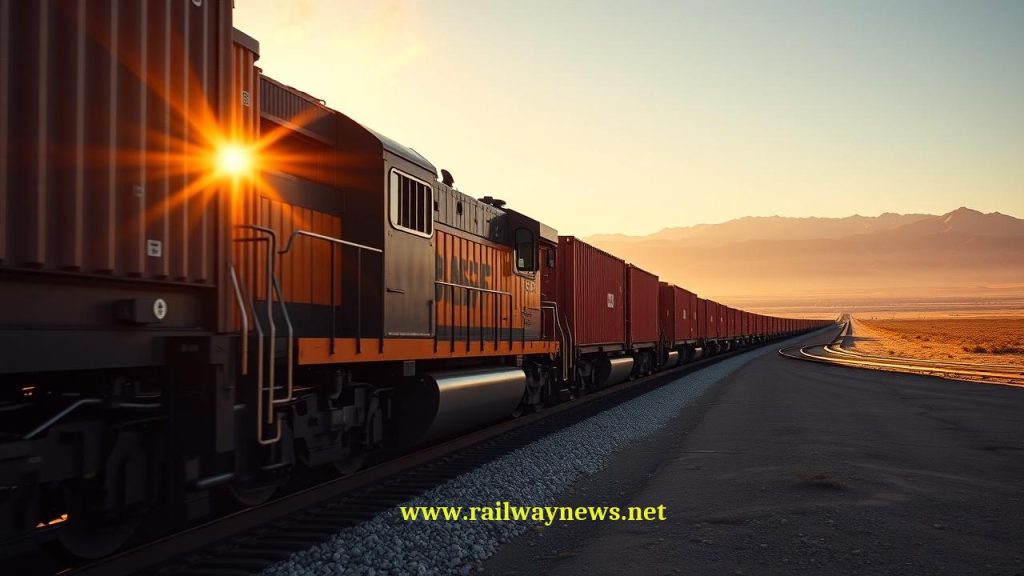
⚡ In Brief: BNSF Railway’s Barstow International Gateway, a USD 4 billion integrated rail terminal on a 4,500-acre site in western Barstow, California, received city council approval and special SB 149 certification from Governor Gavin Newsom, making it the first transport project to earn that designation.
BARSTOW, California – The Barstow City Council has approved the Barstow International Gateway (BIG), a USD 4 billion privately financed integrated rail terminal developed by BNSF Railway on a 4,500-acre (1,821-hectare) site in western Barstow. The project, which received special SB 149 certification from Governor Gavin Newsom in 2025, is the first transport project to secure California’s accelerated infrastructure designation. BIG will include a rail yard, intermodal terminal, and warehouses designed to transfer international maritime containers arriving from the Port of Los Angeles and Port of Long Beach directly onto BNSF’s national rail network for processing and redistribution.
What Is the Full Scope of This Project?
The BIG project spans 4,500 acres in western Barstow and combines three integrated facility types — a classification rail yard, an intermodal transfer terminal, and transload warehouses — under a single operational footprint. BNSF Railway estimates the terminal will eliminate 330 million truck-kilometres (205 million miles) from California roads in 2028, rising to 433 million km (269 million miles) in 2033 and 502 million km (312 million miles) by 2048. The company has committed to deploying zero-emission cargo-handling equipment across the site, including electric cranes and forklifts, and has signed agreements with environmental regulators to test additional emissions-reduction technologies. Ancillary infrastructure includes flood risk reduction works, replacement of the Hinkley Road bridge over the Mojave River, and local road network upgrades. Economic projections for the first two decades of operation forecast approximately 5,400 direct jobs, USD 938 million in total earnings, and a USD 2.9 billion economic contribution to the city of Barstow. Construction is expected to generate an estimated 62,000 jobs, with a further 15,000 permanent positions for facility operation. A specific completion date or construction start date was not disclosed by BNSF Railway at the time of approval.
Key Project Data
| Parameter | Value |
|---|---|
| Project / Contract Name | Barstow International Gateway (BIG) |
| Total Value | USD 4 billion (private investment) |
| Parties Involved | BNSF Railway (developer/operator), City of Barstow, State of California (SB 149 certification) |
| Timeline / Completion | Not disclosed; truck-mile reduction targets benchmarked to 2028, 2033, and 2048 |
| Country / Corridor | United States / Southern California — San Pedro Bay ports to Barstow inland distribution hub |
How Does This Compare to Similar Projects?
The USD 4 billion investment figure for BIG substantially exceeds the scale of most North American intermodal terminal projects. BNSF’s own Logistics Park Chicago in Joliet, Illinois — one of the continent’s largest inland intermodal facilities — was developed in phases at a cumulative investment estimated below USD 500 million. Union Pacific’s intermodal terminal network expansions, including its Inland Empire facility in Southern California, have historically fallen in the USD 100–400 million range per site. The BIG investment places it among the largest single freight-infrastructure commitments by a Class I railroad in North America. This scale aligns with a broader freight rail trend identified in PwC’s midyear 2025 outlook: dealmaking activity is increasingly concentrated on premium, rail-adjacent logistics assets, driven by environmental regulations and trucking-sector labour constraints that push chemical and intermodal logistics segments toward rail. (Source: PwC Transportation & Logistics Midyear Outlook, 2025) The California high-speed rail programme — a separate state-led passenger initiative — has seen its budget escalate from an original USD 33 billion to approximately USD 100 billion, illustrating the fiscal contrast between privately financed freight infrastructure and publicly funded passenger megaprojects within the same state. (Source: Newsweek, 2025) No directly comparable freight terminal of this size and investment magnitude has been announced in the Western United States in the past five years.
Editor’s Analysis
BNSF’s decision to commit USD 4 billion of private capital to an inland intermodal gateway represents a structural vote against the drayage-dependent model that has dominated Southern California logistics for decades. By relocating container sorting and processing 160 km inland from the San Pedro Bay ports, BNSF is effectively building a pressure-release valve for the nation’s busiest port complex — one that bypasses the chronic labour shortages and regulatory scrutiny facing short-haul trucking. The 2025 rail M&A environment, described in PwC’s midyear outlook as increasingly focused on premium rail-adjacent assets, suggests BNSF is positioning BIG as both a defensive moat against competitor encroachment and an offensive platform for capturing intermodal volume growth. The SB 149 fast-track designation — the first ever granted to a transport project — signals Sacramento’s willingness to treat freight rail infrastructure with the same urgency historically reserved for energy and water projects.
FAQ
Q: When will the Barstow International Gateway be completed and operational?
A: BNSF Railway has not disclosed an official completion date for the BIG project. The company’s own emissions-reduction benchmarks cite truck-mile elimination targets for 2028, 2033, and 2048, suggesting phased operational ramp-up over multiple decades.
Q: How does the BIG project differ from California’s high-speed rail initiative?
A: The Barstow International Gateway is a privately funded BNSF freight rail terminal focused on maritime container transfer, entirely separate from California’s state-led high-speed passenger rail programme. The high-speed rail project was approved by voters in 2008 with an initial USD 33 billion budget that has since grown to an estimated USD 100 billion, whereas BIG is a USD 4 billion private freight investment with no public passenger component. (Source: Newsweek, 2025)
Q: What is the terminal’s annual container processing capacity?
A: BNSF Railway has not publicly disclosed a specific annual TEU (twenty-foot equivalent unit) capacity for the BIG facility. The projected truck-mile elimination figures — 502 million km annually by 2048 — indicate substantial throughput, but exact container volumes remain unconfirmed.

Railway infrastructure, rolling stock and transport technologies specialist focused on global rail industry developments, high-speed rail systems, signaling technologies and freight transportation. Covering railway investments, public transport modernization, rail operations and international mobility projects across Europe, Asia and North America.