
PKP Tests GoA2 Autonomous Passenger Train on WKD Line
PKP launched GoA2 autonomous passenger train tests on Poland’s WKD Line No. 48, utilizing a PESA-manufactured EN97 vehicle.
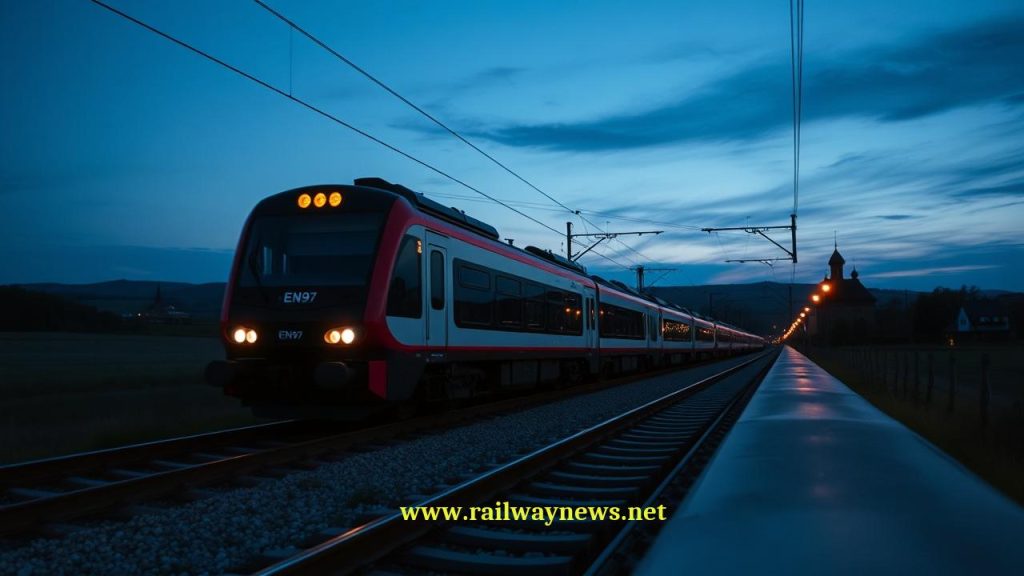
⚡ In Brief: Poland’s state railway PKP is advancing a project to test a Grade of Automation 2 (GoA2) autonomous passenger train on the WKD Line No. 48 near Warsaw, utilizing a PESA-manufactured EN97 vehicle.
WARSAW, POLAND – The Polish state-owned railway company PKP has joined a consortium to develop and test an autonomous passenger train. The project will conduct initial real-world trials at Grade of Automation 2 (GoA2) on a section of WKD Line No. 48 between Podkowa Leśna and Milanówek. The tests will utilize an EN97 electric multiple unit manufactured by PESA.
What Are the Technical Specifications?
The project will be executed in a phased approach, beginning with the creation of a “digital twin” for simulation purposes. This virtual model will replicate the test track’s infrastructure and the autonomous train’s behaviour. Subsequently, a PESA-built EN97 train, operated by Warszawska Kolej Dojazdowa (WKD), will be fitted with cameras, sensors, and specialized software for live testing. The initial trials will operate at GoA2, meaning the train’s acceleration and braking are automated, but a driver remains in the cab for supervision, door operation, and handling irregularities. The long-term goal is to evaluate a transition to fully autonomous, driverless operations, although this would require significant further development.
Key Technical Data
| Parameter | Value |
|---|---|
| Technology / System Name | Autonomous Train Operation (ATO) System Pilot |
| Total Value | Not disclosed |
| Parties Involved | PKP, WKD, PESA, academic and IT sector partners |
| Timeline / Completion | Not disclosed |
| Country / Corridor | Poland / WKD Line No. 48 (Podkowa Leśna – Milanówek) |
Where Does This Technology Stand in the Market?
The Polish project’s focus on GoA2 represents a common, incremental step in mainline and regional rail automation. While GoA4 (fully driverless) operation is standard in many closed metro systems globally, using systems like Alstom’s Urbalis CBTC on the Dubai Metro, its application on open networks with level crossings presents greater complexity. This project is technologically similar to initial mainline ATO tests conducted elsewhere in Europe. For instance, Siemens Mobility and Deutsche Bahn successfully demonstrated the world’s first GoA2 operation on an active, open S-Bahn line in Hamburg in 2021. (Source: Siemens, 2021). In the freight sector, automation is more advanced; Rio Tinto’s AutoHaul™ network in Australia has been operating GoA4 heavy-haul freight trains across a 1,700 km network for several years. (Source: Rio Tinto, 2019). The PKP project is therefore an entry into a proven technological field, but its application on regional passenger rail in Poland is a new frontier for the national network.
Editor’s Analysis
PKP’s initiative is a pragmatic step toward modernizing its network, targeting efficiency gains and operational resilience. By starting with GoA2, the consortium can build technical expertise and address safety cases in a controlled environment before considering more complex, driverless applications. This project aligns with the global trend of retrofitting existing rail infrastructure with advanced automation, a market projected to grow at a Compound Annual Growth Rate (CAGR) of 5.46% through 2031. (Source: Mordor Intelligence). The success of this pilot could establish a scalable model for deploying ATO across other regional lines in Poland.
FAQ
Q: What level of automation is being tested?
A: The initial tests are for Grade of Automation 2 (GoA2). This means automated systems control acceleration and braking, but a driver remains in the cab to supervise the route and operate the doors.
Q: When will the autonomous train be in public service?
A: A timeline for public service has not been announced. The current project phase is focused on digital simulation and closed-track testing without passengers.
Q: Is this the first autonomous train in Europe?
A: No. Fully autonomous (GoA4) metro lines have operated for years in cities like Paris and Copenhagen. Additionally, GoA2 tests on open mainline networks have already been conducted, significantly in Hamburg, Germany.

Railway infrastructure, rolling stock and transport technologies specialist focused on global rail industry developments, high-speed rail systems, signaling technologies and freight transportation. Covering railway investments, public transport modernization, rail operations and international mobility projects across Europe, Asia and North America.
RELATED POSTS

September 6, 2026 5:19 am
Hitachi delivered Taiwan's first N700ST high-speed train from Japan in...

September 5, 2026 4:19 pm
CPK launched formal tender talks with four consortia to design...

September 6, 2026 4:12 am
Alstom delivered the first of 100 new G Class trams...

September 6, 2026 1:17 am
Hitachi Toshiba Supreme Consortium confirmed the first of 12 N700ST...

September 6, 2026 6:17 am
Hungary ordered a national ban on most freight trains from...
September 6, 2026 8:17 am
DB InfraGO reopened the Nuremberg-Regensburg line in Bavaria on 31...