
ÖBB Replaces Innsbruck Bridge: 1,400-Ton Move Complete
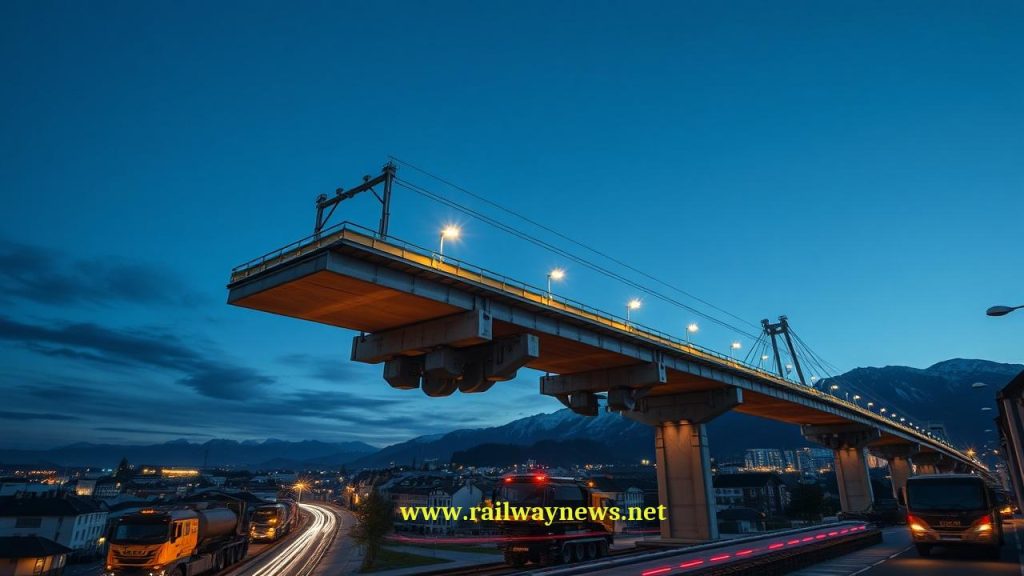
ÖBB expertly relocated the 1,400-ton Rauchmühle railway bridge in Innsbruck using SPMTs, minimizing disruption and setting a new standard for urban infrastructure renewal.
🛑 Key Takeaways:
- ÖBB replaced a critical railway bridge in Innsbruck by pre-building it nearby and moving the 1,400-ton structure into place.
- The relocation was executed using 12 Self-Propelled Modular Transporters (SPMTs) with 56 axles, eliminating the need for heavy-duty cranes.
- This “build-aside” method demonstrates a low-disruption strategy for renewing infrastructure on high-traffic urban rail corridors.
INNSBRUCK, AUSTRIA – Austria’s state-owned railway company, ÖBB, has completed the complex relocation of the new 1,400-ton Rauchmühle bridge, moving the structure nearly 100 meters and rotating it into its final position over Hallerstraße. The operation utilized self-propelled platforms to replace a 60-year-old bridge that handled approximately 270 trains daily, with rail traffic scheduled to resume on January 29.
| Category | Specification / Detail |
|---|---|
| Project | Rauchmühle Railway Bridge Replacement |
| Total Relocated Weight | 1,400 tons (including auxiliary structures) |
| Key Stakeholders | ÖBB (Österreichische Bundesbahnen) |
| Relocation Technology | 12 Self-Propelled Modular Transporters (SPMTs) |
| Bridge Span / Width | 29 meters / 11.25 meters |
| Service Disruption Period | Suspended until January 29 |
Operational & Technical Details
The new concrete bridge was constructed adjacent to its final position to minimize impact on the busy rail junction. Before the move, the entire 1,400-ton assembly was raised 5.13 meters using hydraulic presses. The ground-level transport was conducted by a fleet of 12 SPMT units, equipped with 56 axles and 112 individually controlled wheels.
The structure was moved at a controlled speed of 1–2 km/h. The operation involved a 90-degree rotation before the bridge was placed with millimeter precision onto its final supports. This crane-less method was deemed optimal for the dense urban site. The project also required the dismantling and reinstallation of 100 meters of railway track. The previous steel bridge was decommissioned after 60 years of service, its structural integrity compromised by heavy traffic and alpine weather conditions.
Market Impact Analysis
ÖBB’s successful execution of the Innsbruck bridge replacement serves as a critical case study for European network operators. The “build-aside” and “move-in-place” technique is a strategically vital approach for infrastructure renewal on high-density corridors where long-term service shutdowns are economically unfeasible. By avoiding traditional crane-based construction, this method significantly reduces disruption to both rail and surrounding road traffic. This project reinforces the viability of modular transport solutions for complex engineering tasks in constrained urban environments, offering a template for replacing aging assets across the continent’s rail networks with greater efficiency and lower public inconvenience.
FAQ: Quick Facts
What was the primary goal of this project?
The project’s goal was to replace a 60-year-old railway bridge that had reached the end of its technical service life on a line handling 270 trains per day, using a method that minimized traffic disruption.
When is rail service expected to resume?
The rail blockade on the section between Rum and Innsbruck Central Station is scheduled to end on January 29, at which point normal train traffic is expected to resume.

Railway infrastructure, rolling stock and transport technologies specialist focused on global rail industry developments, high-speed rail systems, signaling technologies and freight transportation. Covering railway investments, public transport modernization, rail operations and international mobility projects across Europe, Asia and North America.
RELATED POSTS
October 1, 2026 10:14 am
HS2 installed a 55-metre steel span in Birmingham, completing phase...

October 1, 2026 11:14 pm
CATS confirmed a six-mile streetcar route in Charlotte to add...
October 1, 2026 11:13 am
Norfolk Southern expanded its 3B Corridor in Alabama in 2025,...
October 1, 2026 1:12 pm
CSX expanded Queensgate Yard in Cincinnati by installing 42 power...

October 4, 2026 11:08 pm
Sound Transit confirmed the September 30 opening of Seattle Pinehurst...
October 6, 2026 12:16 am
FTA awarded $233 million in grants to eight US rail...