
EN 16286-1: Europe’s Blueprint for Safer Rail Gangways
Explore EN 16286-1, the European standard defining railway gangway design, safety, and comfort. It ensures seamless passenger movement and industry interoperability.
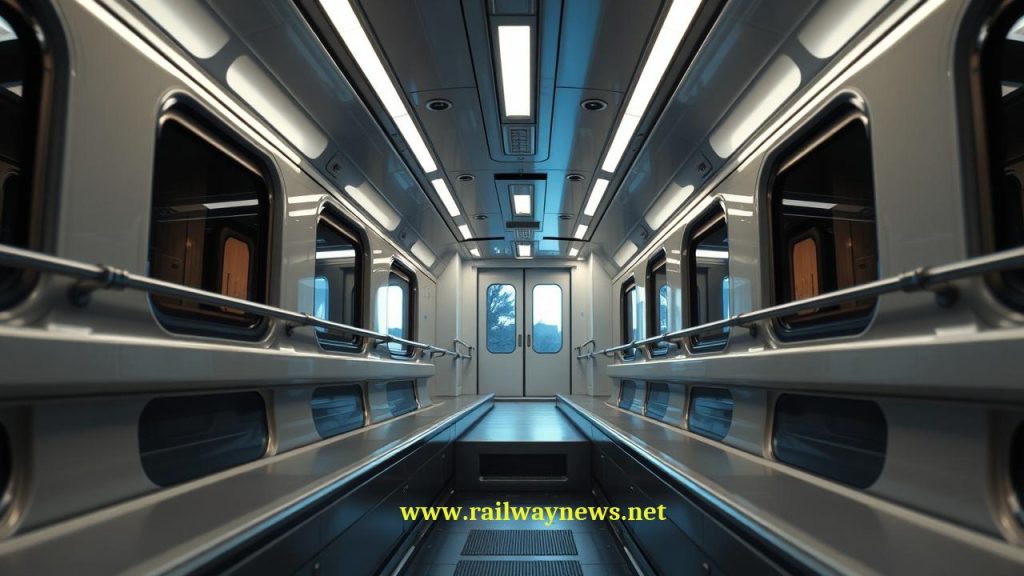
Understanding EN 16286-1: The Standard for Railway Gangway Systems
EN 16286-1 is a European Standard that specifies the essential requirements for the design, manufacturing, and validation of gangway systems used between passenger rail vehicles. As a critical component ensuring passenger safety, comfort, and seamless movement between carriages, the gangway is subject to stringent regulations. This standard provides a unified framework for manufacturers, operators, and regulatory bodies to ensure these systems are robust, reliable, and fit for purpose in mainline railway applications.
The standard, titled “Railway applications – Gangway systems between vehicles – Part 1: Main applications,” focuses on gangways for standard gauge railways, excluding specialized systems like those for rack railways, metros with very tight curves, or tramways, which are covered in other parts of the EN 16286 series.
Key Objectives and Scope of EN 16286-1
The primary goal of EN 16286-1 is to establish a common set of technical criteria that guarantee interoperability, safety, and performance. Its scope covers all aspects of the gangway system from the vehicle body interface to the internal passenger environment.
The standard’s main objectives include:
- Defining Safety Requirements: To ensure the structural integrity, fire resistance, and safe passage for passengers and staff under all operating conditions, including emergency situations.
- Establishing Performance Criteria: To specify requirements for durability, environmental sealing (watertightness), acoustic and thermal insulation, and overall passenger comfort.
- Specifying Interfaces: To define the mechanical and geometric interfaces between the gangway and the vehicle bodies, ensuring compatibility and correct function during vehicle movement.
- Outlining Validation and Testing: To provide clear methodologies for testing and verifying that a gangway system meets the specified requirements before being put into service.
Core Technical Requirements of EN 16286-1
The standard delves deep into several technical domains to ensure a holistic approach to gangway design. These requirements form the backbone of compliance and certification.
Mechanical and Structural Integrity
The gangway must withstand all static and dynamic loads encountered during service life. This includes loads from passenger traffic, pressure pulses when entering tunnels, and inertial forces from train acceleration and braking. The standard defines specific load cases and requires manufacturers to demonstrate fatigue resistance and structural safety through calculation (e.g., Finite Element Analysis – FEA) and physical testing.
Kinematics and Geometric Interfaces
A gangway’s primary function is to bridge the gap between two moving vehicles. It must safely accommodate all relative movements, including:
- Yaw: Rotation on a horizontal plane (navigating curves).
- Pitch: Rotation on a vertical plane (traversing gradients and crests).
- Roll: Torsional movement of the vehicle bodies.
- Linear Displacements: Longitudinal, lateral, and vertical shifts.
EN 16286-1 requires the definition of a “kinematic envelope,” which is the maximum range of motion the gangway must accommodate without compromising safety or performance. This ensures the clear passage for passengers is maintained and no mechanical parts clash.
Fire Safety
Fire safety is paramount in rail vehicle design. Gangways act as a connection between fire compartments (carriages) and must not contribute to the spread of fire or smoke. This section of the standard works in close conjunction with EN 45545 (Fire protection on railway vehicles). It mandates that all materials used in the gangway construction meet specific hazard levels (HL) for flammability, smoke density, and toxicity. The gangway must also maintain its integrity as a fire barrier for a specified duration.
Passenger Environment and Comfort
Beyond pure safety, the standard addresses the passenger experience. Key requirements include:
- Clear Passage: A minimum clear width and height must be maintained under all kinematic conditions to allow for unobstructed passage, including for persons with reduced mobility and for emergency evacuation.
- Acoustic and Thermal Insulation: The gangway must provide effective insulation against external noise and temperature variations, contributing to a comfortable cabin environment.
- Flooring: The floor surface must be slip-resistant, durable, and provide a continuous, safe surface with the vehicle floor. Ramps and bridging plates must be designed to minimize trip hazards.
- Watertightness: The system must prevent the ingress of water (rain, snow, cleaning jets) into the vehicle interior.
Comparison of Key Performance Parameters in EN 16286-1
The following table summarizes some of the critical technical aspects defined by the standard and their importance in railway operations.
| Parameter | Description of Requirement | Rationale / Importance |
|---|---|---|
| Structural Load Capacity | The gangway must withstand defined passenger loads (e.g., persons per square meter), aerodynamic pressures, and inertial forces without permanent deformation. | Ensures the physical safety of passengers and the structural longevity of the component under worst-case operational scenarios. |
| Kinematic Envelope | The design must accommodate the full range of relative vehicle movements (yaw, pitch, roll) specified for the intended route profile. | Prevents mechanical failure, ensures a continuous passage, and guarantees safe operation on complex track geometries. |
| Fire Protection | All materials must comply with specified hazard levels from EN 45545. The gangway must act as a fire barrier for a defined period. | Crucial for preventing the spread of fire and smoke between carriages, allowing for safe passenger evacuation in an emergency. |
| Acoustic Insulation | The gangway must meet a minimum sound insulation index (dB) to reduce the transmission of external noise (wheel-rail, aerodynamic) into the cabin. | Directly impacts passenger comfort and contributes to a premium travel experience, especially on high-speed lines. |
| Watertightness | The system must be proven to be sealed against water ingress under simulated conditions (e.g., high-pressure spray tests). | Protects the vehicle interior and electrical systems from damage, prevents slip hazards, and improves passenger comfort. |
The Role of EN 16286-1 in the Rail Industry
EN 16286-1 serves as a cornerstone for the procurement, design, and approval of railway gangways in Europe and regions that adopt EN standards. For manufacturers, it provides a clear set of design targets and testing protocols, streamlining development. For train operating companies and vehicle procurers, it acts as a guarantee of quality, safety, and reliability, simplifying the technical specification process. Finally, for regulatory authorities, it forms a clear basis for certification, promoting a harmonized and safe railway network.
Conclusion
EN 16286-1 is more than just a technical document; it is a critical enabler of modern, safe, and comfortable passenger rail travel. By standardizing the requirements for gangway systems—from their load-bearing structures to their fire-retardant materials and acoustic properties—the standard ensures that these vital links between carriages perform flawlessly. Compliance with EN 16286-1 is a non-negotiable aspect of vehicle design, reflecting the industry’s unwavering commitment to safety and interoperability.

Railway infrastructure, rolling stock and transport technologies specialist focused on global rail industry developments, high-speed rail systems, signaling technologies and freight transportation. Covering railway investments, public transport modernization, rail operations and international mobility projects across Europe, Asia and North America.