
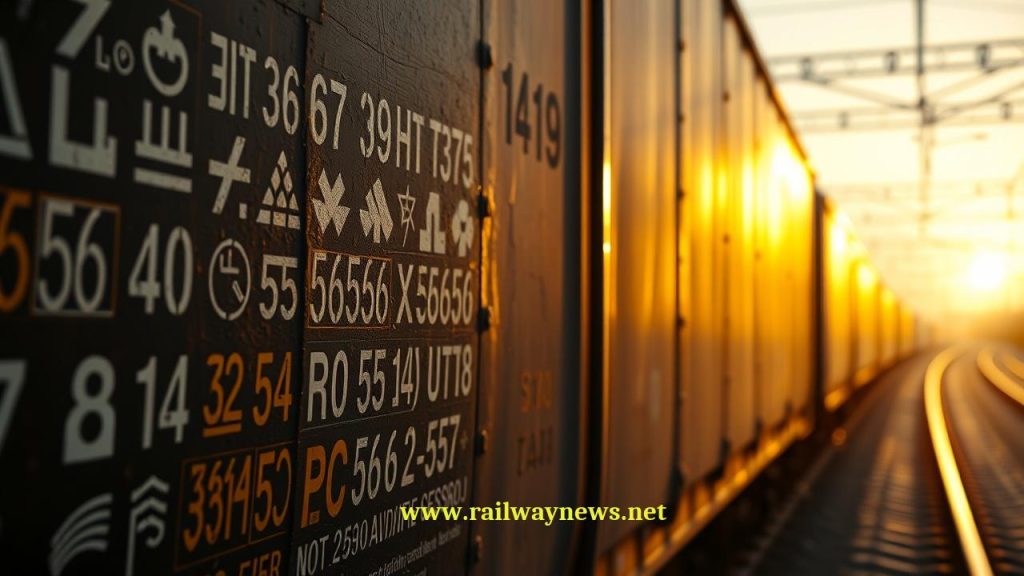
EN 15877-1: A Detailed Guide to Marking on Railway Freight Wagons
EN 15877-1 is a European Standard that specifies the requirements for the marking of freight wagons. These markings are essential for the identification, operation, and maintenance of vehicles within the European railway network, ensuring interoperability, safety, and operational efficiency across different countries and railway undertakings.
The Core Objectives of EN 15877-1
The standard establishes a unified system of markings to achieve several critical objectives in the railway sector. Its implementation is fundamental for the seamless movement of goods by rail.
- Interoperability: By standardizing markings, freight wagons can be easily identified and handled by staff and systems across the entire trans-European rail network, regardless of the wagon’s country of origin or its keeper.
- Safety: Clear and unambiguous markings provide crucial information to railway personnel, such as brake weight, maximum load, and hazard warnings. This data is vital for safe train composition, shunting operations, and emergency response.
- Operational Efficiency: Standardized markings streamline logistics and operations. Information like tare weight, length, and loading capabilities can be quickly read, facilitating faster train formation and more accurate documentation.
- Maintenance and Traceability: Markings include unique vehicle numbers and maintenance codes, allowing for the effective tracking of a wagon’s history, overhaul schedules, and technical specifications, which is essential for asset management.
Technical Breakdown of Key Markings
EN 15877-1 defines a wide array of markings, each with a specific purpose and location on the freight wagon. These are broadly categorized into identification, operational, and safety-related markings.
1. The European Vehicle Number (EVN)
The most critical marking is the 12-digit European Vehicle Number (also known as the UIC wagon number), which uniquely identifies each freight wagon. It is structured as follows:
- Digits 1-2: Regime of Exchange Code. Indicates the interoperability capability of the wagon (e.g., TEN, RIV).
- Digits 3-4: Country Code. Identifies the country where the vehicle is registered.
- Digits 5-8: Technical Characteristics. A four-digit code defining the wagon’s type, series, and key technical features like the number of axles and brake type.
- Digits 9-11: Serial Number. A unique running number for wagons with the same technical characteristics.
- Digit 12: Check Digit. An auto-calculated digit used to validate the accuracy of the preceding 11 digits.
Alongside the EVN, the Vehicle Keeper Marking (VKM) is displayed, which is a 2-5 letter code identifying the company responsible for the wagon (e.g., DB for Deutsche Bahn).
2. Operational Markings
These markings provide essential data for day-to-day railway operations:
- Load and Weight Table: A grid that shows the maximum permissible payload (in tonnes) based on the speed category (e.g., S, SS) and the line category (A, B, C, D).
- Tare Weight: The empty weight of the wagon in tonnes.
- Length over Buffers: The total length of the wagon, measured in meters, which is crucial for calculating train length.
- Braking Information: Includes the type of brake system (e.g., KE, GP-A) and the brake weight, which is the value used by train drivers to calculate the train’s overall braking performance.
- Loading Gauge Symbol: Indicates the kinematic profile the wagon conforms to, ensuring it can pass safely through tunnels, under bridges, and past platforms.
3. Maintenance and Safety Markings
These markings are vital for ensuring the vehicle is maintained correctly and handled safely:
- Lifting and Jacking Points: Symbols indicating the correct and safe locations for lifting or jacking the wagon during maintenance or in case of a derailment.
- Date of Last Overhaul: The date and location of the last major inspection or overhaul are stenciled on the wagon frame.
- Warning Symbols: Standardized pictograms for specific hazards, such as high voltage from an overhead catenary or warnings for wagons carrying dangerous goods.
- Handbrake Symbol: Indicates the presence and location of a manually operated handbrake.
Comparison of Marking Categories
The following table summarizes the different categories of markings as defined by EN 15877-1 and their primary purpose in the railway environment.
| Marking Category | Example Markings | Primary Purpose |
|---|---|---|
| Identification | 12-digit EVN, Vehicle Keeper Marking (VKM) | To provide a unique, unambiguous identity for legal, operational, and administrative tracking of the vehicle. |
| Operational Data | Load/Weight table, Tare Weight, Length over Buffers, Brake Weight | To provide train planners and operators with the necessary data for safe and efficient train composition and movement. |
| Safety & Handling | Lifting/jacking points, Handbrake symbol, High-voltage warning | To ensure the safety of personnel during maintenance, shunting, loading/unloading, and emergency situations. |
| Interoperability | Loading gauge symbol, RIV/TEN designation | To confirm the wagon’s compliance with international network requirements, allowing it to cross borders without technical reassessment. |
Implementation and Compliance
Compliance with EN 15877-1 is mandatory for all freight wagons intended for use on the trans-European network. Vehicle keepers are responsible for ensuring their wagons are correctly marked and that the markings remain legible throughout the vehicle’s service life. The standard also specifies requirements for the durability of the markings, including resistance to weathering, UV radiation, and cleaning agents. Markings are typically applied using durable paint stencils or high-performance adhesive decals placed in standardized positions on the wagon’s underframe or body for consistent visibility.
Conclusion
EN 15877-1 is more than just a set of rules for painting numbers on a wagon; it is a foundational element of the modern, interoperable European rail system. By creating a common visual language, the standard enables safer, faster, and more reliable freight transport across the continent, underpinning the efficiency and competitiveness of the railway sector.
Frequently Asked Questions about EN 15877-1
What is the primary purpose of EN 15877-1?
The primary purpose of EN 15877-1 is to standardize the markings on railway freight wagons to ensure interoperability, safety, and operational efficiency across the European rail network. It provides a common system for identifying vehicles and conveying critical operational and safety information.
Does EN 15877-1 apply to passenger coaches?
No, EN 15877-1 specifically covers marking requirements for freight wagons. Markings for other types of railway vehicles, such as passenger coaches, traction units, and special vehicles, are covered in other parts of the EN 15877 standard series (e.g., EN 15877-2).
What is the 12-digit number on a freight wagon?
The 12-digit number is the European Vehicle Number (EVN), a unique identifier for each wagon. It contains coded information about the wagon’s interoperability capability, country of registration, technical characteristics, and a serial number, all validated by a final check digit.
Why are the durability and placement of markings so important?
The durability and standardized placement of markings are crucial for ensuring that information remains legible and easily accessible to railway staff throughout the wagon’s operational life. This reliability is essential for safety, as illegible markings (like brake weight or maximum load) could lead to serious operational errors.
