
Thailand’s High-Speed Rail: A Billion-Dollar Bid
Thailand’s ambitious high-speed rail project: a $6.8 billion undertaking demanding cutting-edge technology and global collaboration. Discover how this game-changing infrastructure project is shaping the future of Southeast Asia!
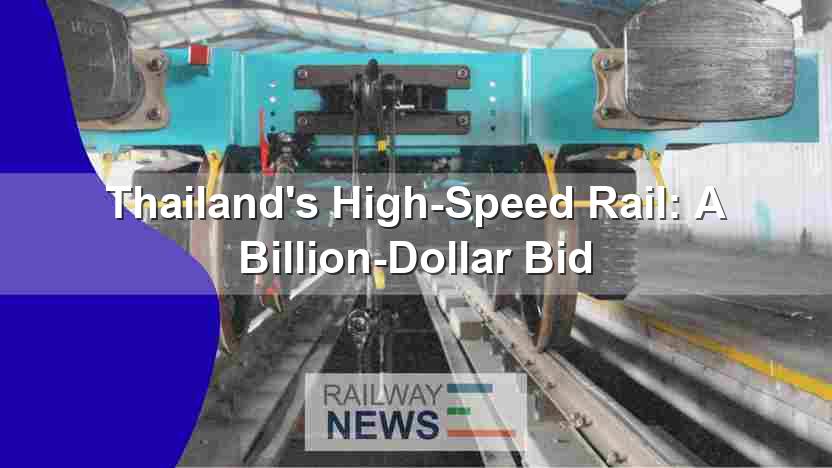
Thailand’s ambitious high-speed rail project, valued at $6.8 billion, represents a significant undertaking in the nation’s infrastructure development. This project aims to revolutionize connectivity between three major international airports: Don Mueang International Airport, Suvarnabhumi International Airport (both in Bangkok), and U-Tapao International Airport in Rayong. The project’s significance extends beyond mere transportation; it serves as a cornerstone of the Eastern Economic Corridor (EEC) initiative, aiming to stimulate economic growth in the eastern region of Thailand. This article explores the intricacies of the bidding process, the key players involved, and the potential impact of this project on Thailand’s economic landscape and transportation infrastructure. We will examine the consortium formations, the technological challenges, and the projected timelines for completion, providing a detailed overview of this monumental undertaking.
Consortium Formation and Strategic Partnerships
The bidding process for the Thai high-speed rail project attracted significant interest from international and domestic players, resulting in a diverse range of consortia submitting proposals. Two notable bidders emerged: the Charoen Pokphand Group (CP Group) consortium and the BSR Joint Venture (JV). The CP Group consortium assembled a powerful alliance including prominent international players such as China Railway Construction, CITIC Group (both Chinese state-owned enterprises), Siemens (German engineering conglomerate), Hyundai (South Korean multinational conglomerate), Bangkok Expressway and Metro (a Thai company), the Japan Bank for International Cooperation (JBIC), and Ferrovie dello Stato Italiane (the Italian state railway company). This strategic partnership leveraged expertise in various aspects of high-speed rail development, from construction and technology to financing and operations. The BSR JV, on the other hand, represented a collaboration between Sino-Thai Engineering and Construction, Ratchaburi Electricity Generating Holding, and BTS Group Holdings, demonstrating a blend of local expertise and international connections.
Technological Considerations and Infrastructure Development
The Thai high-speed rail project demands advanced technological solutions to ensure efficient and safe operation. The selected technology will need to address factors like track gauge, signaling systems, train control management (TCM), and rolling stock compatibility. The integration of various technologies from different international partners within the consortia necessitates careful planning and coordination to avoid compatibility issues and ensure seamless operation. Additionally, the project’s integration with existing rail infrastructure will require meticulous engineering to ensure smooth transitions and minimal disruptions to current services. The successful completion of this project will contribute significantly to Thailand’s overall infrastructure development, promoting greater connectivity and facilitating economic growth within the EEC.
Financial Implications and Project Financing
The $6.8 billion price tag highlights the significant financial investment required for the project. The involvement of international financial institutions, such as the JBIC, underscores the complexities of securing funding for such large-scale infrastructure projects. The financial viability of the project will depend not only on securing sufficient funding but also on efficient cost management throughout the construction and operational phases. The successful bidder will need to demonstrate a clear understanding of financial projections, risk assessment, and sustainable operational models to ensure the project’s long-term financial health. Transparent and efficient financial management will be crucial to maintaining public trust and ensuring the project’s overall success.
Project Timeline and Expected Impact
The State Railway of Thailand (SRT) was tasked with evaluating the bids, with the winning consortium expected to be announced by January following the bid submission deadline in early November 2018. Construction was anticipated to begin in the first quarter of 2019 and to last approximately five years. The project’s completion is expected to significantly reduce travel time between Bangkok and the Eastern Economic Corridor, fostering economic integration and development in the region. The project’s successful implementation will contribute to Thailand’s overall transportation infrastructure, enhancing connectivity, and boosting economic activity within the EEC and beyond. The high-speed rail line will also improve the accessibility of U-Tapao International Airport, potentially increasing tourism and foreign investment in the region.
Conclusions
The bidding process for Thailand’s $6.8 billion high-speed rail project showcased the intense competition and collaboration among international and domestic players. The formation of powerful consortia, such as the CP Group consortium and the BSR JV, underscored the strategic importance of the project and the expertise required for its successful implementation. The project represents a substantial investment in Thailand’s infrastructure development, with implications extending beyond transportation to encompass economic growth and national development. The successful bidder will be responsible not only for constructing the high-speed rail line but also for integrating it seamlessly into existing infrastructure and ensuring its long-term financial viability. The selection criteria will consider factors including technical expertise, financial capacity, and experience in managing similar projects. The project’s completion will have a profound impact on Thailand’s connectivity, promoting economic integration and facilitating the growth of the Eastern Economic Corridor. Beyond the immediate economic benefits, the project serves as a testament to Thailand’s commitment to modernizing its infrastructure and strengthening its position as a regional economic hub. The successful completion of this ambitious project will be a significant milestone in Thailand’s infrastructural development, potentially serving as a model for similar high-speed rail projects in Southeast Asia and beyond. The meticulous planning, transparent financial management, and effective collaboration with international partners will be key to the project’s ultimate success.

Railway infrastructure, rolling stock and transport technologies specialist focused on global rail industry developments, high-speed rail systems, signaling technologies and freight transportation. Covering railway investments, public transport modernization, rail operations and international mobility projects across Europe, Asia and North America.
RELATED POSTS

October 8, 2026 1:15 pm
Alstom secured a €1bn contract to build 13 automated trains,...

October 1, 2026 7:09 am
United States regulators confirmed a September 30 deadline for the...

October 8, 2026 12:18 pm
Siemens Mobility signed an agreement with VinSpeed to supply 350...

October 4, 2026 5:14 pm
Alstom secured a CA$4.7 billion order from VIA Rail Canada...

October 5, 2026 6:12 pm
AECOM and Jacobs secured a contract in September 2026 to...

October 1, 2026 12:13 am
Illinois approved $1.5 billion annually for the Northern Illinois Transit...