
What is Shinkansen? Japan’s Bullet Train Network Explained (2026)
Shinkansen explained: Japan’s bullet train network, all lines, speeds up to 320 km/h, train series from 0 Series to N700S, safety record and Chuo Shinkansen maglev future.
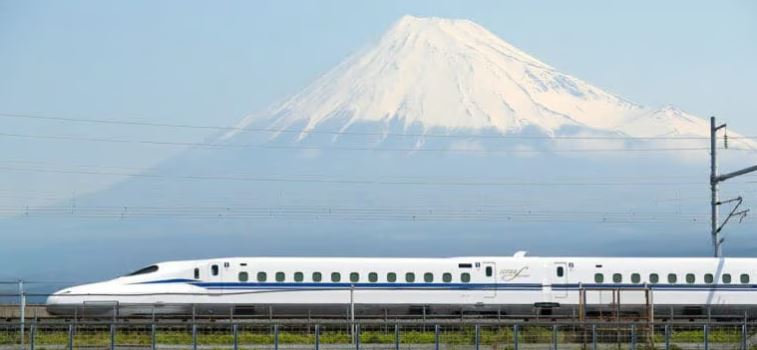
Quick Answer — Shinkansen
Shinkansen (新徉網, literally “new trunk line”) is Japan’s high-speed rail network, colloquially known as the bullet train. Operated by the JR Group, it spans over 3,000 km of dedicated standard-gauge track across Honshu, Kyushu, and Hokkaido. The first line — the 東海道新徉網 (Tokaido Shinkansen) — opened on October 1, 1964, just nine days before the Tokyo Olympic Games. Operating at speeds of up to 320 km/h in regular service, the Shinkansen holds one of the most remarkable safety records in transport history: zero passenger fatalities from train accidents in over 60 years of continuous operation across more than 10 billion passenger journeys.
What Does Shinkansen Mean?
The word Shinkansen is composed of two Japanese characters: shin (新, new) and kansen (徉網, trunk line). The name refers to the dedicated new railway lines built separately from Japan’s existing narrow-gauge conventional network — not to the trains themselves, though the term is widely used for both.
The colloquial English name bullet train comes from the aerodynamic, elongated nose of the original 0 Series trains, which resembled a bullet when viewed from the front. The term has stuck internationally, though Japanese speakers always use Shinkansen.
Shinkansen lines use standard gauge track (1,435 mm) — the same as most European high-speed rail — rather than the 1,067 mm narrow gauge used by Japan’s conventional rail network. This incompatibility means Shinkansen trains cannot run onto conventional lines, and conventional trains cannot access Shinkansen tracks (with the exception of Mini-Shinkansen services, which use specially modified trains).
The Shinkansen Network: All Lines at a Glance
| Line | Route | Operator | Length | Max Speed | Opened |
|---|---|---|---|---|---|
| Main Shinkansen Lines | |||||
| Tokaido | Tokyo → Osaka (Shin-Osaka) | JR Central | 515 km | 285 km/h | 1964 |
| Sanyo | Osaka → Hakata (Fukuoka) | JR West | 554 km | 300 km/h | 1975 |
| Tohoku | Tokyo → Shin-Aomori | JR East | 675 km | 320 km/h | 1982 |
| Hokkaido | Shin-Aomori → Shin-Hakodate-Hokuto | JR Hokkaido | 149 km | 260 km/h | 2016 |
| Joetsu | Omiya → Niigata | JR East | 269 km | 275 km/h | 1982 |
| Hokuriku | Tokyo → Tsuruga | JR East / JR West | 345 km | 260 km/h | 1997 |
| Kyushu | Hakata → Kagoshima-Chuo | JR Kyushu | 257 km | 260 km/h | 2004 |
| Nishi-Kyushu | Takeo-Onsen → Nagasaki | JR Kyushu | 66 km | 260 km/h | 2022 |
| Mini-Shinkansen (shared track with conventional lines at reduced speed) | |||||
| Yamagata | Fukushima → Shinjo | JR East | 148 km | 130 km/h | 1992 |
| Akita | Morioka → Akita | JR East | 127 km | 130 km/h | 1997 |
Shinkansen Train Series: From 0 Series to N700S
| Series | Lines Used | Max Speed | Notable Feature | Status |
|---|---|---|---|---|
| 0 Series | Tokaido / Sanyo | 220 km/h | The original 1964 bullet train — iconic round nose | Retired 2008 |
| 500 Series | Sanyo (now Kodama) | 300 km/h | Distinctive cylindrical fuselage — most aerodynamic Shinkansen | Limited service |
| N700 Series | Tokaido / Sanyo | 300 km/h | Active tilting (1°) — first Shinkansen with tilt for curve speed | In service |
| N700S Series | Tokaido / Sanyo | 285 km/h | Latest generation (2020) — SiC inverters, battery backup, improved ride | In service ★ |
| E5 / H5 Series | Tohoku / Hokkaido | 320 km/h | Fastest operational Shinkansen — “Hayabusa” & “Komachi” services | In service ★ |
| E7 / W7 Series | Hokuriku / Joetsu | 275 km/h | Active suspension — smooth ride over mountain terrain | In service |
| L0 Series | Chuo (maglev — under construction) | 603 km/h* | SCMaglev — world speed record holder (*test run, 2015) | Under development |
How Fast is the Shinkansen? Services Explained
Speed depends not only on the train series, but also on the service type — defined by how many stops the train makes. The Tokaido/Sanyo network uses three service categories:
| Service | Stops | Tokyo–Osaka (515 km) | Equivalent |
|---|---|---|---|
| Nozomi のぜみ | Tokyo, Shin-Yokohama, Nagoya, Kyoto, Osaka only | 2 hr 22 min | Express (fastest) |
| Hikari ひかり | Major stations + selected intermediate stops | ~3 hr | Semi-express |
| Kodama こだま | All stations | ~4 hr | Stopping service |
On the Tohoku Shinkansen, the equivalent fastest service is Hayabusa (はやぶさ), operated by E5/H5 Series trains at 320 km/h — covering the 675 km from Tokyo to Shin-Aomori in approximately 3 hours.
The Shinkansen’s Safety Record: Why Zero Passenger Fatalities?
Perhaps the most remarkable aspect of the Shinkansen is its perfect safety record. Since the first train ran on October 1, 1964, the Shinkansen network has carried well over 10 billion passengers without a single fatality caused by a train accident — a record unmatched by any other rail network of comparable size and speed.
This record is the result of multiple overlapping safety systems:
- Dedicated infrastructure: Shinkansen lines are completely grade-separated — no level crossings, no pedestrian access, no shared running with freight or conventional trains. This eliminates the most common cause of high-speed rail accidents.
- Automatic Train Control (ATC): Every Shinkansen operates under a digital ATC system that continuously monitors train speed and automatically applies brakes if a train exceeds the permitted speed for its section. Driver override is not possible for safety-critical interventions.
- Earthquake Early Warning (UrEDAS): A network of seismometers along and around the lines detects P-waves (the fast, low-energy precursor to destructive S-waves) and automatically cuts traction power and initiates emergency braking before the damaging shaking arrives. This system has successfully stopped Shinkansen trains before major earthquakes multiple times.
- Rigorous maintenance: Each train undergoes daily inspections, and major overhauls are conducted on a strictly time-based schedule regardless of observed condition. The Tokaido Shinkansen has a maintenance window every night during which no trains run and the entire infrastructure is inspected.
- Zero-defect culture: JR operators have institutionalised a maintenance philosophy derived from the original 1964 engineering team, in which any deviation from specification — no matter how small — is treated as a serious event requiring investigation.
Two derailments have occurred on Shinkansen lines: during the 2004 Chuetsu earthquake (no injuries) and the 2022 Tohoku earthquake (minor injuries, no fatalities). In both cases, the earthquake early warning system functioned as designed but the shaking intensity exceeded its response time window.
How Shinkansen Technology Works
Aerodynamic Design
At speeds above 200 km/h, aerodynamic forces dominate the engineering challenges of a train. The elongated, pointed nose of modern Shinkansen trains — particularly the 15-metre nose of the N700S and the even longer nose of the E5 Series — serves two purposes: reducing air resistance at speed, and critically, managing the tunnel boom effect. When a train enters a tunnel at high speed, it compresses the air ahead of it into a pressure wave. If this wave exits the far end of the tunnel faster than the sonic speed of the compressed air (approximately 1,236 km/h), it produces a loud sonic boom. Japan’s Shinkansen routes pass through many tunnels, making aerodynamic nose design essential — the E5 Series’ 15-metre nose was specifically designed to eliminate tunnel boom on the Tohoku line.
Electrification and Power
All Shinkansen lines use 25 kV AC overhead electrification, at either 50 Hz (eastern Japan — Tohoku, Joetsu, Hokuriku) or 60 Hz (western Japan — Tokaido, Sanyo, Kyushu). Modern Shinkansen trains use distributed traction — rather than dedicated locomotive units, electric motors are distributed throughout the train in every car — providing the high power-to-weight ratio needed for rapid acceleration and the adhesion needed for maximum speed.
The N700S introduced Silicon Carbide (SiC) inverters, replacing the older IGBT-based systems. SiC inverters are smaller, lighter, and more energy-efficient, reducing total train energy consumption by approximately 7% compared to the N700. The N700S also incorporates an onboard battery system that can move a train at low speed to the nearest station during a power outage — a safety feature introduced after the 2011 Great East Japan Earthquake.
The Future: Chuo Shinkansen Maglev
The next chapter of the Shinkansen story is the Chuo Shinkansen — JR Central’s SCMaglev project connecting Tokyo (Shinagawa) and Nagoya over 286 km at a planned operational speed of 505 km/h. The line will use the L0 Series SCMaglev trainsets, the same vehicles that set the 603 km/h world speed record in 2015.
Unlike conventional Shinkansen lines, the Chuo Shinkansen will run approximately 86% underground — through a series of tunnels bored beneath the Japanese Alps. This design avoids the surface land acquisition and community disruption that delayed previous Shinkansen construction, but has created its own challenges: a long-running dispute with Shizuoka Prefecture over concerns that tunnelling will affect local water supplies has significantly delayed the project. As of 2026, JR Central has not announced a revised opening date for the Tokyo–Nagoya section, with estimates pointing to the early 2030s at earliest.
The Chuo Shinkansen’s Tokyo–Osaka extension (further 130 km) is targeted for completion around 2037, which would reduce the journey time between Japan’s two largest cities from the current 2 hours 22 minutes to approximately 67 minutes.
Frequently Asked Questions (FAQ)

Railway infrastructure, rolling stock and transport technologies specialist focused on global rail industry developments, high-speed rail systems, signaling technologies and freight transportation. Covering railway investments, public transport modernization, rail operations and international mobility projects across Europe, Asia and North America.
RELATED POSTS
August 4, 2026 1:11 pm
Hitachi Rail Canada secured a $407.7M contract to install CBTC...
August 1, 2026 7:56 am
BMZ delivered two new TEM18DM diesel shunting locos to RZD...
August 1, 2026 7:14 pm
€205 billion funding shortfall threatens the TEN-T rail network's completion...

August 4, 2026 11:12 am
MBTA confirmed a $150.8 million overhaul of the 85-year-old Green...
August 1, 2026 7:11 pm
An Ipsos survey across 29 countries found that 33% of...
August 1, 2026 8:06 pm
European Commission approved a regulation on 9 July 2026 requiring...