
What is Maglev? Magnetic Levitation Train Technology Explained (2026)
Maglev explained: how magnetic levitation trains work, EMS vs EDS systems, speed records, operational lines (Shanghai, Chuo Shinkansen) and the future of maglev technology.
QUICK ANSWER — MAGLEV
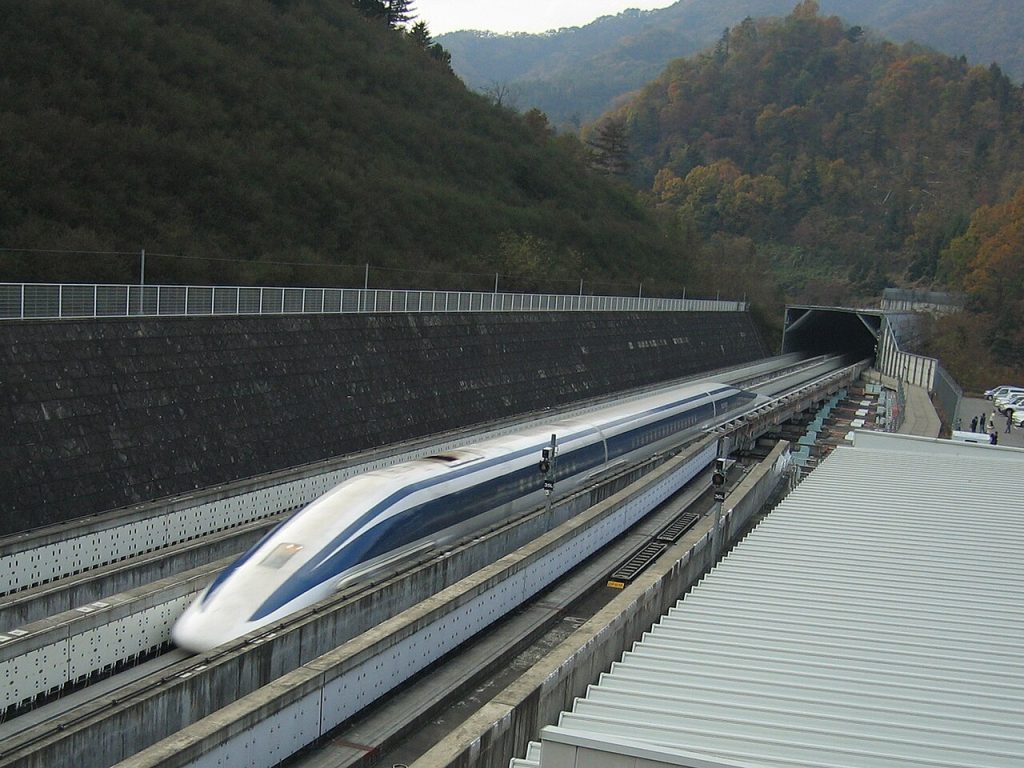
Maglev (short for Magnetic Levitation) is a transport technology in which trains levitate above a guideway using magnetic forces — eliminating all wheel-rail contact. With no mechanical friction in the suspension system, maglev trains can reach speeds impossible for conventional rail: the current world record stands at 603 km/h, set by Japan’s SCMaglev L0 series in 2015. Two main systems exist: EMS (Electromagnetic Suspension, used by Germany’s Transrapid and China’s Shanghai Maglev) and EDS (Electrodynamic Suspension, used by Japan’s Chuo Shinkansen). Today, five commercial maglev lines operate worldwide, with Japan’s 286 km Chuo Shinkansen under construction as the largest maglev project ever built.
What Does Maglev Mean?
Maglev is a portmanteau of Magnetic Levitation. It describes any transportation system in which a vehicle is lifted, guided, and propelled using electromagnetic forces rather than mechanical contact with a surface. Unlike conventional trains — which rely on steel wheels rolling on steel rails — a maglev vehicle floats above its guideway, held in place by precisely controlled magnetic fields.
The concept was first patented in 1902 by American engineer Alfred Zehden, but practical maglev systems only became feasible with the development of powerful electromagnets and high-speed power electronics in the second half of the 20th century. Today, maglev represents the highest-speed land transport technology available — and the leading candidate for the next generation of ultra-high-speed rail.
How Does Maglev Work? The Physics Explained
All maglev systems rely on three electromagnetic functions working simultaneously:
- Levitation — Magnetic forces lift the vehicle clear of the guideway, eliminating wheel-rail contact and the friction and wear that comes with it.
- Guidance — Lateral magnetic forces keep the vehicle centred on the guideway, preventing it from drifting sideways.
- Propulsion — A linear induction motor (LIM) or linear synchronous motor (LSM) drives the vehicle forward. In most maglev systems, the propulsion coils are embedded in the guideway rather than the vehicle.
The specific way in which levitation is achieved defines the two principal maglev technologies: EMS and EDS.
EMS vs EDS: The Two Main Maglev Technologies
| Feature | EMS — Electromagnetic Suspension | EDS — Electrodynamic Suspension |
|---|---|---|
| Principle | Attractive force — electromagnets on the underside of the train attract upward toward a ferromagnetic rail on the guideway | Repulsive force — superconducting magnets on the train induce currents in guideway coils, creating a repulsive upward field |
| Levitation gap | Small — typically 8–10 mm. Requires continuous active control to maintain stability | Large — typically 100–150 mm. Inherently more stable once levitated |
| Minimum speed | Can levitate at any speed, including standstill | Requires approximately 150 km/h before levitation begins — wheels used at low speed |
| Temperature | Room temperature electromagnets — no special cooling required | Superconducting magnets cooled with liquid helium (−269°C) or liquid nitrogen (HTS systems) |
| Max speed achieved | 501 km/h (Transrapid, Germany test track, 2003) | 603 km/h (JR Central L0 series, Japan, 2015) |
| Commercial examples | Shanghai Maglev (Transrapid TR08), Changsha Maglev, Beijing S1 Line | Chuo Shinkansen (JR Central L0 series — under construction) |
| Key challenge | Active control system complexity — small gap requires constant adjustment | Cryogenic cooling system maintenance and cost |
A Third Type: High-Temperature Superconducting (HTS) Maglev
A newer variant — HTS Maglev — uses high-temperature superconducting materials that require only liquid nitrogen cooling (−196°C) rather than the liquid helium needed for conventional EDS systems. This dramatically reduces operating costs. China has been a leader in HTS development: Southwest Jiaotong University has operated an HTS maglev test vehicle since 2000, and CRRC’s T-Flight project is developing HTS maglev for potential speeds exceeding 600 km/h in a low-pressure tube environment.
Maglev Speed Records
| Speed | Vehicle | System | Date | Status |
|---|---|---|---|---|
| 603 km/h | JR Central L0 Series | SCMaglev (EDS), Japan | April 2015 | World Record 🏅 |
| 581 km/h | JR Central MLX01 | SCMaglev (EDS), Japan | December 2003 | Previous record |
| 501 km/h | Transrapid TR09 | EMS, Germany (Emsland test track) | November 2003 | EMS record |
| 430 km/h | Transrapid TR08 | EMS (Shanghai Maglev, commercial) | Since 2004 | Operational max |
Operational Maglev Lines Around the World
| Line | Country | System | Length | Max Speed | Opened |
|---|---|---|---|---|---|
| Shanghai Maglev | China 🇨🇳 | Transrapid TR08 (EMS) | 30.5 km | 430 km/h | 2004 |
| Linimo (Tobu Kyuryo Line) | Japan 🇯🇵 | HSST (EMS, urban) | 8.9 km | 100 km/h | 2005 |
| Incheon Airport Maglev | South Korea 🇰🇷 | UTM-02 (EMS, urban) | 6.1 km | 110 km/h | 2016 |
| Changsha Maglev Express | China 🇨🇳 | CRRC (EMS, medium-speed) | 18.5 km | 120 km/h | 2016 |
| Beijing S1 Line | China 🇨🇳 | CRRC medium-speed EMS | 10.2 km | 120 km/h | 2017 |
Maglev vs High Speed Rail: What is the Difference?
| Feature | Maglev | High Speed Rail (HSR) |
|---|---|---|
| Contact with guideway | None — magnetically levitated | Steel wheels on steel rail |
| Top commercial speed | 430 km/h (Shanghai Maglev) | 320 km/h (China HSR, TGV) |
| Infrastructure cost | Very high — bespoke guideways, incompatible with existing rail | High, but shared infrastructure possible in some cases |
| Interoperability | None — maglev vehicles cannot use conventional rail lines | Limited — some HSR vehicles can use conventional tracks at lower speed |
| Wheel/rail wear | Zero — no mechanical contact | Significant at high speeds — regular rail and wheel maintenance required |
| Noise at speed | Lower mechanical noise — aerodynamic noise dominates above 200 km/h | Wheel-rail noise significant below 300 km/h, aerodynamic above |
| Network maturity | 5 commercial lines worldwide (2026) | 50,000+ km of HSR globally |
The Future of Maglev: Chuo Shinkansen and Beyond
Chuo Shinkansen — Japan’s SCMaglev Megaproject
The most significant maglev project currently under construction is Japan’s Chuo Shinkansen, operated by JR Central. The line will connect Tokyo (Shinagawa) and Nagoya over 286 km using SCMaglev (EDS superconducting) technology, with a planned operational speed of 505 km/h — making it the fastest commercial rail service in history. The project has faced delays due to environmental opposition in Shizuoka Prefecture, with the Tokyo–Nagoya opening now targeted for the early 2030s. An extension to Osaka is planned for completion around 2037.
The Chuo Shinkansen will use the L0 Series trainsets — the same vehicles that set the 603 km/h world speed record in 2015. The fully underground route through the Japanese Alps represents an extraordinary feat of civil engineering, with approximately 86% of the line running through tunnels.
China’s HTS Maglev Programme
China is pursuing maglev development on multiple fronts. Beyond its operational medium-speed maglev lines, CRRC’s T-Flight project is developing a high-temperature superconducting maglev system intended for operation in a low-pressure tube — a concept similar to Hyperloop. Test runs have reportedly reached speeds exceeding 600 km/h in controlled conditions. If commercialised, this technology could theoretically support speeds of 1,000 km/h or above.
Maglev and Hyperloop
Many Hyperloop concepts use maglev principles for levitation and propulsion, combined with a near-vacuum tube to eliminate aerodynamic drag — the primary limiting factor for land speed above 400 km/h. While no commercial Hyperloop system is in operation as of 2026, the underlying maglev technology is proven; the engineering challenge is the tube infrastructure and the pressurisation systems required to maintain a near-vacuum at scale.
Advantages and Disadvantages of Maglev
| ✅ Advantages | ❌ Disadvantages |
|---|---|
| No wheel-rail contact — zero mechanical friction in suspension | Extremely high infrastructure cost — guideways are purpose-built and expensive |
| Higher maximum speeds than conventional rail | No interoperability with existing rail networks |
| Lower mechanical maintenance (no wheels, axles, or rail to maintain) | High energy consumption, particularly at speeds above 400 km/h |
| Smoother ride — no track irregularities transmitted to passengers | EDS systems require cryogenic cooling — complex and expensive to maintain |
| Lower wheel-rail noise — aerodynamic noise only above 200 km/h | Very limited global network — stations and routes are isolated islands |
| Grades of up to 10% possible — less sensitive to topology than HSR | Transition sections (where vehicles move between maglev and conventional infrastructure) are technically complex |
Frequently Asked Questions (FAQ)
1. What is the fastest maglev train in the world?
The fastest maglev train is the JR Central L0 Series SCMaglev, which set a world land speed record of 603 km/h on April 21, 2015, during an unmanned test run on the Yamanashi Maglev Test Line in Japan. The fastest operational (passenger-carrying) maglev is the Shanghai Maglev, which reaches 430 km/h in regular commercial service — making it the fastest commercial train of any type in the world.
2. Why don’t more countries have maglev trains?
The primary barrier is cost. Maglev guideways are significantly more expensive to build than conventional high-speed rail track, and maglev vehicles cannot share existing rail infrastructure. For most countries, investing in proven high-speed rail technology offers a better return on investment — especially given that HSR already connects to existing networks. Maglev makes most economic sense on dense, high-demand corridors where the speed advantage over HSR justifies the premium infrastructure cost.
3. Is maglev safer than conventional trains?
Maglev has an excellent safety record. The absence of wheel-rail contact eliminates derailment risks caused by rail fractures or wheel failures — among the most common causes of high-speed rail accidents. Maglev vehicles also have no conventional axles or bogies that can fail mechanically. However, maglev systems are not immune to accidents: a fatal crash occurred on the Transrapid test track in Germany in 2006, involving a maintenance vehicle that had not been cleared from the line — a human operational error rather than a maglev-specific technical failure.
4. What is the difference between maglev and Hyperloop?
Most Hyperloop concepts use maglev principles for levitation and propulsion — so Hyperloop is, in a sense, a type of maglev. The critical difference is the operating environment: conventional maglev runs in open air, while Hyperloop operates inside a near-vacuum tube. Removing air resistance allows theoretical speeds of 1,000 km/h or above, whereas aerodynamic drag limits open-air maglev to practical speeds of around 600–700 km/h. As of 2026, no commercial Hyperloop system is in operation, while conventional maglev has been carrying passengers since 2004.
5. When will the Chuo Shinkansen maglev open?
The Chuo Shinkansen’s Tokyo–Nagoya section has faced significant delays due to environmental opposition in Shizuoka Prefecture, where tunnelling work has been contested over concerns about its impact on local water resources. As of 2026, JR Central has not confirmed a definitive revised opening date, with estimates ranging from the early 2030s. The Tokyo–Osaka extension remains targeted for completion around 2037, though this schedule is contingent on resolving the Shizuoka impasse.
📖 RELATED READING — FASTEST TRAINS & HIGH SPEED RAIL
🚅
Top 10 Fastest Trains in the World (2026 Speed Rankings)
Full speed rankings including maglev, Shinkansen, TGV and HSR — with technical specs, routes and current records.
📌 Editor note: Add TechArticle + FAQPage JSON-LD schema to <head> after publishing.

Railway infrastructure, rolling stock and transport technologies specialist focused on global rail industry developments, high-speed rail systems, signaling technologies and freight transportation. Covering railway investments, public transport modernization, rail operations and international mobility projects across Europe, Asia and North America.
RELATED POSTS

October 1, 2026 7:09 am
United States regulators confirmed a September 30 deadline for the...

October 8, 2026 1:15 pm
Alstom secured a €1bn contract to build 13 automated trains,...

October 4, 2026 5:14 pm
Alstom secured a CA$4.7 billion order from VIA Rail Canada...

October 1, 2026 12:13 am
Illinois approved $1.5 billion annually for the Northern Illinois Transit...

October 6, 2026 2:14 am
Union Pacific launched export rail shipments with Ferromex to deliver...

October 1, 2026 6:10 am
Amtrak approved a System Expansion Committee on July 30 to...