
What is a Hydrogen Train (Hydrail)?
What is a Hydrogen Train (Hydrail)? Comparing Hydrogen Fuel Cells vs. Diesel and Electric trains. Advantages, range, and the future of zero-emission rail.
⚡ In Brief
- A hydrogen train generates its traction electricity onboard using a hydrogen fuel cell — combining stored hydrogen with atmospheric oxygen in an electrochemical reaction that produces electricity, heat, and water vapour as the only exhaust.
- Hydrogen trains are the primary technology candidate for decarbonising non-electrified regional railway lines where the capital cost of overhead electrification (€1–3 million per km) is not justified by traffic levels.
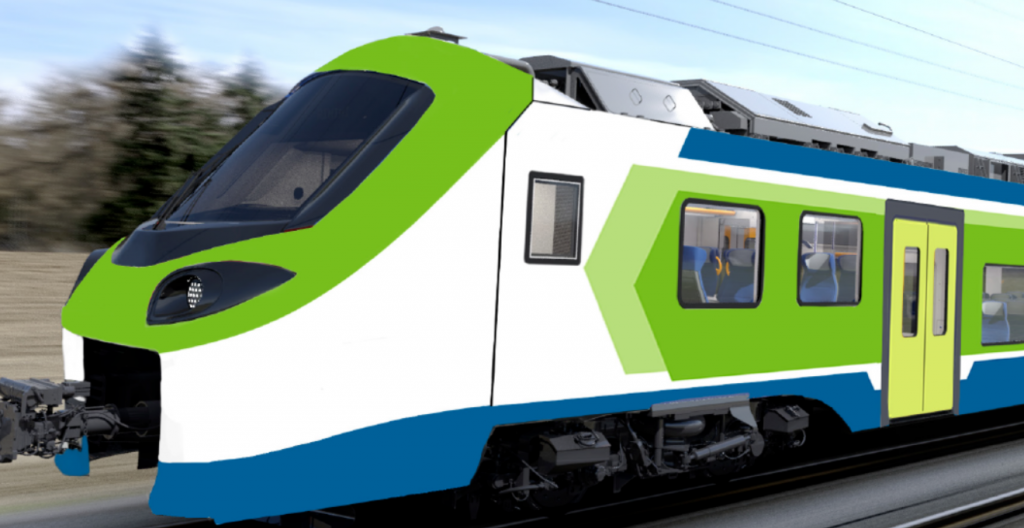
- The Alstom Coradia iLint, which entered passenger service in Germany in 2018 as the world’s first hydrogen passenger train, achieved a range of over 1,000 km on a single fill and is now operating commercially on several German regional routes.
- The fundamental efficiency disadvantage of hydrogen versus direct electrification is significant: well-to-wheel efficiency for green hydrogen is approximately 25–35%, compared to 70–80% for catenary electric. This means roughly three times as much renewable electricity is required to move the same train the same distance.
- As of 2025–2026, several hydrogen rail programmes that appeared commercially promising — including UK’s HydroFLEX, California’s Hydrogen Train pilot, and several German fleet expansions — have been scaled back, paused, or cancelled, raising questions about hydrogen’s near-term commercial viability against battery-electric alternatives.
On 16 September 2018, two Alstom Coradia iLint hydrogen trains began carrying fare-paying passengers between Cuxhaven and Buxtehude in Lower Saxony, Germany — replacing diesel multiple units on a 100 km non-electrified regional route. The trains emitted nothing but water vapour. They ran quietly. They operated on schedule. For a technology that had been described as a “fuel cell laboratory on rails” just five years earlier, it was a genuine commercial milestone.
Six years later, the picture is more complicated. Germany has deployed 41 iLint trains in service but has also published studies concluding that battery-electric trains are cheaper per kilometre on most of the routes originally planned for hydrogen. The UK’s flagship hydrogen train project was paused. Several planned fleet orders have been deferred or converted to battery specification. Hydrogen trains exist, work, and carry passengers — but whether they represent the future of non-electrified rail or an expensive transitional technology that battery trains will ultimately displace is a genuinely open question in 2026.
How a Hydrogen Train Works
A hydrogen train is fundamentally an electric train — it uses electric traction motors to drive the wheels, exactly like any EMU. The difference is how the electricity is generated onboard:
| Stage | What Happens | Engineering Detail |
|---|---|---|
| 1. Hydrogen storage | Compressed hydrogen stored in roof-mounted tanks | 350–700 bar pressure; carbon-fibre composite tanks; iLint carries ~90 kg H₂ |
| 2. Fuel cell reaction | H₂ + ½O₂ → H₂O + electricity + heat | PEM (Proton Exchange Membrane) fuel cell stack; ~50–60% efficient at cell level |
| 3. Power conditioning | DC output from fuel cell regulated by DC-DC converter to traction bus voltage | Fuel cell output varies with load; converter maintains stable traction voltage |
| 4. Battery buffer | Li-ion battery provides peak power for acceleration; stores regenerative braking energy | Fuel cell optimised for steady-state; battery handles transient demand spikes |
| 5. Traction motors | Combined fuel cell + battery power drives inverters and traction motors | Identical drivetrain to battery or EMU — only the energy source differs |
| 6. Exhaust | Water vapour released from roof exhaust vents | Zero CO₂, zero NOx, zero particulates; water sometimes visible as steam plume |
Hydrogen vs Diesel vs Battery vs Catenary: Full Comparison
| Parameter | Hydrogen (FCEMU) | Battery (BEMU) | Diesel (DMU) | Catenary Electric (EMU) |
|---|---|---|---|---|
| Point-of-use emissions | Zero (water only) | Zero | High CO₂, NOx, particulates | Zero (at vehicle) |
| Well-to-wheel efficiency (green) | ~25–35% | ~70–80% | ~30–35% | ~80–90% |
| Typical range | 800–1,200 km | 80–300 km (on battery only) | 800–1,500 km | Unlimited |
| Refuel / recharge time | 15–30 minutes | 30–120 minutes (depot); partial on-route | 15–30 minutes | Instantaneous (continuous supply) |
| Infrastructure required | H₂ refuelling stations (~€2–5M each) | Charging points at depots; optional en-route top-up | Fuel depot (widely available) | Overhead line / third rail (€1–3M/km) |
| Vehicle cost premium vs diesel | ~50–100% higher | ~20–50% higher | Baseline | ~10–30% higher (but no fuel cost) |
| Fuel cell / battery lifespan | Fuel cell stack: ~30,000–50,000 hours (replacement needed) | Battery pack: 10–15 years (degradation) | Engine: 30+ years | No fuel cell or battery lifecycle issue |
| Best application | Long non-electrified regional routes (>150 km); high daily mileage | Short–medium non-electrified routes; mixed electrified/non-electrified | Legacy operations; low-frequency rural lines | High-frequency mainlines and metros |
The Hydrogen Colour Code: Green, Blue, Grey
Whether a hydrogen train is truly zero-emission depends entirely on how the hydrogen was produced. Hydrogen is colourless, but the industry uses a colour classification to describe its production method and associated carbon footprint:
| Colour | Production Method | Carbon Footprint | Current Share |
|---|---|---|---|
| Grey hydrogen | Steam methane reforming (SMR) of natural gas — no CCS | ~10 kg CO₂ per kg H₂ — worse than diesel per kWh | ~95% of global production |
| Blue hydrogen | SMR of natural gas with carbon capture and storage (CCS) | ~2–4 kg CO₂ per kg H₂ (depending on CCS capture rate) | <1% of production |
| Green hydrogen | Electrolysis of water using renewable electricity | Near-zero lifecycle (depends on grid carbon intensity) | <1% of production (but growing rapidly) |
In 2025–2026, virtually all hydrogen available at commercially viable prices is grey hydrogen. Green hydrogen — the version that makes hydrogen trains genuinely zero-emission — costs 3–5 times more than grey hydrogen and requires dedicated renewable-powered electrolysis capacity that does not yet exist at rail-relevant scale in most markets. This gap between the narrative (“zero emission trains”) and the reality (“trains powered by natural gas reforming”) is one of the primary criticisms of hydrogen rail deployments that claim environmental credentials without specifying hydrogen source.
Current Hydrogen Train Deployments (2025–2026)
| Train / Operator | Country | Fleet | Status | Notes |
|---|---|---|---|---|
| Alstom Coradia iLint / evolis H₂ | Germany | 41 trains | In service (Lower Saxony, Hesse) | World’s first passenger hydrogen fleet; further expansion paused as battery costs fall |
| Siemens Mireo Plus H | Germany / Austria | Trials ongoing | Test operations; limited commercial deployment | Pre-series testing on Bavarian routes |
| Stadler FLIRT H₂ | USA (San Bernardino) | 5 trains ordered | Delivery and commissioning phase | First hydrogen passenger trains in USA |
| Alstom iLint / SNCF | France | 12 trains (planned) | Order deferred; review ongoing | France shifted priority toward battery bi-mode |
| Porterbrook HydroFLEX (UK) | United Kingdom | 1 prototype | Development paused | Programme placed on hold; uncertainty over UK fleet strategy |
| CRRC hydrogen DMU | China | Multiple prototype / trial | Trials on several routes | China pursuing hydrogen alongside battery on non-electrified lines |
The Efficiency Problem: Why Hydrogen Loses to Batteries on Energy Grounds
The well-to-wheel energy efficiency comparison between hydrogen and battery-electric trains is one of the most important — and most frequently misunderstood — aspects of the hydrogen rail debate. The chain of energy conversions required to move a hydrogen train is longer than for a battery train, and each conversion step loses energy:
Green hydrogen path: Renewable electricity → electrolysis (70% efficient) → compression / liquefaction (85% efficient) → transport → fuel cell (55% efficient) → traction motor (95% efficient) = ~31% overall
Battery-electric path: Renewable electricity → grid transmission (95%) → charging (92%) → battery storage (97%) → traction motor (95%) = ~81% overall
This means that to move the same train the same distance, the hydrogen route requires approximately 2.5–3 times as much renewable electricity as the battery-electric route. In a world of constrained renewable energy capacity and high electricity prices, this is a significant economic and environmental disadvantage.
Where Hydrogen Wins: The Range and Refuelling Argument
Despite the efficiency disadvantage, hydrogen maintains genuine advantages over batteries in specific operational contexts:
Long-range non-electrified routes: Battery trains operating in pure battery mode are typically limited to 80–200 km between charges. On long non-electrified regional routes (300–1,000 km), hydrogen trains with 800+ km range can operate full diagrams without the mid-route charging infrastructure that battery trains would require. The Alstom iLint’s 1,000 km range on a single fill enables it to complete a full day’s service on rural regional routes without returning to depot.
Refuelling speed: Hydrogen refuelling takes 15–30 minutes — comparable to diesel. Battery charging at the current technology level takes 30–120 minutes for a significant state-of-charge recovery. For trains with tight turnaround times at terminus stations, this difference can determine whether the operational diagram is achievable.
Extreme cold: Lithium-ion battery capacity degrades significantly in very cold conditions (below −20°C). Hydrogen fuel cells are less affected by temperature extremes, making hydrogen potentially more viable for Arctic or high-altitude operations where battery performance is compromised.
Editor’s Analysis
The hydrogen train story in 2026 is a study in the distance between narrative and economics. The narrative — zero-emission trains replacing diesel on rural routes, powered by green hydrogen from renewable electricity — is compelling and technically coherent. The economics in 2026 are not. Green hydrogen costs €6–12 per kg at the point of delivery, compared to diesel at a heat-equivalent cost of €2–3 per kg. The efficiency penalty of hydrogen versus batteries means three times as much renewable electricity is needed per train-km. Battery train costs have fallen faster than hydrogen system costs. Several operators who ordered hydrogen trains in 2020–2022, when battery range was more limited and battery costs higher, are now re-evaluating as battery technology has improved. This does not mean hydrogen trains have no future in rail — long-distance regional routes, extreme climates, and high daily mileage operations may still favour hydrogen when green hydrogen production reaches cost-competitive scale. But the window in which hydrogen was the only credible zero-emission option for non-electrified rail has narrowed significantly as battery energy density has improved. The likely outcome is a market segmentation: batteries for routes up to 200–300 km of non-electrified operation, hydrogen for the longer-range cases — which turn out to be a smaller share of the non-electrified network than the early hydrogen optimists projected. The environmental case for either technology depends entirely on the carbon intensity of the electricity supply. A hydrogen train running on grey hydrogen is not a zero-emission train — it is a natural-gas train with extra steps. — Railway News Editorial
Frequently Asked Questions
- Q: Is a hydrogen train the same as a hydrogen-powered train?
- Yes — a hydrogen train (also called a fuel cell EMU or FCEMU) uses hydrogen as its energy carrier and converts it to electricity via a fuel cell to power electric traction motors. It is not a train with a hydrogen combustion engine (though hydrogen combustion locomotives have been explored, they are less common). The term “hydrogen-powered” is sometimes used loosely to include trains that use hydrogen as a combustion fuel rather than in a fuel cell, but in current railway applications, fuel cell technology is the standard approach.
- Q: Is hydrogen safe to store on a passenger train?
- Hydrogen storage on railway vehicles has been certified to very high safety standards, including crash testing and fire resistance. The tanks — carbon-fibre reinforced composite cylinders at 350–700 bar pressure — are designed to survive severe impact without catastrophic failure. Hydrogen’s physical properties provide some inherent safety advantages: it is 14 times lighter than air and disperses rapidly upward when released, rather than pooling at ground level like diesel or LPG. However, hydrogen’s flammability range (4–75% in air, compared to 1.4–7.6% for petrol vapour) and very low ignition energy mean that any leak that does ignite can burn across a wide concentration range. The safety record of the Alstom iLint fleet in commercial service since 2018 — with no hydrogen-related incidents — supports the conclusion that the technology can be operated safely with appropriate engineering and maintenance standards.
- Q: Why is the efficiency of hydrogen so much lower than battery-electric?
- Every energy conversion step loses some energy as heat. To produce green hydrogen, renewable electricity is used to split water molecules via electrolysis — a process that is approximately 65–75% efficient. The hydrogen is then compressed to 350–700 bar for storage, consuming more energy. At the vehicle, the fuel cell converts hydrogen back to electricity at approximately 50–60% efficiency. Each step multiplies the losses: by the time electricity from a wind farm has been converted to hydrogen, compressed, transported, and converted back to electricity in the fuel cell, roughly 65–75% of the original electrical energy has been lost. A battery-electric train using the same wind farm electricity directly, via grid transmission and battery charging, loses only 15–25% of the original energy. This is a fundamental thermodynamic characteristic of hydrogen as an energy carrier — it is not a failure of current technology but a consequence of the chemistry involved in producing and reconverting hydrogen.
- Q: What routes are most suitable for hydrogen trains?
- Hydrogen trains are best suited to non-electrified routes that are too long for battery-only operation, too lightly trafficked to justify electrification, and where daily mileage is high enough to make the refuelling infrastructure economically viable. Routes of 150–600 km of continuous non-electrified operation, with clear terminus points where refuelling infrastructure can be installed, represent the primary use case. German regional lines in Lower Saxony, rural routes in France and the UK, and branch lines in Australia and the USA have all been studied as hydrogen-appropriate corridors. Routes where existing charging infrastructure can support battery top-up en route — including at stations with dwell time — are increasingly better served by battery technology, narrowing the addressable market for pure hydrogen solutions.
- Q: How does a hydrogen train compare to a bi-mode train for replacing diesel?
- A bi-mode train carries both electric and diesel (or battery) propulsion, switching between them depending on whether the route section is electrified. A hydrogen train carries only hydrogen-electric propulsion and operates the same way regardless of electrification. The bi-mode approach has the advantage of leveraging existing electrified infrastructure for the majority of the route and using the alternative power source only where electrification is absent — minimising both energy cost and emissions on electrified sections. The disadvantage is that the vehicle carries the weight and cost of two powertrain systems. For routes that are predominantly electrified with limited non-electrified sections, bi-mode (catenary + battery) is generally more efficient than hydrogen. For routes that are entirely or predominantly non-electrified, hydrogen or battery-only approaches are more appropriate than bi-mode.

Railway infrastructure, rolling stock and transport technologies specialist focused on global rail industry developments, high-speed rail systems, signaling technologies and freight transportation. Covering railway investments, public transport modernization, rail operations and international mobility projects across Europe, Asia and North America.
RELATED POSTS

October 8, 2026 1:15 pm
Alstom secured a €1bn contract to build 13 automated trains,...

October 1, 2026 7:09 am
United States regulators confirmed a September 30 deadline for the...

October 8, 2026 12:18 pm
Siemens Mobility signed an agreement with VinSpeed to supply 350...

October 4, 2026 5:14 pm
Alstom secured a CA$4.7 billion order from VIA Rail Canada...

October 5, 2026 6:12 pm
AECOM and Jacobs secured a contract in September 2026 to...

October 1, 2026 12:13 am
Illinois approved $1.5 billion annually for the Northern Illinois Transit...