
The Vertical Revolution: Double Stack Rail Transport Explained
Maximize freight efficiency with Double Stack rail. Discover how stacking containers vertically doubles train capacity and why infrastructure limits its global adoption.
⚡ In Brief
- Double-stack nearly halves the cost per container-mile compared to single-stack on the same route: When a locomotive hauls two containers for the traction energy required to haul one — because the locomotive, crew, and infrastructure costs are essentially fixed per train regardless of how many containers are aboard — the cost per container falls by approximately 40–45%. On a 2,800 km Los Angeles–Chicago corridor where a single-stack train might carry 200 containers at a fully-loaded cost of $1,800 per container, a double-stack train carries 400 containers at approximately $1,000 per container — a cost reduction that cannot be achieved by any other single operational change. This economics is the reason that every major North American Class I railroad converts every feasible line segment to double-stack clearance: the return on infrastructure investment is among the highest available in railway capital allocation.
- The well car’s central trough reduces combined stack height by approximately 760–900 mm compared to a flat car carrying the same two containers: A standard flat car has its floor approximately 1,200 mm above the top of rail. Two high-cube containers (each 2,896 mm tall) stacked on it would reach 1,200 + 2,896 + 2,896 = 6,992 mm — nearly 7 metres. The well car’s depressed centre section positions the bottom container floor approximately 350–400 mm above rail, reducing the combined stack height to 350 + 2,896 + 2,896 = 6,142 mm. That 850 mm reduction is the difference between “cannot clear most North American tunnels” and “fits within AAR Plate H clearance on cleared routes” — the infrastructure investment decision that determines whether double-stack is physically possible on a given route.
- India’s Dedicated Freight Corridor (DFCC) is the only electrified double-stack railway built from new in the 21st century: Opened progressively from 2021, the DFCC’s Western Corridor (Mumbai–Delhi, 1,504 km) and Eastern Corridor (Ludhiana–Kolkata, 1,856 km) are purpose-built for double-stack container trains under 25 kV AC electrification, with a pantograph-to-container clearance above the top container managed through a specially designed pantograph with extended reach (5.5 m pantograph height versus the standard 5.0 m) and an overhead wire height of 7.45 m at minimum (compared to 5.3–5.8 m on conventional Indian railways). The DFCC’s double-stack capability on an electrified network resolves the apparent contradiction that “double-stack needs diesel traction” — it requires non-standard OCS geometry, but it is technically achievable on electrified infrastructure with purpose-built design.
- The articulated five-unit well car set is the standard North American double-stack wagon: Rather than discrete individual wagons each with two bogies, North American double-stack cars are manufactured as articulated sets of 3, 5, or 10 units sharing bogies at the junctions — a Jacobs-type arrangement applied to freight wagons. The standard 5-unit articulated well car set (manufactured by TTX Company, Gunderson, and others) is approximately 84 m long, carries 5 pairs of 40 ft containers or 5 × 53 ft containers in the well plus 5 containers on top (10 containers total per set), and weighs approximately 50 tonnes tare carrying up to 320 tonnes payload. Articulation reduces the total bogie count from 12 (for 5 independent cars) to 6, reducing tare weight by approximately 15% and improving ride quality by reducing the number of wheel-rail impact points per train length.
- The Sunset Route clearance project (UP/Southern Pacific, 1984–1992) was the largest single infrastructure investment ever made specifically to enable double-stack operations: Southern Pacific Railroad’s Los Angeles–New Orleans main line — a critical artery for Pacific Coast–Gulf Coast freight — had numerous tunnels and structures that could not accommodate the 6.1 m height of double-stack trains. Between 1984 and 1992, SP (later merged with UP) spent approximately $490 million enlarging or bypassing 32 tunnels, raising 58 bridges, relocating overhead structures, and regrading trackside equipment along the 3,000 km route. The investment returned its capital cost within approximately 7 years through increased revenue from the expanded container traffic that double-stack enabled — a return-on-investment calculation that has been replicated, with local variations, on every subsequent double-stack clearance programme.
The Southern Pacific Railroad’s general freight manager, R.J. Bandeen, was in a difficult meeting with the senior management of Sea-Land Service — the container shipping company founded by Malcom McLean that had effectively created the global containerisation industry — in the autumn of 1977. Sea-Land had an unusual proposal. They wanted to stack their containers two high on SP’s flatcars for the transcontinental service between the Ports of Los Angeles and Long Beach and the Midwest. Bandeen’s initial response was the one that any railwayman with a working knowledge of his network’s clearance constraints would give: the idea was technically impossible on SP’s existing infrastructure. The tunnels were too low. The overhead structures were too close. The bridges had insufficient clearance. Stacking containers two high would create a vehicle 6 metres tall at a time when SP’s most generous clearance was approximately 5.8 metres at scattered locations and considerably less through many tunnels. What Bandeen did not say — what he perhaps could not yet see — was what Sea-Land’s managers already understood from their shipping operations: that if you put twice as many containers on a train, the economics become transformative, and the transformation is so large that it justifies rebuilding the infrastructure that currently prevents it. The result was the first double-stack test run, conducted on a cleared section of SP’s Sunset Route on 11 November 1977, with two Sea-Land containers stacked on an SP flatcar equipped with a specially fabricated corner post frame. The run was technically successful. SP’s chief engineer concluded from the test data that systematic clearance modification was feasible. The subsequent 15-year, $490 million programme that rebuilt the Sunset Route for double-stack clearance became the template for every similar investment across North America’s Class I railroad network — and the origin point of what is now the most cargo-efficient land freight technology in operation anywhere on earth.
What Is Double-Stack Rail Transport?
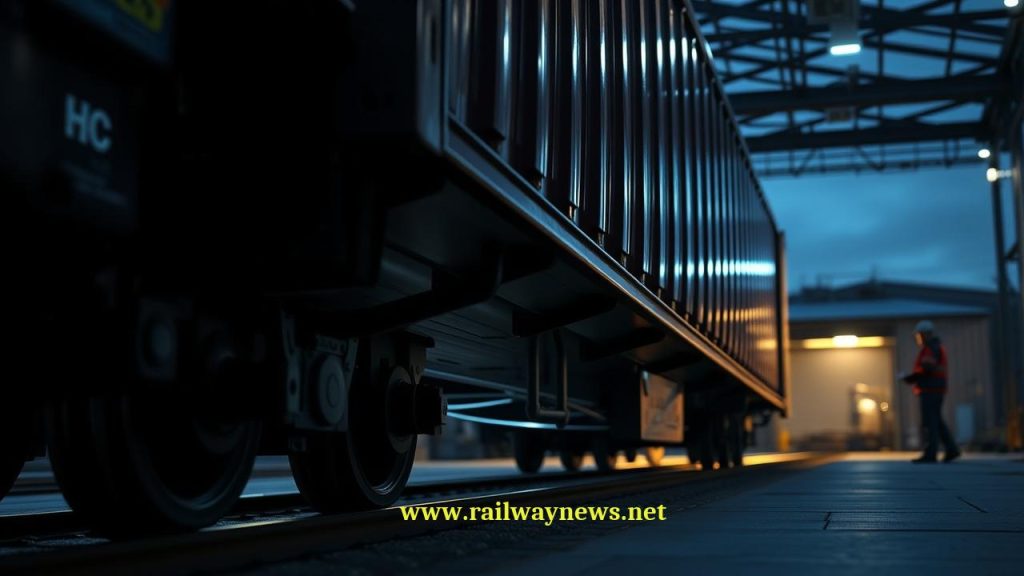
Double-stack rail transport is the operation of intermodal freight trains in which two ISO containers are stacked vertically on each wagon position — the lower container resting in the wagon’s depressed centre section (the “well”) and the upper container resting on the lower container’s top, secured by ISO corner casting twist-locks. The combined train height of approximately 6.1 m (for high-cube 9 ft 6 in containers, the dominant container type in deep-sea shipping) requires railway infrastructure with clearances of at least 6.5–7.0 m above the top of rail — clearances that are available throughout North America’s Class I freight network on cleared routes, exist on India’s purpose-built Dedicated Freight Corridor, are being developed on selected Chinese routes, and are physically impossible on most of Europe’s and Japan’s legacy railway infrastructure without wholesale reconstruction.
The well car (also called a double-stack car or intermodal well car) is the purpose-designed wagon that makes double-stack possible: its depressed centre section (“well”) lowers the bottom container floor to approximately 350–400 mm above the rail, reducing the combined stack height by 800–900 mm compared to a standard flat car. The wagon’s structural design must transfer the combined vertical loads of two laden containers (up to 32,000 kg per container × 2 = 64,000 kg plus wagon tare) through the well structure to the bogies, while maintaining the well’s lateral and torsional stiffness under the dynamic loads of freight train operation.
The Height Arithmetic: Why the Well Car Enables What the Flat Car Cannot
Double-stack height budget — well car vs flat car:
Standard flat car floor height above top of rail: 1,200 mm
Lower container (ISO 40 ft high-cube): height = 2,896 mm
Upper container (ISO 40 ft high-cube): height = 2,896 mm
Double-stack on flat car:
Total height = 1,200 + 2,896 + 2,896 = 6,992 mm ≈ 7.0 m
Well car floor height (bottom of well) above rail: 355 mm
Double-stack on well car:
Total height = 355 + 2,896 + 2,896 = 6,147 mm ≈ 6.15 m
Saving from well: 6,992 − 6,147 = 845 mm
North American clearances (AAR):
Plate F (intermodal cleared routes): 7,010 mm ✓ (single-stack)
Plate H (double-stack cleared routes): 7,213 mm ✓
Well car double-stack at 6,147 mm: fits within both ✓
European clearances (UIC):
GB gauge (maximum freight gauge): 4,650 mm
Well car double-stack at 6,147 mm: EXCEEDS by 1,497 mm ✗
→ Double-stack physically impossible in Europe without total infrastructure rebuild
Indian DFCC clearance (purpose-built):
Minimum overhead wire height: 7,450 mm
Pantograph raised height: 6,850 mm (with 600 mm clearance)
Well car double-stack at 6,147 mm: fits ✓
(600 mm pantograph-to-container gap maintained at 6,147 mm height + 100 mm sway)
Why standard India is impossible but DFCC works:
Existing Indian railway OCS height: 5,500 mm
Well car double-stack at 6,147 mm: EXCEEDS by 647 mm ✗
→ Legacy India impossible; DFCC purpose-built → works ✓
Centre of Gravity and Stability
The second engineering concern beyond height is stability. Stacking two containers vertically raises the combined centre of gravity substantially above that of a single container — from approximately 2,100 mm above rail for a single laden container on a flat car, to approximately 4,200 mm above rail for two stacked containers on a well car. This doubled CoG height increases the overturning moment from lateral forces (wind, curve centrifugal acceleration) and reduces the track curvature at which rollover becomes a risk. The well car’s depressed centre section partially compensates by lowering the CoG: the well-car double-stack CoG at 4,200 mm is substantially lower than the flat-car double-stack CoG at approximately 4,900 mm. Nevertheless, the well-car double-stack train has more limited curve speed than equivalent single-stack trains, and AAR’s requirements for double-stack operations include maximum curving speed limits derived from the measured roll-stiffness of the laden wagon.
Centre of gravity height comparison:
Single laden ISO container on flat car:
Container CoG at mid-height: 1,200 + 2,896/2 = 1,200 + 1,448 = 2,648 mm
Double-stack on well car (both containers laden, each 20,000 kg):
Lower container CoG: 355 + 2,896/2 = 355 + 1,448 = 1,803 mm
Upper container CoG: 355 + 2,896 + 2,896/2 = 355 + 2,896 + 1,448 = 4,699 mm
Combined CoG (equal mass containers):
CoG_combined = (1,803 × 20,000 + 4,699 × 20,000) / (2 × 20,000)
= (1,803 + 4,699) / 2 = 3,251 mm above rail
Rollover threshold (simplified, for a wagon of 2.5 m track width):
Lateral acceleration limit for rollover ≈ g × (half_track_width / CoG_height)
Single container: a_rollover = 9.81 × (1,250 / 2,648) = 4.63 m/s²
Double-stack: a_rollover = 9.81 × (1,250 / 3,251) = 3.77 m/s²
→ Double-stack wagon rolls over at 18% lower lateral acceleration
→ Maximum speed through an R = 1,000 m curve (approximate):
Single: v_max = √(a × R) = √(4.63 × 1,000) = 68 m/s = 245 km/h
Double: v_max = √(3.77 × 1,000) = 61 m/s = 221 km/h
(In practice, freight trains are limited to 120 km/h max; both within limits)
The Economics of Double-Stack: Why the Numbers Are Transformative
Cost Per Container-Mile: The Core Calculation
The economic case for double-stack operates through a straightforward cost allocation logic: the costs that are fixed per train (locomotive fuel, crew, track access charges, locomotive depreciation) are divided across twice as many containers when the train double-stacks versus single-stacks. On a typical Class I intermodal service, approximately 60–65% of total operating costs are “fixed per train” in this sense, with 35–40% varying with container count (terminal handling, container positioning, per-container documentation). The fixed-cost allocation benefit is therefore:
Double-stack cost savings — Los Angeles to Chicago (2,800 km):
Single-stack train: 200 containers (100 × 40 ft well cars, 1 per position)
Double-stack train: 400 containers (100 × 40 ft well cars, 2 per position)
Fixed costs per train (locomotive, fuel, crew, track, insurance):
Estimated: $120,000 per LA–Chicago intermodal run
Single-stack: $120,000 / 200 containers = $600 fixed cost per container
Double-stack: $120,000 / 400 containers = $300 fixed cost per container
Variable costs per container (terminal, documentation, positioning):
Estimated: $250 per container (same in both cases)
Total cost per container:
Single-stack: $600 + $250 = $850 per container
Double-stack: $300 + $250 = $550 per container
Cost saving: ($850 − $550) / $850 = 35% reduction per container
Revenue at competitive market rate of $700/container (example):
Single-stack profit per container: $700 − $850 = −$150 (LOSS)
Double-stack profit per container: $700 − $550 = +$150 (PROFIT)
→ At this price point, single-stack is uneconomic; double-stack is profitable
→ This arithmetic explains why Class I railroads invested billions in clearance
upgrades: double-stack made previously unprofitable intermodal routes viable.
Train Length and Payload Density
The payload density advantage of double-stack — tonnes of cargo per metre of train length — is the metric that defines its competitive position against trucking and against alternative freight modes. A double-stack train of 300 m length carrying 75 articulated 5-unit well-car sets (150 40 ft container positions × 2 containers = 300 containers × up to 28 tonnes payload = 8,400 tonnes total payload in 300 m) achieves a payload density of approximately 28 tonnes per metre of train. A comparable truck fleet carrying the same 300 containers at 20 tonnes payload per truck and 15 m per truck requires 300 trucks × 15 m = 4,500 m of road — a road convoy 15 times longer than the train carrying the same cargo. The environmental consequence of this density difference is the well-documented 3–4× fuel efficiency advantage of rail over road per tonne-km — and double-stack pushes that advantage further because the train length (and therefore fuel consumption) does not increase when containers are added vertically.
The Sunset Route Clearance Programme: How $490 Million Rebuilt an Industry
The scale of the infrastructure investment required to enable double-stack on the Southern Pacific Railroad’s Sunset Route (Los Angeles–New Orleans, approximately 3,000 km) provides the clearest quantification of the commitment required to convert an existing main line to double-stack capability. The programme, conducted between 1984 and 1992 following the 1977 test run, addressed 32 tunnels and 58 bridge structures along the route — each of which represented a clearance restriction that a 6.15 m double-stack train could not pass.
Tunnel Enlargement Techniques
Three techniques were used for the 32 tunnel obstructions, depending on the tunnel’s geometry, geology, and structural condition. For short tunnels (under 200 m) with favourable geology, open-cut bypass — simply excavating over the top of the tunnel and lowering the track through a new cut — was the cheapest solution, typically costing $2–5 million per tunnel. For long tunnels in mountain geology where bypass was impractical, concrete liner removal — chipping out the existing concrete lining from the tunnel crown and walls to create 150–300 mm of additional clearance — was used at costs of $5–15 million per tunnel, depending on length and lining thickness. For tunnels in fragile geology where any disturbance risked structural failure, track lowering — excavating the tunnel floor to lower the track by 600–900 mm while maintaining the existing roof arch — was the most expensive option at $15–30 million per tunnel, but the only one that avoided disturbing the tunnel structure. The 32 tunnel modifications collectively cost approximately $280 million of the $490 million programme total.
India’s Dedicated Freight Corridor: Double-Stack Under Wire
India’s Dedicated Freight Corridor Corporation (DFCC) — a government entity established in 2006 to build and operate new rail freight arteries separate from the congested mixed-traffic Indian Railways network — represents the first national-scale commitment to electrified double-stack rail freight in the world. The DFCC’s Western Corridor (Mumbai to Dadri/New Delhi area, 1,504 km) and Eastern Corridor (Ludhiana to Kolkata, 1,856 km) are designed to carry double-stack container trains at 100 km/h under 25 kV AC electrification — a combination never before achieved at network scale.
The OCS Height Challenge
The fundamental barrier to electrified double-stack is the overhead catenary system (OCS). On a conventional electrified railway, the contact wire height is typically 5,000–5,800 mm above the rail — below the 6,147 mm top-of-stack height of a double-stack train. Any contact between the double-stack’s upper container and the OCS would immediately destroy both the container, the OCS, and the current collection infrastructure for kilometres in each direction. The DFCC’s solution was to design the OCS from scratch with the double-stack height as the primary constraint, specifying a minimum contact wire height of 7,450 mm at the lowest point — providing 1,300 mm of clearance above the container top (and a dynamic clearance allowance of 600 mm for vehicle bounce and pantograph height variation). This OCS height of 7,450 mm is substantially higher than any electrified railway in the world prior to DFCC — requiring taller OCS masts, larger span wire tensions, and modified pantograph designs with extended reach to maintain contact at the higher wire height.
DFCC electrified double-stack clearance budget:
Double-stack top height: 6,147 mm (as calculated above)
Dynamic allowance (vehicle bounce + sway at 100 km/h): +250 mm
Construction tolerance: +50 mm
Required minimum contact wire height: 6,147 + 250 + 50 = 6,447 mm
DFCC specified minimum contact wire height: 7,450 mm
Safety clearance: 7,450 − 6,447 = 1,003 mm electrical clearance
Compare to conventional Indian Railways OCS:
Minimum contact wire height: 5,500 mm
Shortfall vs double-stack requirement: 5,500 − 6,447 = −947 mm
→ Legacy network: 947 mm short of double-stack minimum ✗
→ DFCC: 1,003 mm above double-stack minimum ✓
Pantograph specification (DFCC locomotives — WAG-12B):
Working height range: 2,000–6,850 mm
Standard pantograph max working height: ~5,500 mm
DFCC pantograph extended reach: 6,850 mm (350 mm higher than standard)
Maintains contact at wire height 7,450 mm while train at 6,147 mm + 650 mm
pantograph height above container top = 6,797 mm contact height ≈ adequate ✓
DFCC Operational Parameters and Traffic
The DFCC’s Western Corridor entered partial operation in 2021 and reached full operational status by 2023. The operational specification calls for double-stack container trains of up to 1,500 m length, hauled by WAG-12B electric locomotives (rated at 12,000 kW, the most powerful electric locomotive in India) in pairs — providing 24,000 kW for trains of up to 6,000 tonnes gross weight. At 100 km/h maximum speed, the journey time from Mumbai’s Jawaharlal Nehru Port Trust to the Dadri inland container depot near New Delhi (approximately 1,450 km) is approximately 14.5 hours — compared to 3–5 days on the congested conventional Indian Railways network. The traffic projections for DFCC target 200 million tonnes of freight per year at full capacity on the combined Western and Eastern corridors by 2030, representing a modal shift of approximately 15–20% of current highway freight on the Mumbai–Delhi and Delhi–Kolkata corridors.
Global Double-Stack Status: Who Has It, Who Is Building, Who Cannot
| Region | Status | Traction | Key Factor |
|---|---|---|---|
| USA (Class I) | Fully operational on cleared corridors | Diesel | AAR Plate H clearance achieved through 1984–2010 programmes; dominant mode for intermodal |
| Canada (CN, CP) | Fully operational on transcontinental corridors | Diesel | Generous historical mountain tunnel clearances; Vancouver–Toronto 4,400 km world’s longest double-stack route |
| India (DFCC) | Operational (Western 2021; Eastern 2022) | Electric — world’s first electrified double-stack | Purpose-built OCS at 7,450 mm; WAG-12B extended pantograph; 3,360 km combined |
| China | Limited on selected freight corridors | Electric | Selectively building double-stack clearance into new freight corridors; no systematic national programme |
| Australia | Inland Rail under construction; some existing routes cleared | Diesel | Inland Rail (Melbourne–Brisbane, 1,700 km) designed for double-stack from inception; target 2030 |
| Europe (EU27) | Not feasible on any existing route | Electric (OCS prevents double-stack) | GB gauge 4,650 mm vs double-stack requirement 6,147 mm — 1,497 mm gap; estimated rebuild cost: €2–5 trillion |
| Japan | Not feasible | Electric | Even tighter clearances than Europe; complete freight network reconstruction would be required |
Single-Stack vs Double-Stack vs Triple-Stack (Theoretical)
| Parameter | Single-Stack (Flat Car) | Double-Stack (Well Car) | Triple-Stack (Theoretical) |
|---|---|---|---|
| Containers per 300 m train | ~150 (40 ft) | ~300 (40 ft) | ~450 — hypothetical |
| Max height above rail | ~4,100 mm | ~6,150 mm | ~9,050 mm — no infrastructure exists |
| Cost per container (relative) | 100 (baseline) | ~65 (35% lower) | ~45 (if feasible) |
| Rollover threshold lateral accel. | 4.63 m/s² | 3.77 m/s² | ~2.65 m/s² — crosswind risk critical |
| Commercially operational? | Yes — worldwide | Yes — North America, India | No — not commercially proposed |
Double-Stack Operations: Key Examples
| Service / Corridor | Operator | Length | Notable Feature |
|---|---|---|---|
| Los Angeles–Chicago (Sunset Route + BNSF Transcon) | BNSF / UP | 2,800 km | World’s highest-volume double-stack corridor; 40–50 trains/day each direction; origin of 1977 test run; critical trans-Pacific supply chain link |
| Vancouver–Toronto (CN Mainline) | CN (Canadian National) | 4,400 km | World’s longest double-stack route by distance; crosses Rocky Mountains through cleared tunnels; 4–5 day transit; Prince Rupert–Central Canada flow |
| DFCC Western Corridor (JNP–Dadri) | DFCC Corp / Indian Railways | 1,504 km | World’s first electrified double-stack corridor; 25 kV AC + WAG-12B; OCS at 7,450 mm; ~14.5 h Mumbai–Delhi; operational from 2021 |
| Australia Inland Rail (under construction) | ARTC | 1,700 km (Melbourne–Brisbane) | Purpose-designed for double-stack at 7.1 m clearance from day one; target completion 2030; will carry 1,800-tonne double-stack trains |
Editor’s Analysis
The double-stack story is one of the clearest demonstrations in modern transport history that infrastructure investment can create its own commercial justification — that the investment enables the economics that pay for the investment. Southern Pacific’s $490 million was not a speculative bet. By the time the programme was funded, the 1977 test had demonstrated technical feasibility, Sea-Land had demonstrated commercial demand, and the economics were straightforward. The deeper lesson is why Europe has never attempted an equivalent programme despite 50 years of awareness that double-stack would transform its freight economics. The answer is that European railway infrastructure is collectively owned and managed by 27 different national infrastructure managers, each responsible for a segment of the network through which a double-stack train would need to pass. A clearance upgrade on the Hamburg–Basel corridor requires coordination between DB Netz, RFI, Infrabel, and SBB — each with different funding frameworks, regulatory structures, and national political priorities. The coordination problem is not insuperable — the TEN-T Core Network Corridor programme is exactly the mechanism designed to address it — but it is vastly harder than the decision SP’s board made in 1984 to upgrade its own railroad. India’s DFCC succeeded because a single government entity owned and built the entire corridor from inception, with double-stack built in from day one. Europe’s fragmented network will not replicate either the SP or DFCC model — which is why Europe’s freight railways will continue to compensate through longer trains, lower tare weight wagons, and incremental gauge improvements rather than the vertical revolution that transformed North American freight.
— Railway News Editorial
Frequently Asked Questions
1. How are the two containers secured to each other in a double-stack — what prevents the top container from moving?
The top container is secured through the ISO standard corner casting system — the same interlock used in marine stacking, truck chassis mounting, and rail wagon fittings. Each ISO container has eight corner castings with standardised oval apertures (ISO 1161). Four interbox connectors (IBCs) — cross-shaped steel fittings with twist-lock profiles at both ends — are inserted into the top corner castings of the lower container and the bottom corner castings of the upper container simultaneously, then rotated 90° to lock. A correctly locked set of four IBCs resists a vertical pull-apart force of approximately 150 kN per corner, a longitudinal shear of 100 kN, and a lateral shear of 100 kN — sufficient for all freight train dynamic loads including emergency braking. The procedure: IBCs are fitted to the lower container’s top corners before it is craned into the well; the lower container is locked to the wagon; the upper container is craned onto the IBCs and locked. Total time: approximately 3–5 minutes per well position.
2. Are there weight restrictions on which container goes on top in a double-stack?
There are both structural and regulatory constraints. The ISO 1496-1 specification requires any container to withstand a stacking load of 192,000 kg (eight full containers in marine service), so the structural margin for a single container above (maximum 32,500 kg) is comfortable. The binding constraint is the wagon’s maximum gross weight rating (typically 120–130 tonnes for a 5-unit articulated set) and the track’s axle load limit (typically 32.5 tonnes on Class I heavy-haul corridors). Weight distribution within the stack also matters for stability: placing the heavier container in the lower position lowers the combined centre of gravity and reduces rollover risk. Most North American operators follow the convention of lower container heavier, upper container lighter — standard operational practice rather than formal regulation on most routes, but with clear stability logic. Weight-restricted wagons may carry a full-weight container in the well but be limited to an empty or near-empty container on top.
3. What is the “Transcontinental Race” and how did double-stack change competition between rail and trucking in North America?
The transcontinental race refers to the commercial competition between Class I railroads and long-haul trucking on major US corridors — particularly the LA–Chicago route. Before systematic double-stack deployment, rail intermodal was competitive with trucking only above approximately 2,000 km. Double-stack’s 35% cost reduction per container pushed this break-even distance down to approximately 1,200–1,500 km, opening a large category of previously uncompetitive corridors to rail. The volume consequence was dramatic: US rail intermodal grew from approximately 3 million loads in 1984 to approximately 13 million loads by 2019 — a more than 4-fold increase. The trucking industry responded by retreating to shorter corridors and less-than-container-load freight where rail’s minimum shipment size and terminal dwell time disadvantages were most significant. The current equilibrium — rail dominant for containers above 1,200 km, trucking dominant below — is a direct product of double-stack economics reshaping the industry from the 1980s onward.
4. How does double-stack affect train braking — is a heavier, taller train harder to control?
Double-stack trains have three notable dynamic differences from single-stack. First, increased train mass: carrying twice the payload adds approximately 3,000–4,000 tonnes to a full train, increasing stopping distance by 15–20% for the same braking effort and requiring proportionally more tractive effort on grades. Second, higher centre of gravity: the doubled CoG reduces maximum cornering speed by approximately 15–20% before rollover risk becomes significant. Third, greater wind sensitivity: the flat vertical face of a double-stack train presents approximately twice the lateral cross-section to crosswind, generating proportionally higher lateral force — wind-speed-related speed restrictions are more frequently applied to double-stack trains, particularly on exposed desert corridors like the Mojave. These challenges are managed through distributed power (additional mid-train and rear locomotives controlled from the lead unit by radio link), which distributes braking force more evenly along the train and reduces the longitudinal coupler forces that accumulate in a 3 km, 15,000-tonne train during emergency braking. In practice, Class I railroads operate double-stack trains safely at up to 120 km/h on cleared grades, well within the structural and stability margins of well car design.
5. Has triple-stack ever been attempted — why doesn’t it exist commercially?
Triple-stack — three ISO containers stacked vertically — has been conceptually analysed by several research organisations but has never been attempted commercially, and the barriers are essentially insurmountable at any reasonable cost. The height would be approximately 355 + 2,896 + 2,896 + 2,896 = 9,043 mm — approximately 9 metres above the rail. No civil infrastructure in the world provides 9 metre headroom above rail. Rebuilding every bridge, tunnel, OCS structure, and wayside equipment along any significant freight corridor to 10+ metre clearance would cost trillions of dollars and decades of line closure. The stability problem is equally decisive: a 9 metre centre of gravity height on a standard gauge wagon produces a rollover lateral acceleration threshold of approximately 0.27 g — below what crosswinds can generate on exposed corridors at operating speeds. A triple-stack train would need permanent windbreak infrastructure on all exposed sections and speed restrictions that would negate its capacity advantage. The economic case does not exist at any conceivable investment level, which is why triple-stack has never advanced beyond academic thought experiments.

Railway infrastructure, rolling stock and transport technologies specialist focused on global rail industry developments, high-speed rail systems, signaling technologies and freight transportation. Covering railway investments, public transport modernization, rail operations and international mobility projects across Europe, Asia and North America.
RELATED POSTS
August 4, 2026 1:11 pm
Hitachi Rail Canada secured a $407.7M contract to install CBTC...
August 1, 2026 7:56 am
BMZ delivered two new TEM18DM diesel shunting locos to RZD...
August 1, 2026 7:14 pm
€205 billion funding shortfall threatens the TEN-T rail network's completion...
August 4, 2026 11:12 am
MBTA confirmed a $150.8 million overhaul of the 85-year-old Green...
August 1, 2026 7:11 pm
An Ipsos survey across 29 countries found that 33% of...
August 1, 2026 8:06 pm
European Commission approved a regulation on 9 July 2026 requiring...