
The Trench Method: Cut-and-Cover Tunneling Explained
Cut-and-Cover is the most common method for building shallow tunnels and metro stations. Learn how engineers dig a trench, build the tube, and bury it back under the city.
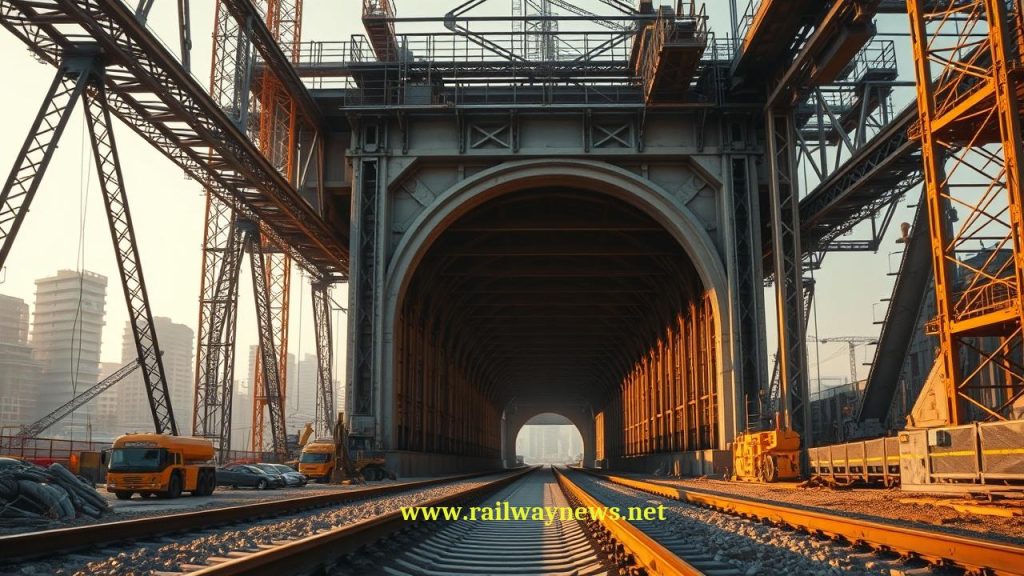
⚡ In Brief
- Cut-and-cover is a tunnel construction method in which a trench is excavated from the surface, the tunnel structure is built within the trench, and the trench is then backfilled and the surface restored — suitable for shallow tunnels (typically 0–15 metres cover depth) where deep boring by TBM is not cost-effective.
- Two distinct cut-and-cover sequences exist: bottom-up (excavate trench first, build structure from base to roof, backfill) and top-down (install perimeter walls and roof slab first while surface remains trafficable, then excavate underneath the completed roof) — the top-down method is preferred in urban environments where extended surface disruption is unacceptable.
- Cut-and-cover produces a rectangular cross-section, which is structurally less efficient than the circular cross-section of a TBM tunnel (a rectangle must resist bending in its walls and roof; a circle can work largely in compression) but more space-efficient for platforms, concourses, and dual-track sections — which is why virtually every underground metro station in the world is cut-and-cover construction.
- The principal cost driver of cut-and-cover in urban environments is not the excavation itself but the utility relocation and diversions required before digging can begin. A 500-metre urban metro station can require the relocation of water mains, sewer trunks, gas supplies, high-voltage cables, telecom ducts, and district heating pipes — each requiring coordination with a different utility owner — over a timeline measured in years before the first cubic metre of soil is removed.
- The Metropolitan Railway in London, opened in 1863 as the world’s first underground railway, was built entirely by cut-and-cover — a technique that tore up Euston Road and Marylebone Road for several years, causing significant disruption but ultimately demonstrating that urban underground railway construction was both feasible and commercially viable.
On 9 January 1863, a steam locomotive hauled the world’s first underground railway passengers between Paddington and Farringdon Street on the Metropolitan Railway in London. The line had been built using the simplest possible approach to underground construction: dig a trench down the middle of Euston Road, build a brick-lined tube in the trench, cover it over, and reinstate the road surface. The cut-and-cover method required closing major central London streets for years, creating enormous disruption to traffic, commerce, and residents. The press at the time described the construction as an “iron road through the bowels of the earth.” The results were transformative.
Over 160 years later, cut-and-cover remains the dominant method for building underground metro stations and shallow tunnels beneath urban streets — not because no better method exists (TBM boring is cleaner, faster, and less disruptive for deep tunnels) but because cut-and-cover’s rectangular cross-section, shallow depth, and direct accessibility from the surface make it uniquely suited to the specific requirements of underground stations, where passengers, trains, and platforms must all fit within a defined space that a circular TBM bore cannot efficiently accommodate. The Metropolitan Railway’s engineers made the right choice for 1860s London. Their successors are making the same choice for 21st-century cities from Mumbai to Madrid.
What Is Cut-and-Cover?
Cut-and-cover is a tunnel construction method in which the tunnel is built within an open excavation from the surface rather than being mined from within the ground. The name describes the two essential operations: excavating (cutting) the ground to create a trench large enough to build the tunnel structure, and then backfilling (covering) the trench after the structure is complete to restore the surface above.
Cut-and-cover is fundamentally different from bored tunnelling (TBM or drill-and-blast) in that the structure is built in the open air within a retained excavation, not within a confined underground space. This distinction has significant implications for construction method, structural form, achievable cross-section, and surface impact.
The Two Cut-and-Cover Sequences
Bottom-Up (Traditional) Method
| Step | Operation | Surface Condition |
|---|---|---|
| 1 | Utility diversion: all services beneath the construction zone are relocated outside the excavation footprint | Partial surface disruption; utility works visible |
| 2 | Temporary shoring: sheet piles, soldier piles, or secant piles installed to support trench sides during excavation | Shoring installation at surface; minor disruption |
| 3 | Open excavation: trench dug to full depth with temporary struts or tiebacks supporting the shoring walls | Full surface closure — open trench across road/street width |
| 4 | Base slab: reinforced concrete base slab cast at the bottom of the excavation | Surface remains open; concrete works in trench |
| 5 | Walls and internal structure: side walls, columns, and internal slabs cast or erected within the trench | Surface remains open throughout |
| 6 | Roof slab: top slab cast over the tunnel, completing the structure | Surface remains open until roof cast |
| 7 | Backfill and reinstatement: trench filled over the tunnel roof; road surface restored; utilities reconnected | Surface restored — road/footway reopened |
Top-Down Method
The top-down method addresses the primary commercial problem of the bottom-up approach — the extended period of surface closure — by completing the tunnel roof structure early and restoring the surface before the main excavation is complete:
- Perimeter walls first: Diaphragm walls (slurry walls) or secant pile walls are constructed from the surface along the tunnel perimeter, to their full final depth. These walls become the permanent tunnel side walls.
- Roof slab at ground level: The tunnel roof slab is constructed at or just below ground level, supported temporarily on the diaphragm walls and on intermediate columns founded on piles.
- Surface restoration: The road or paved surface is reinstated over the completed roof slab. Traffic and surface activities resume — the tunnel works proceed invisibly beneath.
- Excavation below the roof: Excavation proceeds downward through access openings (slots or openings) in the roof slab, removing soil from under the completed structure level by level.
- Internal construction: Intermediate slabs, base slab, internal walls, and track bed are constructed as excavation proceeds downward, working from top to bottom — the reverse of the bottom-up sequence.
Bottom-Up vs Top-Down: Key Differences
| Parameter | Bottom-Up | Top-Down |
|---|---|---|
| Surface disruption duration | Full duration of construction — surface open for entire build programme | Short — surface restored after roof construction (typically 6–18 months into programme) |
| Construction sequence | Foundation → walls → roof (natural sequence) | Perimeter walls → roof → base (inverted sequence) |
| Temporary works cost | Higher — temporary shoring, walers, and struts required | Lower — diaphragm walls become permanent structure; roof slab acts as strut |
| Construction access | Excellent — open trench allows full crane and equipment access | Restricted — excavation and construction through roof openings only |
| Ground movement control | Moderate — shoring provides resistance but trench walls can deflect under soil pressure | Good — diaphragm walls and roof slab together provide stiff, well-braced excavation support |
| Preferred context | Greenfield sites; low-traffic roads; short tunnel sections | Busy urban centres; adjacent sensitive structures; long metro station sections |
| Notable examples | Most suburban metro extensions; road underpasses; Victorian-era tunnels | Bangkok MRT; Singapore MRT City Hall extension; Milan Metro Line 5 |
Cut-and-Cover vs TBM Bored Tunnelling
| Parameter | Cut-and-Cover | TBM (Bored Tunnel) |
|---|---|---|
| Typical depth | 0–20 m cover depth | 15 m+ cover depth (no effective upper limit) |
| Cross-section | Rectangular — structurally less efficient but space-efficient for platforms | Circular — highly efficient structurally; less convenient for platform fit-out |
| Surface disruption | High — major surface works for full construction period (bottom-up) or until roof complete (top-down) | Very low — surface visible only at launch and reception shafts |
| Relative construction cost | Lower for shallow tunnels (typically 30–60% of TBM cost per metre) | Higher for shallow; lower for deep (TBM cost is spread over length) |
| Ground settlement risk | Moderate — settlement from retained wall deflection and dewatering; surface affected directly above works | Low to very low — TBM maintains face pressure; controlled grouting; minimal surface settlement |
| Utility conflict | Major — all utilities within excavation zone must be diverted or suspended | Minor — TBM passes below utility depth; utilities remain in service |
| Best suited for | Stations; shallow running tunnels; portal sections; areas where surface access is needed during construction | Deep running tunnels between stations; river crossings; areas where surface disruption is unacceptable |
Retaining Wall Systems: Supporting the Excavation
The sides of a cut-and-cover excavation must be supported to prevent the surrounding soil from collapsing into the trench. The choice of retaining wall system depends on the ground conditions, excavation depth, proximity to existing structures, groundwater level, and whether the wall will be temporary or permanent:
- Sheet piling: Interlocking steel sections driven into the ground. Fast and economical for shallow to moderate depths in soft ground. The steel can be extracted after backfilling (temporary use) or left in place (permanent use, though durability in permanent use is limited by corrosion). Prone to noise and vibration during installation — unsuitable adjacent to sensitive structures.
- Soldier pile and lagging: Steel H-piles driven at regular intervals with timber or concrete lagging placed between them as excavation proceeds. Economical; suitable for stiff soils; cannot prevent groundwater ingress. Common in North America.
- Secant pile walls: Overlapping concrete bored piles — alternate “primary” piles (unreinforced) and “secondary” piles (reinforced, installed before the primary piles set) create an interlocked wall of overlapping concrete cylinders. Good groundwater control; can be used as permanent structure. Requires less vibration than sheet piling.
- Diaphragm walls (slurry walls): Continuous reinforced concrete walls constructed by excavating a narrow trench with bentonite slurry support, then placing a reinforcement cage and tremie concrete. Excellent groundwater control; large section modulus for deep excavations; becomes the permanent tunnel wall in top-down construction. Most expensive wall type but often the most cost-effective for deep urban excavations.
The Utility Challenge: Why Stations Take Years
The most time-consuming phase of urban cut-and-cover tunnel construction is frequently not the excavation or the structural work — it is the utility diversion programme that must precede it. A typical 400-metre urban metro station passes beneath streets containing:
- Water supply mains (multiple diameters; pressure systems that cannot be interrupted)
- Combined and separate sewer trunks (gravity systems; cannot be raised without backfall issues)
- Gas distribution pipes (high and medium pressure; strict isolation and purging requirements)
- High-voltage electricity cables (132 kV and 33 kV; weeks of planned outages to divert)
- Telecoms ducts (BT/Openreach, dark fibre, mobile network operator infrastructure)
- District heating pipes (pressurised hot water; limited isolation points)
- Drainage and surface water pipes
Each utility is owned by a different company with different design standards, different approval processes, and different lead times for design, procurement, and installation. The utility diversion programme for a major metro station can begin 3–5 years before the first main excavation and may cost as much as the tunnel construction itself. This is why the construction timeline for underground stations in mature cities typically runs to 5–8 years from contract award to passenger service opening.
Ground Settlement: Protecting Adjacent Structures
Retained excavations for cut-and-cover tunnels cause ground settlement in the surrounding area as the excavation is made and the retaining walls deflect inward under soil and water pressure. Settlement is inevitable — the question is how much is acceptable. For a new metro station beneath a street in an established city, the adjacent buildings are typically old masonry structures whose foundations may be shallow and whose tolerance to differential settlement is limited.
Settlement estimation and management is a critical element of cut-and-cover design:
- Settlement trough: The settlement profile around an excavation follows a characteristic “settlement trough” pattern, with maximum settlement directly adjacent to the excavation wall decreasing with distance. The trough width and depth depend on the wall stiffness, excavation depth, and ground type.
- Limiting settlement: Stiff wall systems (diaphragm walls with closely spaced propping), early propping, and groundwater control all reduce settlement. Top-down construction is particularly effective because the roof slab provides a stiff prop at the highest level, limiting inward wall movement.
- Monitoring: Extensive real-time monitoring of ground movements, building settlement, and utility displacements during construction allows the contractor to detect movement rates exceeding predictions and trigger additional support measures before damage occurs.
Editor’s Analysis
Cut-and-cover’s enduring relevance in the era of TBMs and sophisticated mining techniques reflects an engineering reality that is easy to overlook in discussions of tunnelling technology: underground stations have requirements that cannot be efficiently met by a circular bore. A platform serving two parallel tracks, with platform edge doors, staircases, escalators, concourse level, ticket barriers, and ventilation plant, cannot reasonably be accommodated in a pair of 6-metre diameter circular tubes. The rectangular box cross-section of a cut-and-cover station is not a primitive compromise — it is the functional form that matches the functional requirements. The TBM took over from cut-and-cover for running tunnels between stations because the depth requirement for urban tunnels made open excavation impractical; but stations remained cut-and-cover because the functional requirement for a large, column-free, accessible rectangular space cannot be replaced by a more elegant tunnelling method. The cost and disruption of cut-and-cover stations in dense urban environments will continue to drive the search for alternatives — immersed tube stations, mined cavern stations, and other approaches have been used successfully in specific contexts — but none of these has displaced the cut-and-cover box as the standard solution for urban metro stations globally. The Metropolitan Railway’s engineers were right in 1860: when you need a rectangular underground space near the surface in a city, you dig a hole, build a box, and cover it over. The details have changed; the principle has not. — Railway News Editorial
Frequently Asked Questions
- Q: Why is cut-and-cover cheaper than TBM for shallow tunnels?
- A tunnel boring machine is an enormously expensive piece of capital equipment — a modern TBM for a 6–9-metre diameter urban metro tunnel costs €10–30 million to purchase or lease, requires an assembly chamber (a large excavated pit to launch the machine), and needs a logistical support system for removing spoil, supplying lining segments, and maintaining the machine throughout the drive. These fixed costs are spread over the length of the tunnel — for a long tunnel (several kilometres), the cost per metre is reasonable; for a short tunnel (a few hundred metres), the fixed costs dominate and the cost per metre is very high. Cut-and-cover has no equivalent fixed cost — the excavation plant is standard construction equipment, the retaining wall systems are well understood, and the concrete structure can be constructed by any competent civil contractor. For shallow tunnels where the surface can be opened without unreasonable disruption, the cut-and-cover cost per metre is typically 30–60% of the TBM equivalent. The crossover point — where TBM becomes cheaper — depends on tunnel length, depth, urban context, and ground conditions, but typically falls in the range of 500–2,000 metres of running tunnel. Below this length in favourable ground, cut-and-cover is usually the more economical choice.
- Q: What is a “diaphragm wall” and why is it particularly suited to urban cut-and-cover?
- A diaphragm wall (slurry wall) is a continuous reinforced concrete wall constructed by excavating a narrow panel-by-panel trench using a clamshell grab or hydromill, keeping the trench stable by filling it with dense bentonite clay slurry, then lowering a steel reinforcement cage into the slurry-filled trench and pumping concrete in from the bottom upward, displacing the slurry upward and out. The result is a continuous concrete wall of up to 1,200 mm thickness, constructed from the surface without any open excavation, to depths of 60 metres or more. Diaphragm walls are particularly suited to urban cut-and-cover because they combine several properties that other wall types lack simultaneously: excellent groundwater control (the concrete wall is effectively watertight); large bending stiffness (reducing ground settlement adjacent to the excavation); high load capacity (suitable for top-down construction where the wall becomes a permanent structural element); and low noise and vibration during installation (no piling hammer — the clamshell or hydromill works quietly). Their disadvantage is cost — diaphragm walls are the most expensive retaining wall system per square metre — but in urban environments adjacent to existing buildings and services, they are often the only system that can keep ground movements within acceptable limits.
- Q: How is groundwater managed during cut-and-cover excavation?
- Groundwater management is one of the most critical aspects of cut-and-cover design. An uncontrolled water ingress into a deep excavation is dangerous (hydraulic failure of the excavation base or walls) and can cause major ground settlement around the excavation as the groundwater table is drawn down. Several approaches are used: dewatering (pumping groundwater from within the excavation, via sumps or deep wellpoints, to lower the water table inside the excavation) is the simplest method but can cause settlement outside the excavation if the surrounding ground also de-waters. Groundwater cut-off (using watertight retaining walls such as diaphragm walls or secant piles to prevent water from entering the excavation) is more expensive but avoids settlement from external dewatering. On sites where the base of the excavation is at or below the groundwater table, groundwater pressure can push the excavation base upward (base heave) if the remaining soil thickness above a permeable layer is insufficient — the excavation design must include sufficient depth of impermeable wall below the excavation base to create a hydraulic cut-off. In marine or high water-table urban environments, managing groundwater is frequently the most technically challenging and expensive aspect of the entire cut-and-cover programme.
- Q: Can cut-and-cover be used under an existing live railway?
- Yes — and it is done regularly, though it is among the most challenging forms of civil engineering. Building a new underpass, metro station, or cross-passage beneath an operating railway requires maintaining the structural integrity of the track and its supporting formation throughout the works. The standard approach is to install temporary supports (typically steel needles or bridging beams) beneath the existing track before any excavation begins — these supports transfer the track loading to new temporary foundations outside the excavation zone. The excavation then proceeds between these supports, with the track continuing to carry traffic above. Settlement monitoring of the existing track is continuous, with defined trigger levels that require work to pause if movements exceed thresholds. The works are typically restricted to overnight possessions for the most sensitive phases, with the track restored to a known condition and geometry-measured before each passenger service. Several extensions of the London Underground’s deep-level lines have been constructed by underpinning existing surface or sub-surface lines — Crossrail (Elizabeth Line) in London and Grand Paris Express in Paris are examples of major projects where new deep-level metro construction has been executed beneath existing surface railways and metro lines operating throughout.
- Q: What happens to the excavated soil (spoil) in a cut-and-cover project?
- Spoil disposal is a significant logistical challenge in urban cut-and-cover construction. A typical 400-metre double-track underground station with a 20-metre-wide, 15-metre-deep box excavates approximately 120,000 cubic metres of material — equivalent to around 200,000 tonnes of soil. This material must be transported away from the construction site through an already congested urban area, typically in lorries, to licensed disposal sites or reuse locations. Contaminated ground (a frequent issue in urban brownfield sites where former industrial land contains chemical contamination) requires treatment or disposal at specialist licensed facilities, at significantly higher cost than clean fill. Some projects can use excavated material as fill for other parts of the project (embankments on approach routes, for example) or sell clean granular material to other construction projects — but the volumes are rarely balanced exactly, and net disposal costs are a material element of project budgets. For TBM projects, spoil management is continuous and can be planned in advance; for cut-and-cover with shorter and more concentrated excavation phases, the peak lorry movements during excavation can be hundreds of vehicles per day — a significant community impact consideration that requires careful construction traffic management.

Railway infrastructure, rolling stock and transport technologies specialist focused on global rail industry developments, high-speed rail systems, signaling technologies and freight transportation. Covering railway investments, public transport modernization, rail operations and international mobility projects across Europe, Asia and North America.
RELATED POSTS

September 6, 2026 5:19 am
Hitachi delivered Taiwan's first N700ST high-speed train from Japan in...

September 5, 2026 4:19 pm
CPK launched formal tender talks with four consortia to design...

September 5, 2026 7:14 pm
HS2 Ltd signed renegotiated civils contracts with EKFB and Align...

September 6, 2026 4:12 am
Alstom delivered the first of 100 new G Class trams...

September 6, 2026 1:17 am
Hitachi Toshiba Supreme Consortium confirmed the first of 12 N700ST...

September 6, 2026 6:17 am
Hungary ordered a national ban on most freight trains from...