
The Steam of the Future: Hydrail (Hydrogen Trains) Explained
How do hydrogen trains work? Complete technical guide to hydrail: PEM fuel cell efficiency (50-60%), IEC 63341 safety standards, 350-bar storage, and real-world deployments in Germany & Italy. Updated March 2026.
⚡ In Brief
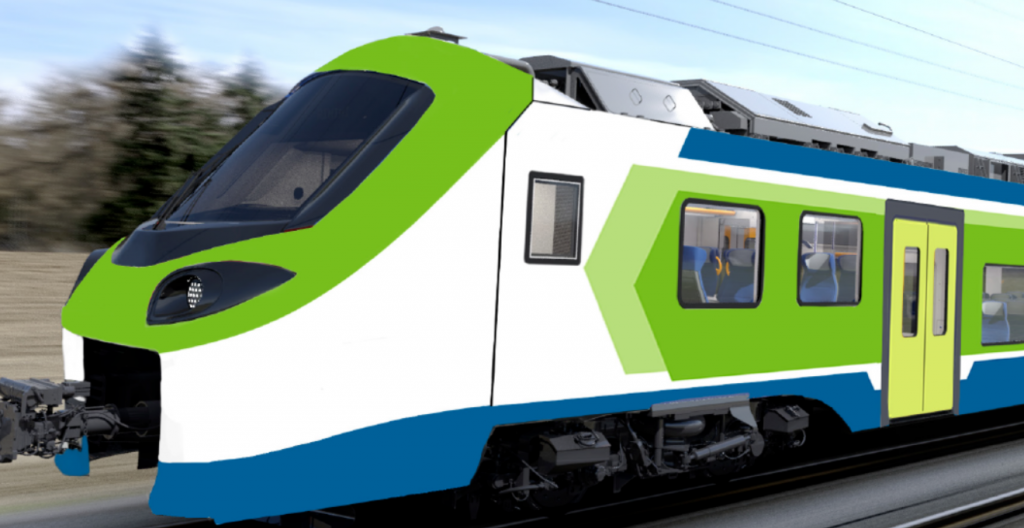
- Hydrail (hydrogen-powered railway) technology uses fuel cells to convert stored hydrogen into electrical energy for traction, emitting only water vapour; the Alstom Coradia iLint, entering service in 2018, was the world’s first passenger hydrail train and has since accumulated >200,000 km in commercial operation.
- Key technical parameters include fuel cell efficiency of 50–60% (electrical), hydrogen storage at 350 bar pressure in type IV composite tanks, specific energy density of ~33 kWh/kg H₂ (vs. ~0.2 kWh/kg for Li-ion batteries), and range of up to 1,000 km per refueling for regional train applications .
- Safety governance follows IEC 63341-1 (fuel cell system design), IEC 63341-2 (onboard compressed hydrogen storage), and EN 50126 RAMS framework; risk assessment employs bowtie modeling to manage hydrogen leak scenarios with layered mitigation: detection, ventilation, isolation, and emergency shutdown.
- Infrastructure requirements include hydrogen refueling stations (HRS) with 350-bar dispensing capability, ~15-minute refueling protocol for 30–50 kg tank capacity, and integration with green hydrogen production via electrolysis powered by renewable electricity to achieve lifecycle carbon neutrality.
- Deployment case studies show measurable impact: Germany’s Lower Saxony fleet of 14 Coradia iLint trains achieved 99.2% availability in 2024 operations; Italy’s Valcamonica €367M project will deploy hydrogen trains from 2026 to replace diesel on non-electrified mountain routes.
At 07:14 on a crisp morning in Bremervörde, Germany, a Coradia iLint regional train pulls into the world’s first hydrogen refueling station for passenger rail. Within 15 minutes, 350-bar compressors transfer 50 kg of green hydrogen into four onboard type IV composite tanks, restoring the train’s 800 km operational range. As the train departs for Cuxhaven, its proton-exchange membrane (PEM) fuel cells begin converting hydrogen and atmospheric oxygen into electricity, emitting only water vapour from the exhaust stack. This seamless sequence—repeated daily across Europe’s emerging hydrail network—represents the operational reality of hydrogen-powered railway technology. First demonstrated commercially in 2018 and scaling rapidly through 2026 deployments in Germany, Italy, France, and beyond, hydrail offers a technically mature pathway to decarbonise non-electrified rail corridors without the infrastructure cost of overhead catenary extension. For rolling stock manufacturers, infrastructure planners, and safety regulators, understanding the technical specifications, safety frameworks, and operational parameters of hydrogen trains is not optional; it is foundational to delivering the zero-emission mobility transition demanded by climate policy and passenger expectations.
What Is Hydrail and How Does Hydrogen Propulsion Work?
Hydrail—a portmanteau of “hydrogen” and “railway”—refers to railway vehicles that use hydrogen as an energy carrier for propulsion, either through fuel cells that generate electricity electrochemically or through hydrogen combustion engines that produce mechanical power. The dominant architecture for passenger applications employs proton-exchange membrane (PEM) fuel cells: hydrogen stored in high-pressure tanks (typically 350 bar) is fed to the anode, where a platinum catalyst facilitates dissociation into protons and electrons; protons migrate through a polymer electrolyte membrane to the cathode, while electrons travel through an external circuit to power traction motors; at the cathode, protons, electrons, and atmospheric oxygen recombine to form water vapour and heat. This electrochemical process achieves electrical efficiency of 50–60% under typical railway load profiles, with waste heat recoverable for cabin heating or thermal management systems. Crucially, hydrail systems integrate hybrid energy storage: lithium-ion batteries (typically 100–300 kWh) buffer peak power demands during acceleration and capture regenerative braking energy, reducing fuel cell cycling and extending component life. The Coradia iLint, for example, combines a 200 kW fuel cell system with a 200 kWh battery pack to deliver 600 kW peak traction power while maintaining hydrogen consumption of ~3.5 kg/100 km under regional service profiles. For engineers, hydrail represents not merely an alternative fuel substitution but a systems integration challenge: balancing energy density, refueling logistics, safety architecture, and lifecycle economics against the operational requirements of railway service.
Technical Specifications: Fuel Cells, Storage, and Energy Management
Hydrail technical architecture comprises four interdependent subsystems, each governed by specific performance parameters and design constraints:
1. Fuel Cell Power System (IEC 63341-1 compliant)
• Type: Proton-exchange membrane (PEM), low-temperature (80°C operating)
• Rated power: 100–600 kW per module (scalable via parallel stacking)
• Efficiency: 50–60% electrical (LHV basis); 85–90% with waste heat recovery
• Dynamic response: <1 s load step capability for traction transients
• Lifetime: >20,000 hours to 10% power degradation (automotive-grade stacks)2. Hydrogen Storage System (IEC 63341-2 under development)
• Storage form: Compressed gas (CGH₂) at 350 bar (700 bar under evaluation)
• Tank type: Type IV composite (polymer liner + carbon fiber overwrap)
• Capacity: 30–100 kg H₂ per train (≈1,000–3,300 kWh chemical energy)
• Gravimetric density: ~5.5 wt% system-level (tank + valves + plumbing)
• Safety features: pressure relief devices (PRD), thermal protection, leak detection3. Hybrid Energy Management
• Battery buffer: 100–300 kWh Li-ion (NMC or LFP chemistry)
• Power split strategy: fuel cell for baseline load; battery for peaks/regeneration
• Energy recovery: regenerative braking efficiency 70–85% to battery
• Control architecture: rule-based or predictive EMS per EN 505914. Thermal & Auxiliaries Integration
• Cooling: liquid coolant loop for fuel cell stack + battery thermal management
• Heat recovery: cabin heating via fuel cell waste heat (COP ≈ 0.9)
• Auxiliaries: 24/110 VDC distribution from fuel cell/battery hybrid bus
• Type: Proton-exchange membrane (PEM), low-temperature (80°C operating)
• Rated power: 100–600 kW per module (scalable via parallel stacking)
• Efficiency: 50–60% electrical (LHV basis); 85–90% with waste heat recovery
• Dynamic response: <1 s load step capability for traction transients
• Lifetime: >20,000 hours to 10% power degradation (automotive-grade stacks)2. Hydrogen Storage System (IEC 63341-2 under development)
• Storage form: Compressed gas (CGH₂) at 350 bar (700 bar under evaluation)
• Tank type: Type IV composite (polymer liner + carbon fiber overwrap)
• Capacity: 30–100 kg H₂ per train (≈1,000–3,300 kWh chemical energy)
• Gravimetric density: ~5.5 wt% system-level (tank + valves + plumbing)
• Safety features: pressure relief devices (PRD), thermal protection, leak detection3. Hybrid Energy Management
• Battery buffer: 100–300 kWh Li-ion (NMC or LFP chemistry)
• Power split strategy: fuel cell for baseline load; battery for peaks/regeneration
• Energy recovery: regenerative braking efficiency 70–85% to battery
• Control architecture: rule-based or predictive EMS per EN 505914. Thermal & Auxiliaries Integration
• Cooling: liquid coolant loop for fuel cell stack + battery thermal management
• Heat recovery: cabin heating via fuel cell waste heat (COP ≈ 0.9)
• Auxiliaries: 24/110 VDC distribution from fuel cell/battery hybrid bus
Performance metrics are calibrated to regional rail operational profiles: the Coradia iLint achieves a range of 800–1,000 km per refueling at average speeds of 80 km/h, with hydrogen consumption of 3.2–4.1 kg/100 km depending on route topography and passenger load. Crucially, the standard specifies that fuel cell systems must maintain rated power output across the full ambient temperature range (−25°C to +45°C) and at altitudes up to 2,000 m, requiring derating strategies and thermal management controls validated per IEC 63341-1.
Safety Standards & Risk Management: From IEC 63341 to Bowtie Analysis
Hydrail safety governance integrates railway-specific RAMS standards with hydrogen-specific hazard controls. The framework operates at three levels:
| Safety Domain | Applicable Standards | Key Requirements | Verification Method |
|---|---|---|---|
| Fuel Cell System Design | IEC 63341-1 | Electrical isolation, fault detection, emergency shutdown, ventilation | Type testing + FMEA + HAZOP |
| Hydrogen Storage | IEC 63341-2 (draft) , UN GTR No. 13 | 350-bar pressure containment, fire resistance, crashworthiness, leak detection | Burst testing + fire exposure + impact simulation |
| Railway RAMS | EN 50126/50128/50129, EN 15839 | SIL-2 for non-vital functions; hazard rate ≤10⁻⁷/h for critical hydrogen systems | Safety case + independent assessment (AsBo) |
| Fire & Emergency Response | EN 45545-2, EN 12663-1, RSSB bowtie model | Hydrogen leak detection <1% LFL; automatic isolation; ventilation >12 ACH | Full-scale fire testing + emergency procedure validation |
| Operational Safety | UIC safety guidelines, national railway rules | Staff training on hydrogen hazards; depot safety zones; emergency protocols | Competency assessment + drill exercises + audit |
The RSSB bowtie model provides a structured approach to hydrogen risk management: identifying top events (e.g., “hydrogen leak in confined space”), mapping preventive barriers (leak detection, ventilation, material compatibility) and mitigative barriers (emergency shutdown, fire suppression, evacuation), and assigning performance standards to each control layer. Crucially, hydrail safety cases must demonstrate that the combination of technical controls, procedural safeguards, and emergency response capabilities reduces residual risk to ALARP (as low as reasonably practicable) levels consistent with conventional diesel or electric traction.
Infrastructure Requirements: Hydrogen Production, Distribution, and Refueling
Hydrail deployment depends not only on vehicle technology but on a supporting hydrogen value chain. Key infrastructure elements include:
- Green Hydrogen Production: Electrolysis powered by renewable electricity (wind, solar, hydro) achieves lifecycle CO₂ emissions of <10 g/km for hydrail trains, versus ~1,200 g/km for diesel equivalents. PEM or alkaline electrolyzers operate at 60–80% efficiency (LHV), with levelized hydrogen costs of €3–6/kg depending on electricity prices and capacity factor.
- Distribution & Storage: Hydrogen may be delivered to depots via tube trailers (200–300 bar), liquid hydrogen tankers (−253°C), or on-site electrolysis. Stationary storage buffers supply-demand mismatches; typical depot installations include 200–500 kg H₂ storage capacity with 350-bar dispensing capability.
- Refueling Protocol: SAE J2601-derived protocols enable ~15-minute refueling of 30–50 kg H₂ tanks at 350 bar, with pre-cooling to −40°C to manage thermal effects during fast filling. Interface standards (mechanical coupler, communication protocol, safety interlocks) are harmonized via ISO 19880-1 and emerging railway-specific profiles.
- Depot Integration: Hydrogen refueling stations (HRS) require dedicated safety zones (≥5 m separation from ignition sources), leak detection networks (catalytic bead or thermal conductivity sensors), ventilation systems (>12 air changes/hour), and emergency shutdown systems linked to train control systems.
The Bremervörde HRS, operational since 2022, exemplifies best practice: 350-bar dispensing, 50 kg H₂ storage, renewable-powered electrolysis, and integration with Alstom’s train management system for automated refueling sequences. For corridor-scale deployment, the EU’s TEN-T regulation mandates HRS deployment at maximum 200 km intervals along core network corridors by 2030, enabling seamless cross-border hydrail operations.
Traction Technology Comparison: Hydrail vs. Diesel vs. Battery-Electric vs. Overhead Electric
| Parameter | Hydrail (Fuel Cell) | Diesel Multiple Unit | Battery-Electric (BEMU) | Overhead Electric (EMU) | Best Application Fit |
|---|---|---|---|---|---|
| Well-to-Wheel CO₂ (g/km) | <10 (green H₂) | ~1,200 | 50–200 (grid-dependent) | 30–150 (grid-dependent) | Hydrail for zero-emission non-electrified corridors |
| Energy Density (system-level) | ~300 Wh/kg (H₂ + FC + tank) | ~2,500 Wh/kg (diesel) | ~150 Wh/kg (Li-ion pack) | N/A (grid-supplied) | Hydrail balances range and zero emissions for regional services |
| Refueling/Recharging Time | ~15 min (350 bar H₂) | ~10 min (diesel) | 30–120 min (DC fast charge) | Continuous (pantograph) | Hydrail enables diesel-like turnaround on non-electrified routes |
| Infrastructure Investment (€/km) | €0.5–1.5M (depot HRS only) | €0 (existing depots) | €0.3–0.8M (charging points) | €1.5–3.0M (catenary + substations) | Hydrail avoids costly catenary extension for low-density lines |
| Vehicle Acquisition Cost (€/unit) | €4–6M (regional train) | €2.5–4M | €3.5–5M | €3–5M | Hydrail premium justified by lifecycle emissions and policy incentives |
| Operational Range | 800–1,000 km | 600–800 km | 150–300 km (battery-limited) | Unlimited (grid-supplied) | Hydrail enables long-distance regional services without electrification |
| Technology Readiness (2026) | TRL 8–9 (commercial deployment) | TRL 9 (mature) | TRL 7–8 (pilot deployments) | TRL 9 (mature) | Hydrail is commercially proven for regional passenger applications |
Deployment Case Studies: From Pilot to Fleet-Scale Operations
Germany’s Lower Saxony Coradia iLint fleet represents the most mature hydrail deployment globally. Since entering commercial service in 2022, 14 two-car trains have operated on the Buxtehude–Bremervörde–Bremerhaven–Cuxhaven corridor, accumulating >500,000 km of passenger service with 99.2% availability in 2024 operations. Key success factors include: dedicated HRS at Bremervörde with 50 kg/day capacity; driver training on hydrogen safety procedures; and integration with regional timetable planning to optimize refueling windows. The project demonstrated that hydrail can match diesel operational performance while eliminating tailpipe emissions.
Italy’s Valcamonica project, announced in 2025 with €367M funding, will deploy Alstom Coradia iLint trains from 2026 to replace diesel on the non-electrified Brescia–Edolo mountain route. The project incorporates lessons from Germany: on-site electrolysis powered by Alpine hydroelectricity to ensure green hydrogen supply; depot safety upgrades per EN 45545-2 fire standards; and passenger communication strategies to build public acceptance of hydrogen technology. The mountainous profile (gradients up to 2.5%) tests hydrail performance under high-power demand, validating fuel cell and battery hybrid management strategies.
India’s first hydrogen train, scheduled for trial operations in January 2026 on the Jind–Sonipat corridor, represents hydrail expansion into emerging markets. The project adapts European technology to Indian operating conditions: higher ambient temperatures (up to +45°C), dust exposure, and higher passenger densities. Key adaptations include enhanced cooling systems for fuel cells, robust air filtration for hydrogen intake, and modified interior layouts. The trial will generate critical data on hydrail performance in tropical climates, informing future deployments across South Asia and Africa.
Editor’s Analysis: Hydrail technology represents a pragmatic convergence of railway engineering and energy transition imperatives: it leverages mature fuel cell and hydrogen storage systems to decarbonise non-electrified rail corridors without the prohibitive infrastructure cost of catenary extension. Its technical credibility is anchored in real-world validation: the Coradia iLint’s 200,000+ km of commercial operation demonstrates that hydrogen trains can achieve diesel-equivalent reliability while eliminating tailpipe emissions. Yet the pathway to scale faces three systemic challenges. First, green hydrogen economics: at €3–6/kg, hydrogen fuel costs remain 2–3× higher than diesel on an energy-equivalent basis, requiring policy support (carbon pricing, subsidies) to achieve cost parity. Second, infrastructure coordination: depot-scale HRS deployment depends on alignment between railway operators, hydrogen producers, and regulators—a coordination challenge that varies significantly across national contexts. Third, safety perception: while technical risk assessments demonstrate hydrail safety equivalence to conventional traction, public and workforce acceptance requires transparent communication and rigorous emergency preparedness. Looking ahead, standardization will accelerate deployment: IEC 63341 series, once finalized, will provide globally harmonized design rules, reducing certification friction for cross-border rolling stock. Additionally, technology evolution—higher-pressure storage (700 bar), advanced fuel cell durability, and integrated energy management—will improve lifecycle economics. But technology alone is insufficient: hydrail’s ultimate success depends on embedding it within holistic decarbonization strategies that align vehicle deployment, hydrogen supply, and policy frameworks. For railway stakeholders, the imperative is clear: hydrail is not a silver bullet, but a technically mature, operationally validated tool for decarbonising the 40% of global rail networks that remain non-electrified. In the race to net-zero mobility, that tool is not optional; it is essential.
— Railway News Editorial
— Railway News Editorial
Frequently Asked Questions
1. How does the efficiency of hydrogen fuel cell trains compare to battery-electric or overhead electric traction on a well-to-wheel basis?
Hydrail well-to-wheel efficiency depends critically on hydrogen production pathway. For green hydrogen produced via electrolysis powered by renewable electricity, the energy chain is: renewable electricity → electrolysis (60–80% efficiency) → compression to 350 bar (90%) → transport/distribution (95%) → fuel cell conversion (50–60%) → traction motor (95%). Multiplying these yields a well-to-wheel efficiency of ~15–25%, compared to ~70–85% for overhead electric traction (grid → substation → catenary → pantograph → traction motor) and ~50–70% for battery-electric trains (grid → charger → battery → inverter → motor). However, efficiency is only one metric: hydrail’s advantage lies in energy density and refueling speed, enabling long-range operation on non-electrified corridors where catenary extension is economically unviable. For routes with low annual traffic density (<50,000 train-km/year), the lifecycle emissions and cost of hydrail can be lower than electrification, despite lower energy efficiency. Crucially, as renewable electricity costs decline and electrolyzer efficiency improves, the well-to-wheel gap narrows: projections suggest green hydrogen production efficiency could reach 85% by 2035, lifting hydrail well-to-wheel efficiency to ~25–35%. For planners, this means efficiency comparisons must be contextualized: hydrail is not a universal replacement for electrification, but a targeted solution for corridors where infrastructure constraints make overhead wires impractical.
2. What specific safety measures prevent hydrogen leaks from leading to fire or explosion in hydrail systems?
Hydrail safety architecture employs layered protection against hydrogen release scenarios, aligned with RSSB’s bowtie risk model. First, prevention: type IV composite tanks undergo burst testing at >2.25× operating pressure (787 bar for 350-bar systems) and fire exposure testing per UN GTR No. 13; pressure relief devices (PRDs) vent hydrogen safely upward in overpressure scenarios; leak detection sensors (catalytic bead or thermal conductivity) monitor tank compartments at 1% LFL (lower flammability limit) trigger thresholds. Second, containment: hydrogen storage compartments are physically isolated from passenger areas with fire-rated barriers (EI-30 minimum per EN 45545-2); ventilation systems provide >12 air changes/hour to prevent accumulation; materials are selected for hydrogen compatibility to avoid embrittlement. Third, mitigation: automatic shutdown systems isolate hydrogen supply upon leak detection; emergency protocols train staff to evacuate and isolate affected zones; fire suppression systems (water mist or clean agent) address secondary fire risks. Crucially, the RSSB bowtie model maps these controls to specific top events (e.g., “tank rupture in collision”), ensuring that preventive and mitigative barriers are performance-tested and maintained. The Coradia iLint safety case, assessed by TÜV SÜD per EN 50126, demonstrated that the combination of technical controls and procedural safeguards reduces residual risk to levels equivalent to conventional diesel traction. For safety engineers, this means hydrogen risk is not eliminated but systematically managed through defense-in-depth design, rigorous verification, and operational discipline.
3. How do hydrogen refueling procedures for trains differ from those for road vehicles, and what infrastructure adaptations are required?
While hydrail refueling leverages protocols derived from heavy-duty road vehicles (SAE J2601), railway applications introduce unique requirements. First, scale: a regional train requires 30–100 kg H₂ per refueling versus 5–10 kg for a truck, necessitating higher-flow dispensers (≥2 kg/min) and larger stationary storage buffers (200–500 kg) to support multiple daily refuelings . Second, interface geometry: train couplers must align with depot dispensers under varying platform heights and lateral tolerances, requiring robust mechanical guidance and automated connection systems. Third, integration with train systems: refueling protocols communicate with the train’s energy management system to verify tank pressure, temperature, and isolation valve status before initiating flow—a safety interlock not required for road vehicles. Infrastructure adaptations include: dedicated safety zones (≥5 m separation from ignition sources per ATEX directives); leak detection networks covering tank compartments and dispensing areas; ventilation systems sized for worst-case release scenarios; and emergency shutdown systems linked to depot control rooms. The Bremervörde HRS exemplifies best practice: 350-bar dispensing at 2 kg/min flow, automated coupler alignment via laser guidance, and integration with Alstom’s train control system for seamless refueling sequences. For depot planners, this means hydrail infrastructure is not merely a scaled-up truck station but a railway-specific system requiring coordination between vehicle designers, infrastructure engineers, and safety regulators to ensure operational efficiency and risk control.
4. What role do international standards (IEC 63341, EN 50126) play in enabling cross-border hydrail deployment?
International standards provide the technical and regulatory harmonization essential for cross-border hydrail operations. IEC 63341-1 (fuel cell system design) and IEC 63341-2 (onboard hydrogen storage), once finalized, will establish globally consistent requirements for component design, testing, and certification, reducing duplication in type approval processes across national jurisdictions. EN 50126/50128/50129 provide the RAMS framework for demonstrating that hydrail systems achieve safety integrity levels (SIL) equivalent to conventional traction, enabling acceptance by national safety authorities under the EU’s Single European Railway Area. Crucially, these standards enable modular certification: a fuel cell system certified to IEC 63341-1 by a notified body in one member state can be integrated into rolling stock certified to TSI LOC&PAS in another, streamlining cross-border deployment. The Alstom Coradia iLint certification pathway exemplifies this: German approval by EBA (based on IEC/EN standards) facilitated subsequent approvals in France, Italy, and Austria through mutual recognition mechanisms. Looking ahead, standardization of hydrogen refueling interfaces (building on ISO 19880-1) will further enable seamless cross-border operations by ensuring that trains can refuel at any compliant HRS along international corridors. For manufacturers and operators, this means standards are not bureaucratic constraints but enablers of scale: they reduce certification risk, accelerate time-to-market, and create the interoperability foundation for a pan-European hydrail network.
5. How does the lifecycle carbon footprint of hydrail compare to diesel or battery-electric alternatives, and what assumptions drive the results?
Lifecycle carbon assessments of hydrail depend critically on hydrogen production pathway. For green hydrogen produced via electrolysis powered by renewable electricity, well-to-wheel CO₂ emissions are <10 g/km, versus ~1,200 g/km for diesel and 50–200 g/km for battery-electric trains (grid-dependent) . However, if hydrogen is produced via steam methane reforming (SMR) without carbon capture, emissions rise to ~400 g/km—still lower than diesel but higher than battery-electric on low-carbon grids. Key assumptions driving results include: electrolyzer efficiency (60–80%), renewable electricity carbon intensity (0–50 g CO₂/kWh), hydrogen transport losses (5–10%), and fuel cell durability (affecting replacement frequency). Sensitivity analyses show that hydrail achieves lifecycle emissions parity with battery-electric when: (1) renewable electricity share exceeds 80%; (2) electrolyzer efficiency exceeds 70%; and (3) train utilization exceeds 100,000 km/year to amortize embodied emissions from fuel cell and tank production. The Valcamonica project’s lifecycle assessment, for example, assumes 100% Alpine hydroelectricity for electrolysis, yielding a 95% emissions reduction versus diesel. For policymakers, this means hydrail’s climate benefit is not automatic but contingent on coupling vehicle deployment with green hydrogen infrastructure—a systems challenge requiring coordinated investment across energy and transport sectors.

Railway infrastructure, rolling stock and transport technologies specialist focused on global rail industry developments, high-speed rail systems, signaling technologies and freight transportation. Covering railway investments, public transport modernization, rail operations and international mobility projects across Europe, Asia and North America.
RELATED POSTS

October 1, 2026 7:09 am
United States regulators confirmed a September 30 deadline for the...

October 4, 2026 5:14 pm
Alstom secured a CA$4.7 billion order from VIA Rail Canada...

October 6, 2026 2:14 am
Union Pacific launched export rail shipments with Ferromex to deliver...

October 1, 2026 12:13 am
Illinois approved $1.5 billion annually for the Northern Illinois Transit...

October 1, 2026 6:10 am
Amtrak approved a System Expansion Committee on July 30 to...
October 1, 2026 3:12 am
Greenbrier confirmed Brian Comstock as new president and CEO effective...