
The Lifeline of Electrification: Overhead Contact System (OCS) Master Guide
What is the Overhead Contact System (OCS)? Explore the anatomy of railway electrification, from catenary wires to droppers, and how it powers the pantograph.
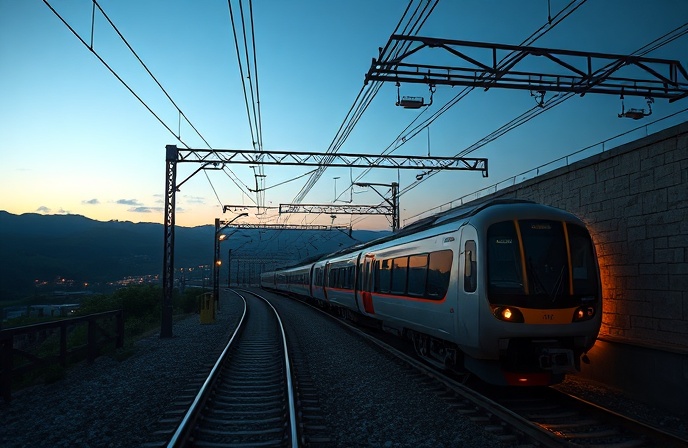
⚡ In Brief
- The Overhead Contact System (OCS), also called the Overhead Line Equipment (OLE) or catenary system, is the infrastructure that transmits electrical power from traction substations to moving trains via continuous contact between the overhead contact wire and the train’s pantograph — the interface through which every electric train draws the energy it needs to move.
- The OCS consists of two primary wire elements: the contact wire (the lower wire that the pantograph physically touches, made of hard-drawn copper or copper-cadmium alloy, 100–150 mm² cross-section) and the catenary wire (the messenger wire hanging in a natural catenary curve above the contact wire, from which the contact wire is suspended at a constant height via droppers). The contact wire must be maintained at a precisely constant height above the rail throughout — typically 5,000–5,500 mm — for reliable pantograph contact.
- Contact wire stagger — the deliberate lateral alternation of the contact wire position from one side to the other of the track centreline across successive mast spans — distributes pantograph wear evenly across the full width of the carbon contact strip rather than wearing a single groove down the centre. Without stagger, a wire running perfectly central would create a deep groove in the middle of every pantograph strip within a short service life.
- Automatic Tensioning Devices (ATDs), using gravity balance weights at the ends of each tensioned section, maintain constant contact wire tension (typically 10–27 kN depending on system design) regardless of temperature. This constant tension ensures the contact wire remains at a consistent height and mechanical wave speed throughout the temperature range — critical for high-speed operation, where the pantograph’s interaction with the OCS must be dynamically predictable.
- The maximum speed at which a pantograph can reliably collect current from an OCS is fundamentally limited by the wave propagation speed of the catenary system — the speed at which a mechanical disturbance (a pantograph passing) travels along the contact wire. Train speed must remain below approximately 70% of this wave speed to maintain continuous contact; for modern high-speed OCS designs, this constrains the maximum speed to 300–380 km/h, with the current world record (Alstom AGV test, 2007) of 574.8 km/h representing the limit of what specially optimised OCS can achieve.
At 13:14 on 3 April 2007, an Alstom V150 test train on the LGV Est line in eastern France reached 574.8 km/h — the fastest a wheeled train has ever travelled on conventional rails. At that speed, the distance between the train and the nearest supporting mast was covered in a fraction of a second. The pantograph — a spring-loaded carbon strip pressed against the overhead contact wire at approximately 70–100 N force — was travelling faster than most commercial aircraft. The contact wire was vibrating in response to each pantograph passage, waves travelling along the wire ahead of and behind the collecting bow. The OCS, specifically designed and tensioned for this record attempt, was performing at the absolute limit of what wire mechanics allow.
No regular passenger service operates at 574.8 km/h. But the wave mechanics that constrained the V150’s OCS during that record run are the same mechanics that determine the maximum speed of every commercial high-speed service today. Understanding the OCS — why it is designed the way it is, why the contact wire must be staggered, why tension must be constant, and why the wave speed of the catenary limits train speed — is understanding one of the most consequential engineering constraints in high-speed rail.
OCS Components: The Full Architecture
| Component | Position | Material / Specification | Function |
|---|---|---|---|
| Contact wire (CW) | Lowest — direct pantograph contact; 5,000–5,500 mm above rail | Hard-drawn copper (CuETP) or Cu-Mg alloy; 100–150 mm² cross-section; grooved profile for clamp attachment | Carries traction current to pantograph; provides smooth sliding surface for pantograph carbon strip; wears gradually — replaced when cross-section wears below minimum |
| Catenary wire (messenger wire) | Above contact wire; sags naturally in catenary curve between supports | Stranded copper or bronze; 50–120 mm² cross-section; higher tensile strength than contact wire | Supports contact wire at constant height via droppers; carries some traction current in parallel with contact wire (reduces voltage drop) |
| Droppers | Vertical connection between catenary wire and contact wire at regular intervals (typically every 3–10 m) | Copper or stainless steel wire; pre-formed or adjustable length; designed to allow small vertical movement | Maintain contact wire at constant height below catenary wire, compensating for the catenary’s natural sag curve |
| Steady arms / cantilever brackets | Attached to mast or portal; positions contact wire laterally (stagger) | Aluminium or steel; adjustable for stagger setting; insulated from mast at appropriate points | Positions contact wire at the correct stagger position (lateral offset from track centreline) and correct height; applies registration force to hold the wire in position |
| Masts / portals | Foundation-mounted at trackside; typically 50–80 m apart | Steel I-section, hollow tube, or concrete pole; galvanised or painted; foundation in ballast or concrete | Structural support for OCS; carries vertical load of catenary and contact wire; resists wind and ice loading; typically spaced further apart on HSR (longer span = greater aerodynamic exposure) |
| Insulators | At all points where live OCS is supported on earthed structures (masts, portals) | Porcelain (legacy), toughened glass, or composite polymer; creep distance specified by voltage class and pollution environment | Electrically isolate live OCS conductors from earthed support structures; must withstand full system voltage plus impulse overvoltages from lightning |
| Automatic Tensioning Device (ATD) | At the ends of each tensioned section; typically every 1,000–1,500 m | Balance weight system (gravity-operated) or spring/hydraulic tensioner; wire anchored at mid-point of tensioned section | Maintains constant contact wire and catenary wire tension regardless of temperature; prevents wire sag in summer or excessive tension increase in winter |
| Section insulators | Within contact wire at electrical section boundaries (neutral sections) | PTFE-coated composite or porcelain; designed for smooth pantograph passage | Electrically isolate adjacent sections of contact wire; allow passage of pantograph without mechanical disturbance (see Neutral Section article) |
The Catenary Curve and Why the Contact Wire Must Be Horizontal
A wire suspended between two fixed points under gravity hangs in a mathematical curve called a catenary — not a parabola (as is sometimes stated), but the curve defined by the hyperbolic cosine function. If the contact wire hung as a natural catenary, its height above the rail would vary continuously between mast positions — lowest at mid-span, highest near the masts. This varying height would cause the pantograph to follow a continuously changing vertical path, generating dynamic contact force fluctuations that would cause arcing and uneven wear.
The OCS design solves this by using two wires in combination: the catenary wire is allowed to hang in its natural curve, while the contact wire is held horizontal by a series of droppers of progressively different lengths — longer droppers near mid-span (where the catenary sags furthest) and shorter droppers near the mast positions (where the catenary is higher). The result is a contact wire that runs at constant height despite the catenary above it following its natural curve.
The precision required is significant: on a high-speed line, contact wire height must be maintained within ±30 mm of the design height (5,000–5,500 mm depending on the network standard) measured at any point on the span, including at high wind loading conditions. Height deviations outside this tolerance create the dynamic pantograph-wire interaction problems that limit current collection at speed.
Contact Wire Stagger: Even Wear Across the Carbon Strip
The contact wire is not installed along the track centreline — it is deliberately positioned to alternate from one side to the other of the centreline across successive spans, typically ±200–250 mm from centre in a sinusoidal pattern. This lateral offset is called the stagger.
The purpose of stagger is purely mechanical: to distribute pantograph wear evenly. A pantograph’s carbon contact strip is typically 1,200–1,600 mm wide (wider than the pantograph bow seen from above). If the contact wire ran perfectly central for its entire length, the current collection would always occur at the same lateral position on the carbon strip — the centre — and a deep groove would develop there within a short time, eventually breaching the strip and requiring emergency replacement. By staggering the contact wire, the collection point migrates laterally across the full strip width with each mast span, distributing wear uniformly and maximising strip service life.
Stagger is maintained within ±50 mm of the designed value throughout the OCS. A stagger deviation outside this tolerance indicates OCS misalignment — requiring adjustment of the steady arms — and can cause pantograph damage if the contact wire moves beyond the pantograph bow width.
Automatic Tensioning: The Physics of Constant Tension
Steel and copper expand and contract with temperature — approximately 17 × 10⁻⁶ /°C for copper. A 1,500-metre tensioned section of contact wire would change in length by approximately 37 mm for every 1°C of temperature change. Over a 60°C annual temperature range, this represents 2.2 metres of potential length change — sufficient to significantly alter the sag and height of the contact wire if the tension were allowed to change.
The Automatic Tensioning Device solves this by allowing the wire to move longitudinally (slide) through the end anchors while maintaining constant tension via a balance weight:
ATD balance weight principle:
As temperature rises → wire expands → wire pays out through pulley → weight descends
As temperature falls → wire contracts → wire draws in through pulley → weight rises
Wire tension = Weight × (pulley mechanical advantage)
Typical contact wire tension: 10–27 kN (constant regardless of temperature)
The tensioned section is fixed at its mid-point — the registration point — and free to expand or contract toward both ends. The mid-point anchor prevents the entire section from drifting longitudinally under train passage. The ATD end anchors allow movement in both directions from the mid-point, with the balance weights maintaining tension throughout.
The Wave Speed Limit: Why OCS Constrains Train Speed
When a pantograph passes under the contact wire, it applies a vertical force to the wire, creating a disturbance that propagates along the wire as a mechanical wave in both directions — ahead of the pantograph (a pressure wave) and behind it (a wake wave). The speed at which this wave travels along the wire is the wave propagation speed, determined by the wire tension and linear mass:
Wave propagation speed: c = √(T / μ)
Where: T = contact wire tension (N); μ = contact wire linear mass (kg/m)
Typical values: T = 20,000 N; μ = 1.2 kg/m
c = √(20,000 / 1.2) ≈ 408 m/s ≈ 1,470 km/h
Maximum train speed for reliable contact: approximately 70% of c
= 0.7 × 1,470 = ~1,030 km/h (theoretical limit for these parameters)
For standard OCS designs (contact wire tension 15–20 kN, linear mass 1.0–1.2 kg/m), the wave speed is approximately 400–450 m/s (1,440–1,620 km/h). The 70% limit for reliable current collection gives a theoretical maximum speed of 1,000–1,130 km/h — far above any commercial service. For existing commercial HSR operating at 300–350 km/h, this wave speed constraint is not the binding limitation.
However, the constraint becomes relevant when considering the dynamic interaction between pantograph and wire at speeds above approximately 300 km/h. At these speeds, the wave the leading pantograph creates ahead of itself begins to affect the wire’s geometry before the pantograph arrives — the wire starts to lift in anticipation of the pantograph, and if a second pantograph follows too closely, it encounters a wire already oscillating from the first pantograph’s wake. This is why high-speed trains typically operate with only one raised pantograph at speeds above 200–250 km/h, and why the minimum distance between pantographs on the same or different trains is specified as a function of speed on high-speed lines.
OCS Design for High Speed: What Changes Above 200 km/h
| Parameter | Conventional OCS (up to 200 km/h) | High-Speed OCS (200–350 km/h) | Engineering Reason |
|---|---|---|---|
| Contact wire tension | 10–15 kN | 20–27 kN | Higher tension increases wave propagation speed; improves dynamic response at high pantograph speed |
| Catenary wire tension | 10–15 kN | 16–21 kN | Higher catenary tension reduces sag; improves geometry consistency between masts |
| Span length | 50–65 m | 55–70 m (optimised; not necessarily longer) | Span length affects dropper spacing and dynamic stiffness; optimised for aerodynamic and wave response |
| Dropper spacing | 5–10 m | 3–5 m | Closer droppers increase contact wire stiffness and reduce dynamic displacement under pantograph |
| Contact wire cross-section | 100–120 mm² | 120–150 mm² | Larger cross-section reduces resistance for higher current demands at high-speed operation; longer service life |
| Pantograph force | 70–150 N (static) | 60–90 N at speed (aerodynamically trimmed) | Aerodynamic uplift on pantograph increases contact force at high speed; aero-trimmed design compensates to keep contact force within range |
| Number of raised pantographs | 1–2 per train | 1 above 250 km/h (typically) | Multiple pantographs create interacting waves in the OCS at high speed; single pantograph avoids destructive interference |
OCS vs Third-Rail: Electrification System Comparison
| Parameter | Overhead Contact System (OCS) | Third Rail (Conductor Rail) |
|---|---|---|
| Typical voltage | 25 kV AC (mainline HSR); 15 kV AC; 1.5–3 kV DC | 750 V DC (Southern UK, London Underground); 630–825 V DC (others) |
| Speed capability | 300+ km/h (with high-speed OCS design) | Maximum ~160 km/h (third rail pickup shoe loses contact at higher speeds) |
| Power transfer capacity | Very high — 25 kV at 10+ MW per train | Limited by low voltage and pickup shoe contact resistance — typically max 4–6 MW |
| Level crossing compatibility | Fully compatible — OCS spans over level crossings | Gap required at level crossing — complex gap management needed |
| Safety | Live wire 5 m above ground — electrocution hazard only if OCS is accessed (climbing, touching) | Live rail at ground level — electrocution risk for anyone entering track area |
| Visual impact | Significant — masts, gantries, and wires visible throughout route | Minimal — low-profile rail alongside track; no overhead structures |
| Weather sensitivity | Ice accumulation on contact wire critical (de-icing trains/pantographs required); wind loading design constraint | Ice can cause pickup shoe bounce; third rail gaps at crossings create arcing in ice |
OCS Inspection and Maintenance
OCS maintenance is a continuous programme combining regular inspection, geometry measurement, and planned renewals:
- Contact wire wear measurement: The contact wire wears from above as pantograph carbon strips abrade it. The wire’s cross-section is measured periodically using optical or laser measurement systems on dedicated inspection vehicles. When wear reduces the cross-section below a minimum threshold (typically 80–90% of new cross-section, or when the height above the groove profile falls below specification), the wire must be renewed.
- Height and stagger measurement: Laser or contact measurement on inspection vehicles continuously maps contact wire height and stagger throughout the network. Deviations from specification indicate loose steady arms, ATD weight fouling, structural settlement, or thermal expansion beyond the ATD capacity.
- Mast and foundation inspection: Corrosion of mast bases, insulator condition, and foundation stability are checked on defined inspection cycles — visual inspection supplemented by sample corrosion testing and, on older infrastructure, ground investigation at suspect foundations.
- ATD maintenance: Balance weight pulleys, wire terminations, and weight stacks are inspected for corrosion, pulley wear, and freedom of movement. An ATD that has seized cannot compensate for temperature change, causing progressive sag or tension increase in the controlled section.
- Pantograph inspection: The train’s carbon contact strips are inspected and replaced at defined intervals — the interaction between pantograph and OCS is bidirectional, and a worn or damaged carbon strip can cause OCS damage as well as degraded current collection. Carbon strip height, wear profile, and inspection frequency are specified by the rolling stock manufacturer and network operator.
Editor’s Analysis
The OCS is the most physically extensive single component of an electrified railway — tens of thousands of kilometres of contact wire, suspended from hundreds of thousands of masts, maintained to millimetre tolerances throughout. It is also among the most maintenance-intensive: the contact wire wears with every pantograph passage and must be renewed on a cycle that depends on traffic density and pantograph force, the ATD systems must remain functional to prevent geometry degradation, and the mast foundations must be inspected and maintained across a route corridor that may traverse everything from urban concrete to embankment to flood plain. What makes OCS maintenance sustainable is its gradual and predictable deterioration — unlike sudden failures (broken rails, signal faults), OCS condition degrades measurably over time, and laser geometry measurement systems on inspection vehicles can map the entire network’s contact wire height and stagger with millimetre precision at line speed, enabling data-driven maintenance scheduling that prioritises the sections with the greatest deviation from specification. The challenge that OCS faces in the coming decades is not from competing technology — third rail electrification has fundamental limits that OCS transcends — but from the increasing speed and traffic demands placed on the same infrastructure. A contact wire specification designed for 160 km/h operation is not automatically suitable for 300 km/h operation; retrofitting existing OCS for higher speed requires not just re-tensioning but often structural replacement of masts, cantilevers, and steady arms that were not designed for the dynamic loads of high-speed pantograph passage. This is one of the principal infrastructure constraints on upgrading existing conventional-speed electrified lines to high-speed operation — the cost of OCS renewal across hundreds of kilometres of route can equal or exceed the cost of the high-speed rolling stock itself. — Railway News Editorial
Frequently Asked Questions
- Q: What is a pantograph and how does it maintain contact with the OCS at high speed?
- A pantograph is the spring-loaded, articulated current collection device mounted on the roof of an electric locomotive or EMU, pressed upward against the contact wire by a controlled force (typically 60–150 N, depending on speed and OCS design). The pantograph’s upper element is a horizontal bow carrying carbon contact strips — the carbon slides along the underside of the contact wire, collecting current by direct electrical contact. The pantograph is not a rigid structure — it has a spring-and-damper mechanism that allows the contact bow to follow the contact wire’s vertical position as it varies between the pantograph’s span stagger positions, maintaining contact force within an acceptable range despite height deviations. At low speed, a simple pantograph spring is adequate. At high speed, the aerodynamic forces on the pantograph structure generate significant additional upward force — at 300 km/h, aerodynamic lift can add 50–100 N to the spring force, raising the contact force well above the optimal range and accelerating both OCS and pantograph wear. Modern high-speed pantographs use aerodynamically shaped profiles that minimise lift at high speed (some designs are actively trimmed using aerodynamic vanes), keeping the contact force within the 60–90 N range specified for 300+ km/h operation. The contact force must remain positive (pantograph must maintain contact) at all times — a loss of contact causes an arc that can damage both the pantograph carbon and the contact wire surface at the point of re-contact.
- Q: Why does ice on the contact wire cause problems, and how is it managed?
- Ice formation on the contact wire creates several problems simultaneously. Ice adds mass to the wire, changing its dynamic response characteristics — the wave propagation speed decreases as effective linear mass increases. Ice can be non-uniform in distribution, creating local height variations that cause pantograph impact at ice boundaries. Ice on the contact wire surface insulates the wire from the pantograph’s carbon strip, interrupting current collection and causing arcing at the ice edge that can damage both the wire and the strip. And large ice accretion can be physically dangerous — chunks of ice shed from a wire struck by a high-speed pantograph can be propelled with significant force. Ice management on OCS includes: anti-icing compounds applied to the contact wire before freezing conditions (effective against light icing); de-icing trains that run along the route with raised pantographs drawing current, using resistive heating to melt ice from the wire surface; and in severe conditions, dedicated de-icing vehicles with heated pantograph systems. High-speed lines in cold climates (Shinkansen in northern Japan, French LGV in winter, Scandinavian HSR) have detailed ice management protocols that include speed restrictions during ice accretion conditions and mandatory de-icing passes before opening the line to normal high-speed traffic.
- Q: What is the difference between a catenary system and a simple suspended wire system (stitched catenary)?
- A simple suspended wire (also called a tramway-style or direct suspension system) uses a single contact wire hung directly from the support brackets at each mast, hanging in a natural catenary curve between supports. This produces a contact wire height that varies between mast positions — lower at mid-span, higher at the masts. For slow-speed operation (tram systems, depot tracks, low-speed commuter systems up to approximately 80 km/h), this height variation is acceptable — the pantograph’s spring mechanism accommodates the gentle geometric changes. Above approximately 80–100 km/h, the varying contact wire height creates unacceptable dynamic pantograph force variations and contact quality deterioration. The compound catenary system — with a messenger wire, droppers, and a separately tensioned contact wire maintained at constant height — is used for all mainline and high-speed applications because the horizontal contact wire ensures consistent pantograph dynamics throughout the span. A “stitched catenary” is a variant of the compound catenary where an additional auxiliary wire (the Y-wire or stitch wire) runs between the messenger wire and the dropper anchor points, providing an intermediate supporting element that further stiffens the contact wire geometry — used on high-speed lines where maximum geometric consistency is required.
- Q: How far apart are OCS masts, and what determines the spacing?
- OCS mast spacing (span length) on European mainlines is typically 50–70 metres, with high-speed lines at the longer end of this range. The span length determines the degree of contact wire sag between masts under wind loading — a longer span sags more under wind, moving the contact wire further from the designed stagger position and height. The maximum allowable contact wire deviation under the design wind speed determines the maximum span. Other constraints on span length include: the maximum dropper length permissible before the dropper’s own dynamic behaviour begins to affect the contact wire (longer droppers are more flexible and can oscillate independently); the interval between registration points (steady arm positions) that maintain stagger — longer spans require fewer registration points but allow greater stagger deviation between registrations; and the structural capacity of the mast, which must resist the cumulative wire tensions and wind loads from the full span length on each side. On curves, span lengths are reduced below the straight-track maximum because the centrifugal tendency of the contact wire to move outward on the curve must be resisted by more frequent steady arm registrations. In tunnels, span lengths may be shorter because reduced wind loading allows more consistent geometry control, and because the tunnel structure may offer attachment points at closer intervals than the standard mast spacing.
- Q: What happens when an OCS wire breaks in service?
- A broken overhead wire in service is one of the most disruptive failures on an electrified railway. When a contact wire breaks, the broken end typically falls to or near rail level — creating an immediate safety hazard (a live 25 kV conductor near the ground or draped over a train), an operational hazard (the broken wire may be draped across pantographs of following trains, causing further damage), and a service disruption (the affected section must be immediately isolated and the line closed). The sequence of events: the wire break is typically detected by the traction substation protection (a fault current or abnormal voltage pattern on the broken section triggers protection) and/or by the train driver (loss of power, arcing visible from the cab or from trackside observers reporting a wire down). The power is isolated to the affected section by the substation switchgear. The affected line is closed to all traffic. A maintenance team attends, assesses the situation, and plans repair — which requires a possession, isolation confirmation, and either a repair weld or section replacement. The repair time depends on the break location and the extent of associated damage (if a pantograph strike caused the break, the pantograph may also have been damaged). On a busy mainline, even a 2–3 hour wire down event causes major service disruption across a wide area as trains queue and platforms fill. This consequence makes OCS condition monitoring and proactive maintenance critical — a worn contact wire at the limit of section is many times more likely to break than a wire with adequate remaining section, and planned renewal is far less disruptive than emergency repair.

Railway infrastructure, rolling stock and transport technologies specialist focused on global rail industry developments, high-speed rail systems, signaling technologies and freight transportation. Covering railway investments, public transport modernization, rail operations and international mobility projects across Europe, Asia and North America.
RELATED POSTS
September 6, 2026 5:19 am
Hitachi delivered Taiwan's first N700ST high-speed train from Japan in...

September 5, 2026 4:19 pm
CPK launched formal tender talks with four consortia to design...

September 5, 2026 7:14 pm
HS2 Ltd signed renegotiated civils contracts with EKFB and Align...

September 6, 2026 4:12 am
Alstom delivered the first of 100 new G Class trams...
September 6, 2026 1:17 am
Hitachi Toshiba Supreme Consortium confirmed the first of 12 N700ST...

September 6, 2026 6:17 am
Hungary ordered a national ban on most freight trains from...