
The Dynamic Duo: Contact Wire vs. Messenger Wire in Railway Electrification
Contact Wire vs. Messenger Wire: Uncover the critical differences between the wire that powers the train and the wire that holds the system together.
⚡ In Brief
- Two wires, two jobs: The contact wire is the live electrical interface with the pantograph; the messenger (catenary) wire is the structural backbone that keeps the contact wire geometrically precise at all speeds.
- Material science matters: Contact wires are typically hard-drawn copper (HD-Cu) or CuMg0.5 alloy with cross-sections of 100–150 mm² per EN 50119; messenger wires are stranded CuCd, aluminium alloy, or galvanised steel selected for tensile strength over conductivity.
- Wave speed is the critical limit: The elastic wave propagation velocity of the contact wire — calculated as c = √(T/μ) — must exceed pantograph speed by a factor of at least 1.4, or current collection collapses. At 300 km/h, c must clear ~428 km/h.
- Auto-tensioning is non-negotiable on HSR: Constant-tension systems (balance weights or tensioning devices) maintain wire tension within ±10% across a temperature range of −40 °C to +60 °C, preventing both sagging in summer and over-tension fractures in winter.
- Stagger keeps the pantograph alive: Contact wires are offset laterally ±200–300 mm from track centreline in a zigzag pattern so pantograph carbon strips wear evenly — without stagger, a single groove would cut through the strip in days.
On 12 August 2020, a high-speed ICE service on the Frankfurt–Cologne line ground to a halt after a pantograph on the leading unit snagged a length of contact wire that had dropped from its droppers following a thermal expansion fault. The wire, now trailing at 250 km/h, tore through three successive spans of overhead equipment before the emergency stop was triggered. No passengers were injured, but 47 trains were delayed and 18 km of overhead contact system required emergency re-stringing — a repair bill exceeding €2.1 million. The root cause was not the contact wire itself, but the failure of a dropper clip that had connected it to the messenger wire above. That one small component, often overlooked in maintenance schedules, holds the geometry of the entire system. The relationship between contact wire and messenger wire is not a partnership of equals — it is a finely calibrated mechanical hierarchy where each element’s properties directly determine how fast a train can safely travel while drawing current from above.
What Is the Overhead Contact System (OCS)?
An Overhead Contact System (OCS) — sometimes called the Overhead Line Equipment (OLE) or Overhead Catenary System (OCS) — is the infrastructure that transmits traction power from fixed electrical substations to moving trains via a sliding contact. Power is fed from the national grid through traction substations (spaced typically 20–40 km apart on 25 kV AC systems), into the overhead wiring, and collected by the train’s pantograph. The OCS is defined and standardised under EN 50119 (Railway applications — Fixed installations — Electric traction — Overhead contact lines for electric traction) in Europe, while AREMA and IEEE standards govern North American practice.
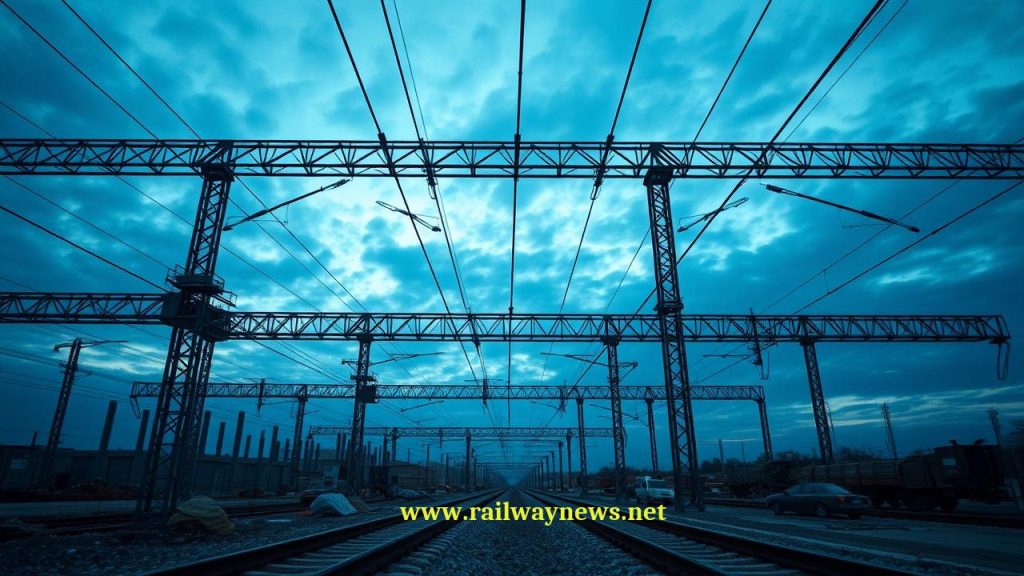
The OCS is not a single wire. It is a composite suspension system whose primary components are: the contact wire, the messenger wire (catenary wire), droppers, registration arms, tensioning equipment, and support masts. Understanding the contact wire and messenger wire — their distinct engineering roles, material specifications, and interaction mechanics — is essential to understanding why OCS design is one of the most technically demanding disciplines in railway infrastructure.
The Contact Wire: Engineering the Electrical Interface
The contact wire is the lowest element of the OCS. It runs parallel to the track at a nominal height — called nominal contact wire height — of between 5.0 m and 6.2 m above rail head, depending on speed, tunnel clearances, and system voltage. This is the wire that the pantograph physically touches; every kilowatt of traction power flows through this contact. Its design must satisfy simultaneous electrical, mechanical, and geometric demands that are often in direct conflict.
Cross-Section and Profile
Contact wires are not circular. They have a figure-of-eight or ribbed cross-section with two longitudinal grooves machined into the upper face. These grooves serve a precise function: they allow dropper clips and registration clamps to grip the wire mechanically without obstructing the smooth underside that the pantograph carbon strip slides across. EN 50119 specifies standard cross-sections of 100 mm², 120 mm², and 150 mm². Higher cross-section means lower electrical resistance (and thus less voltage drop over long distances), but also greater mass per metre — which increases the required messenger wire tension to maintain geometry.
Materials: Copper Alloys for Wear and Conductivity
Pure copper offers the best electrical conductivity (100% IACS — International Annealed Copper Standard), but it is too soft for the abrasive contact with pantograph carbon strips at high speed. Hard-drawn copper (HD-Cu) achieves ~97–99% IACS with tensile strength around 350–400 MPa. For high-speed lines, copper alloys replace pure copper:
| Material | Designation | Conductivity (% IACS) | Tensile Strength (MPa) | Typical Application |
|---|---|---|---|---|
| Hard-Drawn Copper | HD-Cu | 97–99% | 350–400 MPa | Conventional lines, <200 km/h |
| Copper-Magnesium | CuMg0.5 | ~75–80% | 530–580 MPa | HSR lines, 250–350 km/h |
| Copper-Silver | CuAg0.1 | ~96–98% | 400–450 MPa | High current density applications |
| Copper-Tin | CuSn0.2 | ~85–90% | 420–480 MPa | Intermediate speed lines |
CuMg0.5 (copper-magnesium with 0.5% magnesium) is now the standard for European high-speed lines. The Shinkansen N700 series operates under contact wires of similar alloy specification, with a nominal tension of 19.6 kN — among the highest in service globally. The trade-off is conductivity: at 75–80% IACS, auxiliary feeders are often added in parallel to compensate for the increased resistance.
Wear Life and Retirement Criteria
Contact wires wear from below as the pantograph carbon strip slides across them. EN 50119 specifies that a 100 mm² copper contact wire must be retired when its cross-section is reduced to 50 mm² — a 50% reduction. For safety-critical applications, many operators set earlier intervention thresholds at 60 mm². Wear rate is monitored using laser profilometry systems mounted on track geometry vehicles, capable of measuring contact wire height and cross-section to ±0.5 mm accuracy. On the Eurostar route through the Channel Tunnel, contact wire wear monitoring was upgraded from manual sampling to continuous laser measurement in 2017, reducing unplanned OCS interventions by 34%.
The Messenger Wire: Engineering the Structural Spine
The messenger wire — also called the catenary wire, a term derived from the Latin catena (chain) — hangs in a natural parabolic curve between support masts. This curve, strictly speaking a catenary, is the geometric shape any flexible chain or cable assumes under its own weight. The messenger wire’s function is to support the contact wire via vertical hangers (droppers) so that the contact wire remains at a constant, precisely controlled height regardless of the gravitational sag between masts.
The Catenary Geometry Explained
The messenger wire sags between masts. The amount of sag is governed by its tension and linear mass. At the mast (support point), the messenger wire is at its highest. At mid-span, it reaches its lowest point. The droppers connecting messenger wire to contact wire are therefore shortest at mid-span and longest near the masts — exactly compensating for the sag so that the contact wire runs dead straight. This geometry is what makes the system a catenary OCS or compound catenary as opposed to simpler, lower-speed trolley-wire systems.
Sag at mid-span (approximation):
s = (m × g × L²) / (8 × T)
s = (m × g × L²) / (8 × T)
where:
s = sag (m)
m = linear mass of messenger wire (kg/m)
g = gravitational acceleration (9.81 m/s²)
L = span length (m)
T = messenger wire tension (N)
Example: m = 1.0 kg/m, L = 60 m, T = 15,000 N
s = (1.0 × 9.81 × 3600) / (8 × 15,000) = 0.294 m ≈ 294 mm
Messenger Wire Materials
Unlike contact wires, messenger wires are stranded cables — multiple individual wires twisted together — to achieve high tensile strength while remaining flexible for installation. Material selection prioritises mechanical strength over electrical conductivity, though the messenger wire does carry current in most modern compound catenary designs.
| Material | Construction | Tensile Strength | Conductivity | Use Case |
|---|---|---|---|---|
| Copper-Cadmium (CuCd) | 7-strand stranded | ~550 MPa | ~80% IACS | Traditional European OCS |
| Aluminium Alloy (AAAC) | 19-strand stranded | ~300 MPa | ~52–58% IACS | Cost-sensitive, lighter systems |
| Galvanised Steel | 6+1 strand | ~1,200 MPa | ~8–10% IACS | Non-current-carrying structural use |
| Copper-Magnesium (CuMg) | 7-strand stranded | ~600 MPa | ~75–80% IACS | Modern HSR, matches CW alloy |
Note on CuCd: Cadmium-copper was the standard messenger wire material in European railways for most of the 20th century. However, cadmium is classified as a hazardous substance under EU REACH regulations. Network Rail completed a programme to eliminate new cadmium-copper installations on its electrified routes by 2019, replacing them with CuMg or AAAC alternatives.
The Dropper System: Translating Geometry into Reality
Droppers are the vertical (or near-vertical) connectors that link the messenger wire above to the contact wire below. They are the critical intermediary that converts the sagging geometry of the messenger wire into the flat, level geometry of the contact wire. A dropper failure — as in the 2020 Frankfurt ICE incident — collapses this geometric precision instantaneously.
Dropper Length Gradient
Within any given span, dropper lengths vary continuously. At the support mast, where the messenger wire is at its highest relative to the contact wire, droppers are longest — typically 800–1,200 mm for conventional OCS. At mid-span, where the catenary sag brings the messenger wire closest to the contact wire height, droppers may be as short as 50–150 mm. The mathematical relationship governing dropper lengths is derived from the difference in height between the catenary profile and the contact wire design height at each point along the span.
Dropper Types and Failure Modes
Traditional droppers were fixed-length solid copper or phosphor-bronze rods. Modern systems use elastic droppers — pre-tensioned spring elements or elastomeric components — that absorb the dynamic forces of pantograph passage without transmitting shock loads back into the messenger wire. At 300 km/h, the pantograph passes each dropper in approximately 5–8 milliseconds; the dynamic force spike during this contact can exceed the static pantograph contact force of 60–120 N (as specified in EN 50367) by a factor of 2–3 without elastic buffering. Stiff droppers transmit these spikes as wave energy into the messenger wire, creating resonance that degrades current collection quality. Elastic droppers — now standard on lines operating above 200 km/h — reduce these peaks by 40–60%.
Wave Propagation Speed: The Physics of High-Speed Current Collection
The most important and least-discussed parameter in OCS design for high-speed operation is elastic wave propagation velocity. When a pantograph travels along a contact wire, it displaces the wire upward by its contact force. This displacement propagates ahead of the pantograph as an elastic wave — exactly as a wave propagates along a guitar string when plucked. If the pantograph travels faster than this wave, it “outruns” its own disturbance and current collection becomes catastrophically erratic.
Wave propagation velocity:
c = √(T / μ)
c = √(T / μ)
where:
c = wave propagation speed (m/s)
T = contact wire tension (N)
μ = contact wire linear mass density (kg/m)
Example: T = 20,000 N, μ = 1.07 kg/m (120 mm² CuMg)
c = √(20,000 / 1.07) = √18,692 ≈ 136.7 m/s = 492 km/h
Safety criterion: Train speed must not exceed 70% of c
Maximum safe operating speed: 0.70 × 492 = 344 km/h ✓
This calculation explains why high-speed contact wires run under very high tension (15–20 kN on 250–350 km/h lines, versus 8–12 kN on conventional lines) and why low-density alloys are preferred. The Shinkansen Tokaido line, upgraded for 285 km/h N700 operations, uses a contact wire tension of 19.6 kN — one of the highest globally. France’s LGV lines use CuMg contact wire tensioned at 15–17 kN, giving propagation velocities of ~400–450 km/h and safe operating margins well above the 320 km/h TGV Duplex maximum speed.
Auto-Tensioning Systems: Compensating for Temperature
Steel, copper, and aluminium all change length with temperature. A 25 kV AC contact wire spanning 3 km between tensioning points will expand or contract by approximately 1.5–2.0 m between a winter night at −30 °C and a summer afternoon at +50 °C. Without compensation, wire tension would halve in summer (causing sag and loss of wave propagation margin) and double in winter (risking wire fracture at connection points or cantilever clamps).
Balance Weight Tensioning
The most common solution is the balance weight auto-tensioner. At each tension length endpoint (typically every 1,200–1,600 m on European HSR), the contact wire and messenger wire pass over a pulley system and connect to a stack of concrete or cast-iron weights hanging freely. As temperature rises and the wire expands, the weights descend slightly, paying out wire and maintaining constant tension. As temperature drops, the weights rise. The system maintains tension within ±5–10% across the full operational temperature range with no active control required. The Channel Tunnel OCS uses balance weight tensioners with 15 kN design tension, maintaining constant geometry across the 50.5 km undersea bore despite ambient temperatures that vary relatively little — but current loading can raise conductor temperature by 15–20 °C above ambient.
Tension Length and Mid-Point Anchoring
Each tensioned section — called a tension length — is fixed at its centre point via a mid-point anchor that prevents the wire from “creeping” in one direction under repeated thermal cycling. Without mid-point anchors, the entire tension length would drift toward one tensioning device over thousands of thermal cycles, eventually running the weights to their mechanical stops and either snapping the wire (if weights hit bottom) or allowing dangerous sag (if weights hit top).
Contact Wire vs. Messenger Wire: Full Technical Comparison
| Parameter | Contact Wire | Messenger Wire |
|---|---|---|
| Primary Function | Electrical interface with pantograph; current transfer | Structural support of contact wire via droppers |
| Position | Lower wire; horizontally level | Upper wire; catenary curve between masts |
| Cross-Section Shape | Solid, grooved (ribbed underside smooth for pantograph) | Stranded (multi-wire twisted cable) |
| Standard Material (HSR) | CuMg0.5 alloy; 100–150 mm² cross-section | CuMg stranded cable; 70–120 mm² cross-section |
| Typical Design Tension | 10–20 kN (proportional to operating speed) | 10–25 kN (higher than CW to control sag geometry) |
| Primary Wear Mechanism | Mechanical abrasion and electrical erosion from pantograph | Corrosion, fatigue at clamp points, UV degradation |
| Electrical Role | Primary current carrier (direct feed to train) | Auxiliary feeder (reduces longitudinal voltage drop) |
| Replacement Trigger | Wear to 50% nominal cross-section (EN 50119) | Strand breaks, corrosion pitting, clamp slippage |
| Height Above Rail (EN 50119) | 5.0–6.2 m nominal; ±100 mm tolerance band | Variable (sag-dependent); typically 0.8–1.4 m above CW |
The Stagger System: Protecting the Pantograph Strip
A pantograph carbon strip typically measures 1,600–2,000 mm in width and 20–40 mm in height. If the contact wire ran dead centre above the track for its entire length, the pantograph strip would wear in a single line — a groove that would deepen until structural failure of the strip. The solution, implemented since the earliest overhead electrification systems in the 1880s, is stagger: the deliberate lateral displacement of the contact wire alternately to either side of the track centreline.
Conventional lines use a stagger of ±200 mm. High-speed lines typically use ±300 mm. The stagger is achieved by positioning the registration arms (the bracket arms that connect the OCS to the mast and hold the contact wire at the correct lateral position) alternately to the left and right. As the train passes each mast, the contact wire transitions smoothly from one stagger position to the other, distributing pantograph wear across the full strip width. EN 50119 specifies maximum stagger values for each track curvature class to ensure the pantograph strip remains in contact with the wire throughout the transition.
Real-World OCS Specifications: Global HSR Systems
| System | Max Speed | Contact Wire | CW Tension | Span Length | Voltage |
|---|---|---|---|---|---|
| Shinkansen Tokaido (Japan) | 285 km/h | CuSn, 170 mm² | 19.6 kN | 50 m | 25 kV AC |
| LGV (France, TGV) | 320 km/h | CuMg0.5, 150 mm² | 15–17 kN | 60–65 m | 25 kV AC |
| ICE (Germany, DB) | 300 km/h | CuMg0.5, 120 mm² | 14–16 kN | 55–65 m | 15 kV 16.7 Hz |
| HS2 (UK, under construction) | 360 km/h (design) | CuMg0.5, 150 mm² | 27 kN (design) | Up to 75 m | 25 kV AC |
| Channel Tunnel (Eurostar) | 160 km/h (tunnel) | HD-Cu, 150 mm² | 15 kN | Variable | 25 kV AC |
| CRH (China, Beijing–Shanghai) | 350 km/h | CuMg0.5, 120 mm² | 15 kN | 50–60 m | 25 kV AC |
HS2’s design tension of 27 kN for 360 km/h operation represents the current frontier of OCS engineering. At that tension with a 150 mm² CuMg wire (μ ≈ 1.33 kg/m), the wave propagation velocity calculates to c = √(27,000 / 1.33) ≈ 450 km/h — giving a maximum safe operating speed of 0.70 × 450 = 315 km/h by the standard criterion. To reach 360 km/h, HS2’s OCS specification adopts a more refined dynamic assessment per EN 50318, accepting a higher pantograph-to-wave-speed ratio under carefully validated simulation.
Editor’s Analysis
The contact wire and messenger wire represent one of railway engineering’s most elegant solutions to a deceptively complex problem: how do you deliver megawatts of electrical power to a vehicle travelling at 300 km/h through a contact patch measuring roughly 15 mm × 40 mm? The answer — a tensioned wire system maintained in millimetre-accurate geometry by a hanging cable and a series of variable-length droppers — was developed incrementally over more than a century, from the first 600 V DC tram lines of the 1880s to today’s 25 kV AC high-speed systems. What the history reveals is that the physics have always been understood; the limiting factor has always been materials. The shift from HD-Cu to CuMg alloys between the 1980s and 2000s is what unlocked speeds above 250 km/h. The next frontier — speeds above 400 km/h for prototype systems like Japan’s SCMaglev-derived wheel-on-rail research — will require either contact wire tensions above 25 kN with ultra-low-density alloys, or a fundamentally different current collection paradigm altogether. Some researchers are exploring inductive power transfer as a partial solution for tunnel sections, eliminating the OCS entirely in the most geometrically constrained environments. But for the foreseeable future, the compound catenary — two wires, one elastic, one rigid — remains the only proven technology that can sustain megawatt-class power transfer to a high-speed vehicle reliably, safely, and across a network measured in tens of thousands of kilometres.
— Railway News Editorial
Frequently Asked Questions
1. Why does a contact wire have grooves if its underside must be smooth for the pantograph?
The grooves on a contact wire run along the upper face of the wire — the side facing away from the pantograph. This is precisely where the wire needs to be gripped. Dropper clips, registration clamps, and suspension fittings all use jaws or saddles that engage these grooves to prevent the wire from rotating or translating longitudinally under tension and dynamic loads. The underside, where the pantograph carbon strip makes contact, is left completely smooth and slightly rounded in profile to minimise wear and ensure consistent sliding contact across the full pantograph travel. In cross-section, the wire looks roughly like a figure-of-eight with the top lobe containing the grooves and the bottom lobe forming the smooth running surface. This asymmetric design means contact wires are manufactured with a specific orientation that must be maintained during installation — installers use the grooves as reference marks to ensure the wire is not twisted before tensioning. On some older systems, contact wires were occasionally installed inverted by error, resulting in premature clamp slippage and dropper failures that were puzzling until the orientation mistake was discovered.
2. What happens to current collection quality when a dropper fails?
A dropper failure removes one of the geometric constraints that keeps the contact wire level. The contact wire, freed from that support point, sags under its own weight and the tension in adjacent droppers redistributes. The geometry deviation is immediate: a single failed dropper on a 60 m span can cause a height variation of 30–80 mm in the contact wire, depending on its position along the span. At low speeds, this is merely a quality-of-collection issue — the pantograph force varies and current transfer becomes intermittent. At high speeds, the consequences escalate rapidly. If the height deviation exceeds the pantograph’s vertical tracking range (typically ±100 mm from nominal), the pantograph loses contact entirely, creating an arc. The arc event generates a local plasma temperature of several thousand degrees Celsius, eroding both the carbon strip and the contact wire surface. Multiple consecutive arc events can burn through a contact wire entirely. This is why dropper inspection intervals are tightly regulated: Network Rail’s standard requires visual inspection of all droppers every 12 months on electrified routes, with ultrasonic testing of clamp connections every 6 years. On the East Coast Main Line, a programme to replace stiff solid droppers with elastic droppers reduced dropper failure rates by 62% between 2015 and 2021.
3. Why do some systems use a “twin contact wire” arrangement?
Some metro and suburban systems — particularly those with very high current demands due to frequent acceleration and short headways — install two contact wires in parallel, side by side, below a single messenger wire. This is called a twin contact wire or double contact wire arrangement. The primary driver is electrical rather than mechanical: two 100 mm² contact wires in parallel give 200 mm² of cross-section, halving the longitudinal resistance and reducing voltage drop per kilometre proportionally. This matters enormously in DC systems (750 V or 1,500 V) where voltage drop along the feeder is a primary constraint on substation spacing and train performance. Some Tokyo Metro lines and older sections of the Paris Métro use twin-wire arrangements for this reason. The mechanical complexity increases significantly: both wires must be staggered together in the same lateral pattern, all dropper clips must be designed for two-wire engagement, and pantograph design must ensure equal contact force on both wires simultaneously to prevent differential wear. On high-speed AC lines, the combination of higher voltage (25 kV) and auxiliary feeder cables renders twin contact wire unnecessary for voltage-drop management, so it is not used on TGV, ICE, or Shinkansen lines.
4. How is the messenger wire connected to the mast — and why does this connection point matter so much?
The messenger wire connects to the mast via a cantilever arm (also called a steady arm or registration arm assembly) and a messenger wire clamp at the mast head. This connection point is the location of maximum stress concentration in the entire OCS. At this point, the messenger wire transitions from a freely-hanging tensioned cable — where stress is distributed along the full cross-section — to a clamped fitting where bending moments and clamp pressure concentrate stress at the point of grip. Fatigue cracks in messenger wires almost always initiate at or very near clamp interfaces, propagating through individual strands over months or years of repeated dynamic loading from passing pantographs and wind-induced oscillation. EN 50119 requires that clamp designs provide a fatigue life of at least 10 million load cycles, tested to EN 61284. In practice, messenger wire clamp intervals are reduced near tunnel portals, bridges, and areas with high wind exposure where dynamic loading is greatest. The 2015 pantograph strike incident on the Heathrow Express approach at Paddington — which brought down approximately 800 m of OCS and cancelled services for 14 hours — was traced in part to fatigue cracking at a messenger wire clamp that had not been replaced during a scheduled maintenance window due to access constraints during platform remodelling works.
5. Can a contact wire be repaired in situ, or must it always be replaced as a full tension length?
Contact wire repair in situ is possible but technically restricted under EN 50119 and most national infrastructure managers’ standards. The key technique is contact wire joint insertion using a compression-type bolted repair joint (also called a splice clamp). A repair joint allows a damaged section — typically 0.5–5 m cut out after localised burning, mechanical damage, or corrosion — to be replaced without re-stringing the entire tension length. However, repair joints introduce a localised stiffness discontinuity: the steel or bronze clamping body is significantly stiffer and heavier per unit length than the contact wire itself. This creates a mass discontinuity that the pantograph “feels” as a bump, generating an upward force spike. EN 50119 limits the number of repair joints per tension length (typically maximum 2–3 per 1,500 m section) and prohibits their installation on lines operating above a defined speed threshold — commonly 200 km/h in European practice. Above that speed, a full re-string of the affected tension length is mandatory. This is why a single pantograph strike on a high-speed line can result in engineering possessions lasting 8–16 hours and costing hundreds of thousands of euros: not because the wire itself is expensive (a 120 mm² CuMg wire costs approximately €25–35/m), but because a full-tension-length re-string on a live 25 kV AC network in a limited overnight possession window requires specialist teams, road-rail vehicles, and precise tensioning equipment that cannot simply be deployed at speed.

Railway infrastructure, rolling stock and transport technologies specialist focused on global rail industry developments, high-speed rail systems, signaling technologies and freight transportation. Covering railway investments, public transport modernization, rail operations and international mobility projects across Europe, Asia and North America.
RELATED POSTS
September 6, 2026 5:19 am
Hitachi delivered Taiwan's first N700ST high-speed train from Japan in...

September 5, 2026 4:19 pm
CPK launched formal tender talks with four consortia to design...

September 5, 2026 7:14 pm
HS2 Ltd signed renegotiated civils contracts with EKFB and Align...

September 6, 2026 4:12 am
Alstom delivered the first of 100 new G Class trams...
September 6, 2026 1:17 am
Hitachi Toshiba Supreme Consortium confirmed the first of 12 N700ST...

September 6, 2026 6:17 am
Hungary ordered a national ban on most freight trains from...