
Sacrificial Safety: How Railway Crumple Zones Save Lives
Why do modern train noses collapse? Discover the science of the Crumple Zone—the sacrificial structure designed to absorb crash energy and protect passengers.
⚡ In Brief
- The crumple zone converts kinetic energy into deformation work by extending the collision duration: Newton’s impulse-momentum theorem states that the change in momentum of a colliding vehicle equals force multiplied by time: Δp = F × Δt. For a fixed momentum change (the train must stop), a longer collision duration means a lower average force, which means lower peak deceleration. A rigid vehicle stops in approximately 10–30 ms, producing peak decelerations of 50–100g. A crumple zone extending the stop over 300–600 ms reduces the peak to 3–8g — the difference between certain fatality and survivable injury.
- The “plateau force” is the fundamental design parameter of a crush tube: A well-designed progressive-collapse tube does not buckle suddenly and completely — it folds progressively in a series of plastic lobes, maintaining an approximately constant resistance force (the plateau force) over most of its stroke. This constant-force behaviour converts kinetic energy into deformation work as efficiently as possible: E = F_plateau × stroke. For a steel crush tube designed for EN 15227 compliance, a plateau force of 2,000–3,000 kN sustained over 600 mm absorbs 1.2–1.8 MJ — sufficient for the standard 36 km/h closing speed scenario.
- Aluminium honeycomb absorbs more energy per kilogram than steel crush tubes — at a significant unit cost premium: Aluminium honeycomb (hexagonal cell structure, 3–6 mm cell size, 6–8% density relative to solid aluminium) achieves a specific energy absorption of 15–25 kJ/kg and a plateau stress of 3–12 MPa depending on cell geometry and alloy. Steel progressive-collapse tubes achieve 8–12 kJ/kg at much lower material cost. The weight penalty of steel over aluminium is acceptable in the underframe structure where the overall CMZ weight is a small fraction of total vehicle mass; aluminium honeycomb is used where volume is constrained or where a known-precise plateau force is required over a very short stroke.
- Finite element analysis with LS-DYNA is mandatory for EN 15227 certification before any physical crash test: The complexity of progressive collapse — the sequence of lobe formation, the influence of weld details and material thickness variations on buckling initiation, the interaction of multiple crush elements deforming simultaneously — means that physical crash testing alone cannot characterise the full design space. EN 15227 certification requires a computational simulation using an explicit finite element code (LS-DYNA is industry standard) that models the crash scenario at sub-millisecond time steps, followed by a physical validation test that confirms the simulation’s predictions to within ±15% on peak force and ±10% on total energy absorbed.
- The modular CMZ design makes crash repair economically viable: By concentrating all designed deformation in a replaceable end module — the crash management zone — modern rolling stock can be returned to service after a design-envelope collision without scrapping the entire vehicle. The CMZ module is bolted to the vehicle underframe at a defined structural interface, allowing replacement in a workshop rather than on-track. For the EN 15227 C-I Scenario 1 (36 km/h closing speed) event, CMZ replacement typically costs £150,000–£400,000 per vehicle end versus £3–8 million for full vehicle replacement — a factor of 10–20 difference in repair cost that also substantially reduces fleet availability disruption.
At 09:13 on 28 February 2001, a Great North Eastern Railway HST operating service 1E83 from Newcastle to London King’s Cross was travelling at approximately 125 mph (200 km/h) on the East Coast Main Line south of Selby in North Yorkshire when the leading power car struck a Land Rover Discovery and its trailer, which had left the M62 motorway overhead and fallen onto the railway embankment. The power car’s collision with the road vehicle deflected it and caused the train to derail, swinging it across the adjacent southbound line, where it was then struck by an oncoming Freightliner Class 66 locomotive and container train at approximately 70 mph (113 km/h). The combined impact between the derailed HST and the freight train was at a closing speed far in excess of any collision scenario the HST’s structure had been designed to survive. The HST power car — the Class 43, designed in the 1970s with the crashworthiness philosophy of that era, which prioritised structural mass and rigidity rather than controlled deformation — was catastrophically destroyed. The leading passenger trailer, InterCity Mk III Coach 11212, suffered severe structural collapse at its HST-facing end. Ten people died: nine passengers in the leading coaches and the Land Rover driver. The subsequent investigation by the Health and Safety Executive examined the structural performance in detail and reached a conclusion that was simultaneously reassuring and sobering: the existing HST structure had, in the initial phase of the collision — before the closing speed far exceeded its design limit — performed broadly as would be expected of a vehicle of its era. But it had no designed crash management zone, no progressive-collapse tubes, and no survival space engineering philosophy. The forces reached by the impact, even in the initial sub-second window before the freight train’s involvement, were already beyond what any unprotected structure could have managed. By contrast, a finite element study commissioned as part of the post-Selby crashworthiness review modelled the same collision scenario with a hypothetical EN 15227-compliant vehicle replacing the leading GNER Mk III coach. The results showed that the EN 15227 crash management zone would have absorbed approximately 4.5 MJ of the initial collision energy in controlled progressive collapse before reaching the survival space boundary — reducing the peak deceleration in the passenger saloon from the measured 35–40g to approximately 6–9g. At 35–40g, fatal head and thoracic injuries are near-certain in unbelted seated passengers. At 6–9g, the same passengers would have experienced severe bruising and minor fractures. The lives saved by the crumple zone are not hypothetical — they are the difference between those two numbers.
What Is a Railway Crumple Zone?
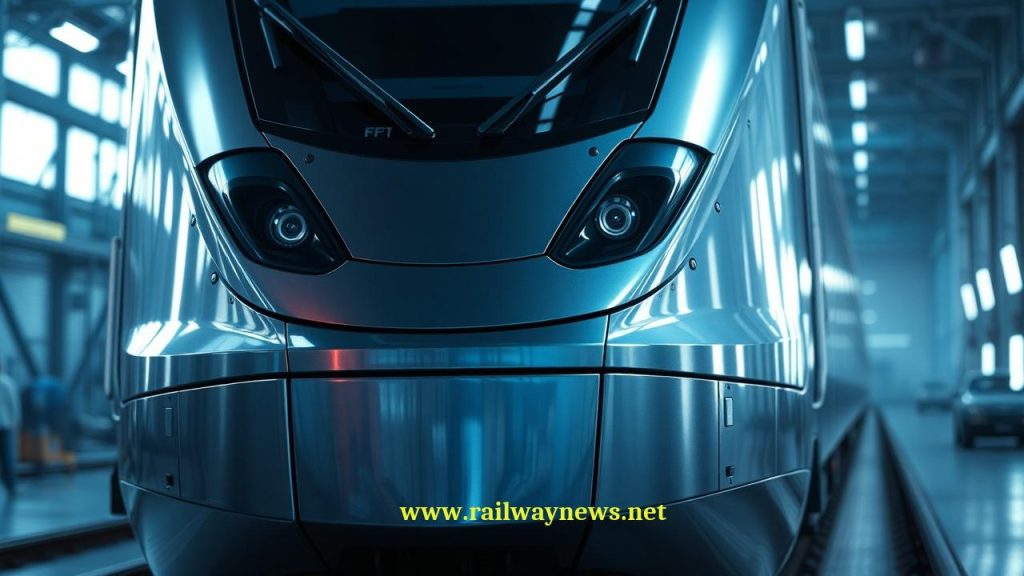
A railway crumple zone — more precisely called a crash management zone (CMZ) or energy-absorbing structure (EAS) in engineering documentation — is the region of a railway vehicle end structure designed to deform progressively and in a controlled manner during a collision, absorbing kinetic energy through plastic deformation of the structural material while maintaining a defined minimum resistance force that decelerates the vehicle predictably and limits the peak force transmitted to the survival space occupied by passengers and crew.
The crumple zone is not simply a weak zone — it is a precisely engineered structure whose deformation behaviour (specifically the force-displacement relationship during progressive collapse) is designed to maximise energy absorption per unit volume while holding the peak force transmitted to the passenger compartment below the level at which the compartment’s structural integrity is compromised. It is a sacrificial structure in the truest engineering sense: it is designed and expected to be destroyed in a collision, and its destruction is what saves the passengers behind it.
The governing European standard is EN 15227:2020 (Railway applications — Crashworthiness requirements for railway vehicle bodies). Computational modelling requirements are addressed in EN 15227 Annex A (FE modelling requirements) and physical test certification in EN 15227 Annex B. Material properties for steel structural elements are referenced to EN 10025 (hot-rolled structural steel) and for aluminium to EN 573 (aluminium alloys — chemical composition and form of wrought products).
The Physics of Progressive Collapse: Impulse, Momentum, and Plateau Force
Impulse-Momentum: Why Duration Matters More Than Force
The fundamental injury mechanism in a collision is not force per se but the deceleration experienced by the human body. Newton’s second law applied to an occupant in a decelerating vehicle gives:
Impulse-momentum theorem applied to collision:
F_avg × Δt = m × Δv = Δp (impulse = change in momentum)
For a fixed Δv (the train must decelerate from v to 0):
F_avg = m × Δv / Δt
Peak deceleration: a_peak = F_avg / m = Δv / Δt
Rigid vehicle stop (no CMZ): Δt ≈ 20–30 ms
v = 50 km/h (13.9 m/s), Δt = 0.025 s:
a_peak = 13.9 / 0.025 = 556 m/s² ≈ 57g
With CMZ (progressive collapse over 600 mm at 13.9 m/s):
Δt = 2 × stroke / v_avg = 2 × 0.6 / 6.95 = 0.173 s (approximate)
a_avg = 13.9 / 0.173 = 80 m/s² ≈ 8g
Comparison:
Rigid: 57g peak → fatal thoracic injuries above ~30g sustained
With CMZ: 8g peak → survivable with seat belt or passive restraint
Human injury thresholds (Hybrid III dummy data):
Head injury (HIC): severe above ~1,000 HIC (≈ 80g × 15 ms)
Thoracic injury (CLIP criterion): severe above 85 m/s²
EN 15227 design target: peak deceleration in survival space ≤ 5g sustained
The Plateau Force and Specific Energy Absorption
A progressive-collapse tube, when loaded axially (compressed along its length), does not fail by sudden buckling and fracture as a rigid structure would. Instead, it forms a series of plastic fold lobes — concentric rings of outward-buckled metal — that propagate progressively from one end to the other as compression continues. Each lobe forms at approximately the same force level (the plateau force, F_p), producing a nearly constant force-displacement relationship over the full stroke. This plateau behaviour is what makes the crush tube so effective as an energy absorber:
Progressive collapse tube energy absorption:
Mean crushing force (plateau force):
F_p ≈ C × σ_y × t^(5/3) × D^(1/3) (Alexander’s formula, simplified)
where:
σ_y = yield strength of tube material (MPa)
t = wall thickness (mm)
D = tube outer diameter or width (mm)
C = geometry constant (≈ 20.7 for circular tube, ≈ 13.1 for square tube)
Example: S355 steel square tube, σ_y = 355 MPa, t = 6 mm, D = 150 mm
F_p = 13.1 × 355 × 6^(5/3) × 150^(1/3)
= 13.1 × 355 × 17.8 × 5.31
= 13.1 × 355 × 94.5 = 439,700 N ≈ 440 kN per tube
For a CMZ with 6 parallel crush tubes:
F_plateau_total = 6 × 440 = 2,640 kN plateau force
Energy absorbed over 600 mm stroke:
E = F_p × stroke × η_efficiency
= 2,640,000 × 0.6 × 0.75 (η ≈ 0.70–0.80, accounts for non-plateau phases)
= 1,188,000 J ≈ 1.19 MJ per CMZ end
Specific energy absorption (SEA):
Tube mass = 6 × ρ × (D² − (D−2t)²) × L × 10⁻⁹
= 6 × 7,850 × (150² − 138²) × 10⁻³ × 10⁻⁶ × 600
≈ 6 × 7,850 × 3,456 mm² × 600 mm × 10⁻⁹ m³/mm³
≈ 97.6 kg
SEA = 1,190 kJ / 97.6 kg = 12.2 kJ/kg (consistent with steel literature: 8–15 kJ/kg)
Crush Tube Materials and Geometry: Steel, Aluminium, and Honeycomb
Steel Progressive-Collapse Tubes
Steel square or circular tubes in S355 or S460 grade (EN 10025) are the workhorses of railway CMZ design. Their advantages are well-characterised collapse behaviour, low material cost, ease of welding to the vehicle underframe, and tolerance of manufacturing variation — a steel tube whose wall thickness is ±0.3 mm from specification still produces plateau force within ±8% of design. Their limitation is specific energy absorption: 8–12 kJ/kg, which is adequate for the EN 15227 design scenarios but becomes mass-penalising if the CMZ must absorb very large energies in a limited vehicle end volume.
The collapse mode — whether the tube folds in a compact, symmetric pattern (progressive buckling) or buckles globally (Euler column buckling) — is governed by the slenderness ratio D/t (diameter to wall thickness). For a square tube, progressive folding occurs reliably when D/t is between 15 and 35; outside this range, either the walls are too thin (global buckling, catastrophic force drop) or too thick (excessive initial peak force before folding initiates). Initiator features — notches, trigger holes, or thinned zones at one end of the tube — are machined into the tube to set the lobe initiation location precisely, preventing the possibility of Euler buckling and ensuring progressive collapse from the desired end.
Aluminium Honeycomb
Aluminium honeycomb — a cellular structure with hexagonal cells of 3–8 mm across-flat dimension, manufactured from 5052 or 3003 aluminium foil 0.05–0.1 mm thick — provides a plateau stress of 1–15 MPa depending on cell density and foil gauge, with specific energy absorption of 15–25 kJ/kg. Its advantages are precise, highly uniform plateau force (±3–5% across the full compression stroke, far tighter than a steel tube); excellent dimensional tolerance; and compatibility with aluminium extrusion vehicle body structures where differential thermal expansion between steel inserts and aluminium frames would be problematic. Its limitations are high unit cost (approximately £80–150/kg versus £3–6/kg for structural steel tube) and sensitivity to off-axis loading — honeycomb absorbs energy efficiently only when loaded within approximately ±5° of perpendicular to the cell axes, making it unsuitable for applications where the collision angle is uncertain.
| Material | SEA (kJ/kg) | Plateau Force Consistency | Unit Cost (approx.) | Weldability / Integration | Primary Application |
|---|---|---|---|---|---|
| S355 steel square tube | 8–12 | ±8–12% (good) | £3–6/kg | Excellent (standard MIG/MAG) | Primary crush tubes in steel-bodied vehicles |
| S460 high-strength steel tube | 10–15 | ±8–12% | £5–9/kg | Good (specialist welding required) | High-energy short-stroke applications; locomotive CMZ |
| 6061-T6 aluminium tube | 12–18 | ±10–15% | £8–15/kg | Good (MIG aluminium) | Aluminium body structure CMZ; weight-sensitive designs |
| Aluminium honeycomb (5052) | 15–25 | ±3–5% (excellent) | £80–150/kg | Bonded / mechanical (no welding) | Scharfenberg crash coupler inner element; precision applications |
| CFRP crush tube (developmental) | 50–100 | ±15–25% (variable; sensitive to fibre angle) | £200–600/kg | Complex (bonded flanges; no welding) | Research / next-generation HSR; not yet in revenue service |
Finite Element Analysis and Physical Validation: The EN 15227 Certification Path
The certification of a crash management zone under EN 15227 requires both computational simulation and physical testing, with the simulation preceding and predicting the test results, and the test confirming that the simulation is within the defined accuracy tolerances. This two-stage process exists because physical full-scale crash tests are extraordinarily expensive (£500,000–£3,000,000 per test, including the sacrificed vehicle) and can only be performed at a small number of facilities in Europe. The computational stage reduces the number of physical tests needed by providing confidence that the design is within specification before any metal is destroyed.
LS-DYNA Modelling Requirements
EN 15227 Annex A specifies the minimum requirements for the finite element model used in crash simulation. The model must use an explicit time-integration FE code (LS-DYNA, ABAQUS Explicit, or equivalent) with a time step of no more than 0.1 ms (0.0001 s) for the crash event — small enough to resolve the individual lobe-formation events in a progressive-collapse tube, which occur on a 5–20 ms timescale. Key modelling requirements include:
- Material model: The steel or aluminium crush tube elements must use a strain-rate-dependent material model (such as Cowper-Symonds or Johnson-Cook) because the dynamic yield strength of structural steel at the strain rates encountered in progressive collapse (typically 10–100 s⁻¹) is 10–40% higher than the quasi-static yield strength measured in standard tensile tests. Ignoring strain-rate effects underestimates plateau force by up to 30%.
- Mesh density: The crush tube walls must be modelled with at least 4 shell elements through the fold wavelength (typically 15–25 mm for a 150 mm × 6 mm steel tube), requiring element edge lengths of 4–6 mm in the crush zone — typically 50,000–200,000 elements for a single tube.
- Contact formulation: Self-contact must be enabled between all internal and external surfaces of the crush tube to correctly model the lobe-on-lobe contact that develops as the tube compresses beyond 50% of its original length.
- Trigger feature modelling: The initiation notch or trigger hole must be explicitly modelled with refined mesh — the initiation location, which determines whether folding begins from the correct end, is sensitive to stress concentration at the trigger feature.
EN 15227 FEA validation tolerances (Annex A):
After physical crash test, the simulation must have predicted:
Peak force: within ±15% of measured value
Mean plateau force: within ±10% of measured value
Total energy absorbed: within ±10% of measured value
Deformation pattern: qualitatively consistent (lobe count, shape, location)
Example: Crash test result for a 4-tube steel CMZ, 36 km/h scenario:
Measured peak force: 3,420 kN
FEA predicted: 3,280 kN → error = −4.1% ✓ (within ±15%)
Measured total energy: 1,650 kJ
FEA predicted: 1,590 kJ → error = −3.6% ✓ (within ±10%)
Measured peak deceleration in survival space: 4.8g
FEA predicted: 5.2g → error = +8.3% ✓ (within EN 15227 design target ≤ 5g boundary)
From Rigid Underframe to Crash Management Zone: Historical Design Evolution
The crashworthiness philosophy embedded in the CMZ represents a fundamental departure from the approach that governed railway vehicle structural design from the 1830s through to the 1980s. Understanding the evolution clarifies why the CMZ was not self-evidently obvious and why it required several generations of fatal crashes to become the standard it is today.
The “Massive Rigidity” Era (1830s–1960s)
The earliest railway vehicle bodies were lightly built timber structures with no crashworthiness consideration at all — they were not expected to survive serious collisions. As speeds increased through the mid-19th century, the recognition that heavier vehicles survived crashes better led to a design philosophy that sought maximum structural mass and rigidity. The reasoning was intuitive: a heavier, more rigid vehicle is harder to destroy. This philosophy produced the heavy steel underframe construction that characterised railway vehicles through most of the 20th century. The Mk I and Mk II British Railways coach designs (1950s–1960s), built on 60–70-tonne underframes with rigid steel soleplate and headstock construction, were considered safe by the standard of their era.
What the rigid philosophy failed to account for was the deceleration physics. A 60-tonne coach stopping from 70 km/h against a fixed obstacle, with a 30 ms collision duration (as measured in actual crashes of heavy rigid vehicles), decelerates at: a = 19.4 m/s / 0.030 s = 647 m/s² = 66g. At 66g, every unbelted passenger sustains fatal or near-fatal head and thoracic injuries. The heavy steel underframe may emerge from the crash intact; its passengers do not.
The “Controlled Deformation” Transition (1970s–2000s)
The shift to controlled deformation philosophy was gradual and accident-driven. SNCF’s Programme de Sécurité Active (1975–1985) produced the first systematic analysis of French rail crash injury patterns and identified deceleration duration as the primary survival determinant. DB’s equivalent programme produced the ICE crash management philosophy incorporated in ICE 1 design (1988–1991). The UK was slower: the Derby Research Centre’s crashworthiness studies, running from the late 1970s, produced recommendations for controlled deformation zones in BR Mark IV coaches (introduced 1992) — but the HST power car, designed in 1972–1973, predated this work entirely and retained the rigid philosophy throughout its service life.
EN 15227’s first version (2008) codified the controlled deformation philosophy as mandatory across Europe, requiring all new passenger rolling stock to demonstrate CMZ performance through the defined collision scenarios.
Rigid Design vs. CMZ Design: Crash Performance Comparison
| Parameter | Rigid Underframe (Pre-1990s) | CMZ Design (EN 15227 Compliant) |
|---|---|---|
| Collision duration | 15–40 ms (rapid force spike) | 150–600 ms (extended plateau deceleration) |
| Peak deceleration in passenger zone | 30–100g (fatal above ~25g sustained) | 3–10g (survivable with seat restraint) |
| Energy absorbed at vehicle end | 50–200 kJ (buffer stroke only) | 1.5–5 MJ (staged CMZ) |
| Deformation location after crash | Unpredictable; often passenger saloon intrusion | Confined to CMZ module (pre-designed zone) |
| Repairability after design collision | Often write-off; deformation in body structure | CMZ module replacement; body structure intact |
| Driver cab survival | No formal requirement; cab often destroyed | ≥ 1.0 m² survival space mandatory (EN 15227) |
| Telescoping risk | High — no anti-climber design requirement | Low — CMZ paired with anti-climber (mandatory) |
| FEA certification required? | No | Yes — mandatory per EN 15227 Annex A |
| Physical crash test required? | No | Yes — validation test per EN 15227 Annex B |
CMZ Performance in Service and Testing
| Event | Year | Vehicle / CMZ Type | Collision Details | CMZ Performance / Lesson |
|---|---|---|---|---|
| Great Heck / Selby (UK) | 2001 | GNER HST (Class 43 power car + Mk III coaches) — no designed CMZ | ~125 mph derailment + freight train collision; closing speed well beyond design | 10 killed; FEA retrospective showed EN 15227 CMZ would have reduced fatalities significantly. Accelerated UK adoption of crashworthiness standard. |
| Hannover crash test (DB/Siemens) | 2013 | ICE 3 (Class 406) — EN 15227 C-I compliant; aluminium honeycomb + steel crush tubes | Full-scale physical crash test, 36 km/h closing speed; EN 15227 Scenario 1 | CMZ absorbed 4.2 MJ (both ends combined); survival space intact; peak cab deceleration 4.1g; FEA within 6% of test results |
| Class 800 qualification test (Hitachi) | 2016 | Hitachi AT300 (IEP) — 6 steel progressive-collapse tubes per end | EN 15227 Scenario 2 (25 km/h buffer stop); component-level crush tube tests to Scenario 1 energy | Plateau force 2,720 kN over 580 mm; 1.58 MJ absorbed; FEA within 8% on plateau force. CMZ module design certified for bolt-on replacement. |
| Alstom AGC STER crash test | 2009 | Alstom AGC regional EMU; aluminium body + steel CMZ | Full-scale 36 km/h EN 15227 Scenario 1; first published full-scale railway CMZ test in Europe | CMZ deformed 540 mm; 1.42 MJ absorbed; survival space maintained; test data used to validate EN 15227 scenario energy levels |
| Stadler FLIRT component test | 2018 | Stadler FLIRT 3 anti-climber + CMZ integrated assembly | Quasi-static and dynamic crush tube tests; 900 kN × 150 mm anti-climber vertical test concurrent with horizontal crush | Combined vertical + horizontal loading confirmed no adverse interaction between anti-climber and CMZ force paths; certified to 12.5% above EN 15227 minimum |
Editor’s Analysis
The story of the crumple zone in railway engineering is really a story about how long it takes for a correct physical insight to become an engineering standard. The insight that extending collision duration reduces peak deceleration — and that deceleration, not the collision itself, is what kills passengers — was available to any engineer who had read Newton’s Principia in 1687. The first systematic application of this insight to vehicle design came in the automotive sector in the 1950s with Béla Barényi’s crumple zone patents at Mercedes-Benz. The railway sector, constrained by inertia (in every sense), did not systematically adopt controlled deformation until the 1990s, and did not mandate it across Europe until EN 15227 in 2008. The time lag between insight and mandate was approximately 50 years. In those 50 years, the rigid underframe philosophy that had been standard practice since the 1870s continued to kill people in train crashes who, by the physics of controlled deformation, could have survived. The lesson for the present day is not to be complacent about whether there are equivalent time-lags in current railway safety thinking. CFRP crush tubes offer 5–8 times the specific energy absorption of steel at a fraction of the mass — sufficient to absorb EN 15227 energy in a module short enough to mount on a tram or a metro car where current steel CMZ designs do not fit. The technology has been demonstrated in the laboratory. It is not in revenue service because the certification cost, the supply chain for structural CFRP repair, and the inspection protocols for post-impact CFRP do not yet exist in railway-approved form. These are solvable problems. They should be solved before the next generation of very lightweight, very fast trains makes the current steel CMZ inadequate — rather than after.
— Railway News Editorial
Frequently Asked Questions
1. What is the difference between a crumple zone and a buffer — do buffers not already absorb crash energy?
Buffers and crumple zones are both energy-absorbing devices, but they operate at completely different energy levels and for different purposes. A conventional railway buffer — the spring or elastomer-filled cylindrical device at each end of a vehicle — is designed to absorb the energy of coupling impacts: when two vehicles are shunted together in a marshalling yard or when a train is coupled at a platform, the buffer stroke (typically 75–105 mm) absorbs 20–60 kJ of energy at forces up to approximately 1,000 kN. This is sufficient for operational impacts at speeds up to about 8–10 km/h. In a serious collision — even the relatively modest 36 km/h closing speed of the EN 15227 design scenario — the kinetic energy is approximately 2,500 kJ per vehicle (for a 200-tonne train at 18 km/h). A buffer absorbs 20–60 kJ — roughly 1–2% of the collision energy. The remaining 98% must go somewhere: if there is no crumple zone, it goes into permanent deformation of the vehicle body structure — the passenger saloon. The crumple zone is the staged energy absorber that fills the gap between what the buffer can manage (20–60 kJ, operational impacts) and what the passenger structure must not receive (anything beyond residual forces after the CMZ is exhausted). The buffer handles the bottom 1–2% of the energy range; the crumple zone handles the next 98%; and the hard structural body shell must resist the forces that propagate past both.
2. Why does a crush tube produce a nearly constant force during progressive collapse — what is the physics of the plateau force?
The plateau force in progressive tube collapse arises from the mechanics of sequential plastic lobe formation. When an axially compressed tube begins to buckle, the initial buckling creates a single circumferential fold — a pair of plastic hinges (at the tube end and partway up the tube wall) with plastic flow between them. The force required to form this fold is determined by the bending moment capacity of the tube wall section, which depends on the material’s yield stress and the tube geometry — specifically t^(5/3) × D^(1/3) in Alexander’s formula. Once the first fold is complete (typically 20–30% of the tube diameter in axial stroke), the compressed fold material has thickened and work-hardened, but the new fold is forming on fresh, unworked tube material at the same force level. Because each subsequent fold forms on fresh material with the same geometry as the previous fold, the forming force is approximately the same for each lobe — hence the plateau. The plateau force is not perfectly constant: there is a slight oscillation as each fold initiates (force rises slightly) and then completes (force drops slightly as the hinge reaches maximum rotation). The ratio of peak force to mean plateau force (the initial force peak ratio, or Pcf/Pm) is typically 1.3–1.6 for a well-designed tube, and this ratio is reduced by the trigger feature that weakens the tube slightly at the first fold initiation point, deliberately reducing the first peak to be closer to the plateau. The Alexander formula’s accuracy (typically ±15%) is sufficient for preliminary design; the precise plateau force for certification is determined by the FEA simulation and confirmed by physical testing.
3. How does a crash test for EN 15227 actually work — what physically happens during the test and how are results measured?
A full-scale EN 15227 collision test is one of the most complex and expensive physical experiments in transport engineering. The test typically involves propelling a complete vehicle (or a representative end section of approximately one vehicle length) along a test track at the specified closing speed using a propulsion system (hydraulic catapult, rocket sled, or gravity ramp depending on the facility), until it strikes either a fixed instrumented barrier (Scenario 2 — buffer stop), an identical propelled vehicle head-on (Scenario 1 — train-train), or a defined obstacle mass (Scenario 3). The vehicle is instrumented with: accelerometers at the bogie frames and floor structure (to measure deceleration); force transducers in the crush tube elements (to measure real-time plateau force); high-speed cameras (1,000–10,000 frames per second) filming through the vehicle side, top, and end to capture the deformation sequence; and a photogrammetry reference grid on the vehicle exterior for post-test 3D deformation mapping. The total instrumentation data recording rate is typically 100,000 samples/second per channel across 50–200 channels simultaneously. After the test, the vehicle is removed from the track and the deformation zone is measured dimensionally to confirm that the survival space boundary has not been exceeded. The test report compares measured force-time and force-displacement data against the FEA prediction curves, applying the EN 15227 Annex A tolerance checks. If the FEA is within tolerance and the survival space is intact, the vehicle design is certified to the tested scenario. A full test campaign for EN 15227 C-I certification typically requires 3–5 physical crash tests (component-level tube tests plus at least one full-scale end-structure test) and takes 18–36 months from first FEA model to certification.
4. Why cannot the crumple zone simply be made longer to absorb more energy and handle higher-speed collisions — what limits the CMZ length?
The CMZ length is limited by two constraints that reflect fundamental trade-offs in vehicle design. The first is vehicle length and layout: the crumple zone occupies the vehicle end structure, and every metre added to the CMZ is a metre subtracted from the passenger saloon or the driver’s cab. For a typical 26-metre coach, the CMZ occupies approximately 1.0–1.5 m at each end; doubling this to 2.0–3.0 m would reduce the usable passenger saloon length by 10–15%, with significant revenue implications on high-density routes. The second constraint is the relationship between stroke and energy at the plateau force level. Doubling CMZ stroke doubles absorbed energy — but also doubles the CMZ module mass and length. For the EN 15227 C-I design scenario (2.5 MJ per end), the current CMZ of 600–800 mm stroke is sized correctly. For a hypothetical 200 km/h head-on collision, the energy to be absorbed is approximately 50× greater — requiring a CMZ of 30+ metres, clearly impossible. The EN 15227 design scenarios are therefore not arbitrary — they are the realistic worst-case scenarios that can be managed within practical vehicle geometry constraints. Above these speeds, no passive CMZ can adequately protect occupants, and safety depends on preventing the collision entirely through ATP/ETCS active protection rather than surviving it through passive crashworthiness. The crumple zone is the last-resort protection for when active prevention has failed; its scope is necessarily limited by the geometry of the vehicle it protects.
5. What is CFRP’s potential as a future crush tube material — and why is it not in railway CMZ service despite much higher specific energy absorption?
Carbon fibre reinforced polymer (CFRP) composite tubes achieve specific energy absorption of 50–100 kJ/kg — 5–8 times higher than steel — through a fragmentation failure mode rather than the progressive folding of metals. When an axially loaded CFRP tube is compressed, the fibres in the wall fail by brittle fracture, producing a frond of splayed fibres that absorbs energy through friction between fibres and through fibre fracture work. The resulting force-displacement curve is extremely flat (plateau variation ±5–10%), the energy density is exceptional, and the material can be designed with precise fibre orientation to tune the plateau force to the required level. The barriers to railway service are threefold. First, certification: EN 15227 requires FEA prediction of crash behaviour to within ±10–15%; CFRP fragmentation is a stochastic fracture process that current composites simulation tools (LS-DYNA Progressive Composite Damage models) predict to ±20–35% — outside certification tolerance. Second, post-crash inspection: after a collision, a steel CMZ can be visually inspected for deformation; any deformation beyond a defined limit requires replacement. A CFRP CMZ that has absorbed partial energy — in a sub-design-scenario collision — may have sustained internal fibre damage invisible to visual inspection, leaving uncertain residual energy absorption capacity for any subsequent collision. There is currently no approved non-destructive inspection method for CFRP railway CMZ elements that can reliably quantify residual energy absorption capacity after partial damage. Third, repair supply chain: replacing a deformed steel CMZ module requires a structural steel fabricator with railway certification — available in every European country. Replacing a CFRP CMZ requires an aerospace-grade CFRP fabrication facility certified to railway structural standards — of which there are very few, making post-crash repair logistics problematic. These barriers are real but not insuperable; the CFRP certification, inspection, and repair frameworks are exactly the kind of infrastructure that would precede, not follow, the introduction of CFRP CMZs into revenue service, and active research programmes at the University of Bath and at DLR are working to resolve each of them.

Railway infrastructure, rolling stock and transport technologies specialist focused on global rail industry developments, high-speed rail systems, signaling technologies and freight transportation. Covering railway investments, public transport modernization, rail operations and international mobility projects across Europe, Asia and North America.
RELATED POSTS

September 6, 2026 5:19 am
Hitachi delivered Taiwan's first N700ST high-speed train from Japan in...

September 5, 2026 4:19 pm
CPK launched formal tender talks with four consortia to design...

September 5, 2026 7:14 pm
HS2 Ltd signed renegotiated civils contracts with EKFB and Align...

September 6, 2026 4:12 am
Alstom delivered the first of 100 new G Class trams...

September 6, 2026 6:17 am
Hungary ordered a national ban on most freight trains from...

September 6, 2026 1:17 am
Hitachi Toshiba Supreme Consortium confirmed the first of 12 N700ST...