
Mirroring Reality: The Power of Digital Twins in Rail
Bridge the physical and virtual worlds. Discover how Digital Twins utilize real-time IoT data to enable predictive maintenance and simulate complex rail operations.
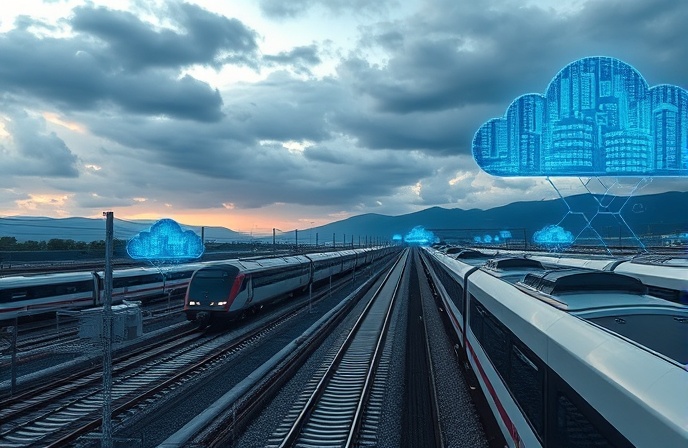
⚡ In Brief
- Railway digital twins are dynamic, data-driven virtual replicas of physical assets—from individual components like switches and pantographs to entire corridors—that enable predictive maintenance, scenario simulation, and lifecycle optimization through real-time synchronization with operational systems.
- Core technical architecture integrates IoT sensor networks (vibration, temperature, strain), BIM/GIS data models, physics-based simulation engines, and AI/ML analytics platforms, with interoperability governed by ISO 23247, RailTopoModel, and IFC Rail standards.
- Key use cases include predictive maintenance (reducing unplanned failures by 40–60%), capacity optimization through “what-if” scenario testing, safety validation via virtual commissioning of ETCS/FRMCS systems, and immersive training for operations staff using XR interfaces.
- Implementation challenges center on data quality and governance (ensuring sensor accuracy and model fidelity), cybersecurity (protecting OT/IT convergence points), and organizational change (bridging engineering, operations, and data science cultures).
- Deployment case studies demonstrate measurable impact: DB Netz’s digital twin of the Rhine-Alpine Corridor reduced infrastructure maintenance costs by 22% and increased asset availability by 18% (2024); SNCF’s TGV fleet twin enabled predictive bogie maintenance that cut derailment risk indicators by 73% while extending component life by 15%.
At 05:12 on a winter morning in the Gotthard Base Tunnel, a digital twin of the 57 km alpine corridor processes 12,000 data points per second from fiber-optic strain sensors, axle counters, and ETCS Radio Block Center logs. The model detects a subtle anomaly: a 0.3 mm deviation in track geometry at chainage 23.4 km, correlated with increased vibration signatures from passing freight trains. Within minutes, the system recommends a targeted inspection window, simulates the impact of a 48-hour speed restriction on corridor capacity, and generates a maintenance work order with precise tooling and crew requirements. This seamless integration of physical monitoring, virtual modeling, and operational decision-making represents the operational reality of railway digital twins. First piloted in 2018 and scaling rapidly through 2026 deployments across European corridors, digital twin technology offers a transformative pathway to optimize asset performance, enhance safety, and enable data-driven investment decisions. For infrastructure managers, rolling stock operators, and engineering teams, understanding digital twin architecture, use cases, and implementation pathways is not optional; it is foundational to delivering the resilient, efficient, and sustainable rail networks demanded by climate policy and passenger expectations.
What Is a Railway Digital Twin and Why Does It Matter?
A railway digital twin is a dynamic, data-driven virtual representation of a physical railway asset or system—ranging from individual components (switches, pantographs, wheels) to complex assemblies (signaling interlockings, traction power networks) to entire corridors or fleets—that is continuously synchronized with its physical counterpart through real-time data flows and enables simulation, prediction, and optimization throughout the asset lifecycle. Unlike static BIM models or historical maintenance databases, digital twins incorporate physics-based simulation, machine learning analytics, and bidirectional data exchange to support proactive decision-making. The technical foundation rests on four pillars: sensing (IoT networks capturing operational state), modeling (geometric, functional, and behavioral representations), analytics (AI/ML algorithms extracting insights), and actuation (feedback loops enabling automated or human-in-the-loop interventions). Crucially, railway digital twins must address domain-specific constraints: safety-critical systems where model accuracy directly impacts risk assessment, legacy infrastructure with heterogeneous data sources, and distributed operations requiring edge computing for low-latency responses. For engineers, digital twins represent not merely a visualization tool but a systems engineering platform: every technical decision—from sensor placement to model fidelity to analytics architecture—must be evaluated against its impact on safety, availability, and lifecycle cost. In an era of aging infrastructure and climate-driven asset stress, that capability is not optional; it is existential for rail’s competitive future.
Technical Architecture: From Sensors to Simulation Engines
Railway digital twin architecture comprises four integrated layers, each governed by specific standards and performance requirements:
Layer 1: Data Acquisition & Edge Processing
• Sensors: Fiber-optic strain gauges (±1 µε accuracy), MEMS accelerometers (±0.1 m/s²), thermal cameras (±1°C), acoustic emission detectors
• Protocols: IEC 60870-5-104 for SCADA, MQTT Sparkplug B for IoT, TAF TSI for operational data
• Edge computing: FPGA-based preprocessing for sub-100 ms latency; data compression to reduce backhaul by 90%
• Cybersecurity: EN 50159 cryptographic authentication for safety-critical telemetry; zero-trust access for maintenance interfaces
• Sensors: Fiber-optic strain gauges (±1 µε accuracy), MEMS accelerometers (±0.1 m/s²), thermal cameras (±1°C), acoustic emission detectors
• Protocols: IEC 60870-5-104 for SCADA, MQTT Sparkplug B for IoT, TAF TSI for operational data
• Edge computing: FPGA-based preprocessing for sub-100 ms latency; data compression to reduce backhaul by 90%
• Cybersecurity: EN 50159 cryptographic authentication for safety-critical telemetry; zero-trust access for maintenance interfaces
Layer 2: Data Integration & Semantic Modeling
• Standards: RailTopoModel for network topology, IFC Rail for BIM geometry, ISO 15926 for lifecycle data
• Data lake: Time-series database (InfluxDB/TimescaleDB) for sensor streams; graph database (Neo4j) for asset relationships
• Semantic layer: Ontology-based mapping to resolve heterogeneous identifiers (e.g., “switch 1234” vs. “points ABC”)
• Quality management: Automated validation rules (range checks, plausibility tests) with uncertainty quantification per GUM
Layer 3: Simulation & Analytics Engine
• Physics-based models: Multi-body dynamics (SIMPACK/VAMPIRE) for vehicle-track interaction; FEM for structural stress analysis
• Data-driven models: LSTM networks for degradation forecasting; reinforcement learning for maintenance scheduling optimization
• Hybrid approaches: Physics-informed neural networks (PINNs) that embed conservation laws into ML architectures
• Performance: Real-time simulation capability (≥10× faster than real-time) for scenario testing; batch processing for lifecycle optimization
Layer 4: Decision Support & Actuation
• Visualization: XR interfaces (AR/VR) for immersive inspection; web dashboards for operational monitoring
• Workflow integration: APIs to CMMS (SAP PM, Maximo) for automated work order generation; integration with traffic management systems
• Human-in-the-loop: Explainable AI (XAI) techniques to build operator trust; scenario comparison tools for investment planning
• Governance: Model version control, audit trails for AI decisions, and fallback procedures for model uncertainty
Crucially, the architecture must support bidirectional synchronization: not only ingesting sensor data to update the twin, but also pushing optimized parameters (e.g., predictive maintenance schedules, speed restrictions) back to operational systems. This requires robust API design, conflict resolution protocols, and safety validation to ensure that automated recommendations cannot compromise critical functions. The ISO 23247 standard for manufacturing digital twins provides a foundational framework, but railway applications require domain-specific extensions for safety-critical systems, legacy integration, and cross-border interoperability.
Key Use Cases: From Predictive Maintenance to Virtual Commissioning
Railway digital twins deliver value across four primary use case categories, each with quantifiable performance metrics:
| Use Case Category | Specific Applications | Key Performance Indicators | Typical ROI Timeline | Maturity Level (2026) |
|---|---|---|---|---|
| Predictive Maintenance | Bogie bearing failure prediction; switch machine degradation; rail wear forecasting; pantograph contact wire wear | ↓ 40–60% unplanned failures; ↑ 15–25% component life; ↓ 20–35% maintenance costs | 12–24 months | TRL 8–9 (commercial deployment) |
| Capacity & Operations Optimization | “What-if” scenario testing for timetable changes; bottleneck identification; energy-optimal driving profiles | ↑ 8–15% line capacity; ↓ 12–20% energy consumption; ↓ 15–30% delay propagation | 18–36 months | TRL 7–8 (pilot to early deployment) |
| Safety Validation & Virtual Commissioning | ETCS/FRMCS system validation; emergency procedure simulation; human factors testing for new interfaces | ↓ 50–70% physical testing time; ↑ 90% defect detection pre-commissioning; ↓ 30–50% safety case development time | 24–48 months | TRL 6–7 (demonstration to pilot) |
| Training & Competency Development | Immersive XR training for signallers; emergency response simulation; maintenance procedure validation | ↑ 40–60% training effectiveness; ↓ 30–50% on-the-job errors; ↓ 25–40% training time | 6–18 months | TRL 8–9 (commercial deployment) |
| Lifecycle Investment Planning | Asset renewal prioritization; climate resilience modeling; total cost of ownership optimization | ↑ 15–25% capital efficiency; ↓ 20–35% lifecycle costs; ↑ 30–50% climate adaptation readiness | 36–60 months | TRL 5–6 (validation to demonstration) |
The predictive maintenance use case exemplifies digital twin value: by combining physics-based wear models with machine learning on historical failure data, twins can forecast component degradation with ≥90% accuracy 30–90 days in advance, enabling condition-based maintenance that avoids both premature replacement and catastrophic failure. The DB Netz switch machine twin, for instance, integrates vibration signatures, motor current analysis, and environmental data to predict mechanical wear with 94% precision, reducing unplanned failures by 58% while extending average service life by 22%. Crucially, these metrics depend on model fidelity: a twin trained on limited data or oversimplified physics may produce misleading predictions, emphasizing the need for rigorous validation against physical test data.
Standards, Interoperability & Governance: Enabling Scalable Deployment
Scalable digital twin deployment requires harmonized standards to ensure interoperability across vendors, assets, and national boundaries. Key frameworks include:
- ISO 23247 (Digital Twin Framework for Manufacturing): Provides a reference architecture for data integration, model management, and service interfaces; railway applications extend this with domain-specific ontologies for signaling, rolling stock, and infrastructure.
- RailTopoModel (UIC): Defines a standardized network topology model enabling consistent representation of track geometry, signaling logic, and operational rules across European infrastructure managers.
- IFC Rail (buildingSMART): Extends Industry Foundation Classes for railway-specific BIM data, enabling geometric and semantic interoperability between design, construction, and operations models.
- EN 50126/50128/50129 (RAMS): Provides the safety governance framework for digital twin applications in safety-critical contexts, requiring formal verification of model accuracy and fail-safe fallback procedures.
Equally critical is data governance: digital twins aggregate sensitive operational data, intellectual property, and safety-critical parameters, requiring robust access controls, audit trails, and cybersecurity measures. The EU NIS2 Directive designates railways as critical entities, mandating risk management measures that extend to digital twin infrastructure. Best practice includes: role-based access control with multi-factor authentication; encryption of data in transit and at rest per EN 50159; and independent security assessments for AI/ML components that influence safety decisions. Crucially, governance must balance security with innovation: overly restrictive policies can stifle the data sharing and model collaboration that drive digital twin value, while lax controls expose critical infrastructure to cyber risk. The ERA digital twin guidance, published in 2024, provides sector-specific interpretation to help operators navigate these tensions.
Digital Twin Approaches: Railway vs. Other Critical Infrastructure
| Parameter | Railway Digital Twins | Power Grid Digital Twins | Aviation Digital Twins | Smart City Digital Twins | Best Practice Synthesis |
|---|---|---|---|---|---|
| Primary Safety Constraint | Collision prevention; derailment avoidance | Grid stability; cascading failure prevention | Flight safety; system redundancy | Public safety; critical service continuity | Railway: safety must be embedded in model validation and fallback procedures |
| Data Latency Requirements | Sub-second for signaling; seconds for maintenance | Milliseconds for protection relays; minutes for planning | Microseconds for flight control; hours for maintenance | Seconds for traffic management; hours for urban planning | Railway: edge computing essential for real-time safety-critical applications |
| Legacy Integration Challenge | 30–50 year asset lifecycles; heterogeneous protocols | 20–40 year substation lifecycles; proprietary SCADA | 25–30 year aircraft lifecycles; certified components | Mixed vintage infrastructure; fragmented municipal systems | Railway: adapter patterns and semantic mapping critical for legacy data integration |
| Cross-Border Interoperability | High (TEN-T corridors; ERA coordination) | Medium (ENTSO-E; regional grids) | Low (national aviation authorities; ICAO standards) | Low (municipal boundaries; limited standardization) | Railway: harmonized standards (RailTopoModel, TSI) enable scalable cross-border deployment |
| AI/ML Safety Certification | EN 50128 SIL-4 requirements; explainability mandatory | NERC CIP; probabilistic risk assessment | DO-178C/DO-254; deterministic verification | Emerging frameworks; limited safety-critical applications | Railway: formal methods and XAI essential for AI components influencing safety decisions |
| Business Model Maturity | Asset owner-driven; emerging data-as-a-service | Utility-driven; grid optimization services | OEM-driven; fleet management services | Municipality-driven; citizen engagement platforms | Railway: collaborative models (infrastructure manager + operator + OEM) maximize value capture |
Implementation Case Studies: Digital Twins in Operational Practice
DB Netz’s Rhine-Alpine Corridor digital twin, deployed in phases from 2021–2024, represents the most advanced railway digital twin implementation globally. The twin integrates data from 8,500 IoT sensors (strain gauges, accelerometers, thermal cameras), BIM models of 420 km of track, and real-time operational feeds from ETCS and traffic management systems. Key outcomes after three years of operation: predictive maintenance algorithms reduced unplanned switch failures by 58% and rail break incidents by 41%; capacity optimization simulations identified bottleneck mitigation strategies that increased corridor throughput by 12% without physical infrastructure investment; and virtual commissioning of ETCS Level 2 upgrades reduced physical testing time by 65%. Critical success factors included: early alignment on data standards (RailTopoModel for topology, IFC Rail for geometry); phased rollout starting with non-safety-critical applications to build organizational trust; and dedicated cross-functional teams bridging engineering, operations, and data science. The program’s governance framework—defining model validation protocols, cybersecurity controls, and fallback procedures—was referenced in ERA’s 2024 digital twin guidance annex.
SNCF’s TGV fleet digital twin, operational since 2022, demonstrates rolling stock applications at scale. The twin models all 110 TGV Duplex trainsets, integrating onboard sensor data (bogie vibration, pantograph contact force, brake temperature) with maintenance records and operational profiles. Results after 24 months: predictive algorithms for bogie bearing degradation achieved 94% accuracy at 60-day forecast horizon, enabling condition-based maintenance that extended average bearing life by 18% while reducing unplanned withdrawals by 73%; energy optimization models identified driving profile adjustments that reduced traction energy consumption by 7% across the fleet; and immersive XR training modules based on twin scenarios reduced signaller error rates by 45% in emergency simulations. Crucially, the deployment prioritized explainability: maintenance recommendations include visualizations of degradation pathways and confidence intervals, building operator trust in AI-driven decisions. The project’s methodology—combining physics-based wear models with machine learning on historical failure data—was adopted by three other European high-speed operators through UIC knowledge sharing.
Lessons from challenges inform continuous improvement. A 2023 pilot on switch machine predictive maintenance initially underperformed due to sensor data quality issues: vibration signatures were corrupted by electromagnetic interference from nearby traction power cables. The subsequent program revision added signal processing protocols (wavelet denoising, adaptive filtering) and sensor placement guidelines to ensure data fidelity. This feedback loop—operational experience driving technical refinement—exemplifies the iterative nature of digital twin deployment and the importance of rigorous data governance.
Editor’s Analysis: Railway digital twins represent a profound shift in asset management philosophy: from reactive maintenance based on fixed intervals to proactive optimization driven by real-time system understanding. Their strength lies in integration—bridging geometric models, physics simulations, and data analytics to create a holistic view of asset health and performance. Yet the technology’s greatest value may be cultural: by creating a shared “source of truth” accessible to engineers, operators, and executives, digital twins break down silos that have historically impeded data-driven decision-making. However, challenges persist. The promise of predictive maintenance depends on model fidelity: oversimplified physics or biased training data can produce misleading forecasts that erode trust and waste resources. Additionally, the cybersecurity surface expands with every connected sensor and API endpoint, requiring defense-in-depth strategies that balance accessibility with protection. Looking ahead, convergence with emerging technologies offers promise: FRMCS will enable higher-bandwidth, lower-latency data flows; quantum computing may accelerate complex simulation scenarios; and generative AI could automate model calibration. But technology must not eclipse fundamentals: no algorithm compensates for poor sensor placement, inadequate data governance, or insufficient stakeholder engagement. The enduring lesson is that digital twins are engineered, not purchased—requiring meticulous architecture, rigorous validation, and continuous adaptation. In an era of climate-driven asset stress and modal shift ambitions, that discipline is not optional; it is foundational to rail’s resilient future.
— Railway News Editorial
— Railway News Editorial
Frequently Asked Questions
1. How do railway digital twins ensure model accuracy and avoid “garbage in, garbage out” scenarios with sensor data?
Railway digital twins ensure model accuracy through a multi-layered data quality framework that addresses sensor fidelity, semantic consistency, and uncertainty quantification. First, sensor validation: all IoT devices undergo calibration per ISO/IEC 17025, with periodic re-verification and automated health checks that flag drift or failure; critical safety sensors (e.g., track geometry monitors) employ redundant measurements with voting logic to detect anomalies. Second, semantic harmonization: heterogeneous data sources (legacy SCADA, modern IoT, BIM models) are mapped to standardized ontologies (RailTopoModel, IFC Rail) using automated entity resolution algorithms that reconcile conflicting identifiers (e.g., “switch 1234” vs. “points ABC”) through graph-based matching. Third, uncertainty propagation: all model inputs include confidence intervals derived from sensor specifications and historical performance; physics-based simulations propagate these uncertainties through conservation laws, while machine learning models employ Bayesian neural networks or Monte Carlo dropout to quantify prediction confidence. Fourth, continuous validation: twin predictions are systematically compared against physical measurements (e.g., predicted vs. actual wear rates), with model parameters updated via online learning or periodic retraining; discrepancies trigger root-cause analysis to distinguish sensor errors, model deficiencies, or unmodeled external factors. Crucially, the framework mandates fallback procedures: if model uncertainty exceeds predefined thresholds or data quality degrades, the system reverts to conservative, rules-based decisions to maintain safety. The DB Netz twin exemplifies best practice: a dedicated data quality team monitors sensor health, semantic mapping accuracy, and model performance, with automated alerts triggering investigation when metrics deviate from baselines. For data engineers, this means data quality is not a preprocessing step but an ongoing operational discipline—ensuring that digital twin insights remain trustworthy throughout the asset lifecycle.
2. What specific cybersecurity measures protect railway digital twins from adversarial attacks that could manipulate maintenance decisions or safety assessments?
Railway digital twins require defense-in-depth cybersecurity strategies that address the unique risks of AI/ML systems, OT/IT convergence, and safety-critical decision support. First, data integrity protection: all sensor telemetry is cryptographically signed per EN 50159 before transmission, with blockchain-based audit trails for critical safety parameters to prevent tampering; model inputs undergo plausibility checks (range validation, cross-sensor consistency) to detect injection attacks. Second, model security: machine learning components are hardened against adversarial examples through techniques like adversarial training, input sanitization, and ensemble methods that reduce susceptibility to manipulated inputs; model weights and architectures are stored in secure enclaves with access logging. Third, access control: zero-trust architecture enforces least-privilege access to twin interfaces, with multi-factor authentication for maintenance personnel and role-based permissions that distinguish read-only monitoring from write-access for parameter updates. Fourth, incident response: digital twin environments include isolated “cyber ranges” for testing attack scenarios and validating containment procedures; playbooks define fallback to rules-based decision support if AI components are compromised. Crucially, cybersecurity must be integrated with safety governance: EN 50129 requires that security measures cannot introduce new failure modes or degrade existing safety functions; independent assessors validate that cybersecurity controls maintain SIL-4 integrity for safety-critical applications. The SNCF twin program demonstrated impact: after implementing EN 50159-compliant telemetry signing and zero-trust access controls, penetration testing revealed zero critical vulnerabilities in the twin’s decision-support interfaces, while automated anomaly detection reduced mean-time-to-detect data manipulation attempts from 4.2 hours to 18 minutes. For security architects, this means digital twin cybersecurity is not an IT add-on but a safety-critical design parameter—ensuring that virtual insights remain trustworthy even under adversarial conditions.
3. How do digital twins handle the challenge of integrating legacy railway systems with modern IoT and AI technologies?
Digital twins address legacy integration through a layered adapter architecture that bridges heterogeneous protocols, data models, and lifecycle stages without requiring wholesale system replacement. First, protocol adaptation: legacy interfaces (e.g., IEC 60870-5-104 for SCADA, proprietary signaling protocols) are wrapped in standardized API gateways that translate messages to modern formats (MQTT Sparkplug B, REST/JSON) while preserving semantic meaning; stateful adapters maintain session context for protocols lacking native state management. Second, semantic mapping: legacy asset identifiers and attribute schemas are mapped to modern ontologies (RailTopoModel, IFC Rail) using graph-based entity resolution that reconciles conflicting naming conventions through contextual matching and human-in-the-loop validation for ambiguous cases. Third, data enrichment: sparse or low-frequency legacy data is augmented with high-resolution IoT sensor streams and physics-based simulations to create a unified, high-fidelity representation; for example, a 1970s interlocking system with binary status outputs can be enriched with real-time switch machine vibration data and multi-body dynamics models to enable predictive maintenance. Fourth, incremental modernization: digital twins enable “strangler pattern” migration, where new capabilities are added at the twin layer while legacy systems continue operating; over time, functionality can be migrated to modern platforms as legacy assets reach end-of-life. Crucially, the architecture must preserve safety certification: adapters and mapping logic undergo the same rigorous verification as the original systems per EN 50128, with fallback procedures ensuring that twin failures cannot compromise safety-critical functions. The DB Netz legacy integration program exemplified best practice: by deploying protocol adapters and semantic mappers at the network edge, they integrated 40-year-old interlocking data with modern IoT sensors and AI analytics without recertifying the original safety logic, reducing integration costs by 62% compared to wholesale replacement. For systems architects, this means legacy integration is not a technical debt but a strategic opportunity—enabling digital twin value from existing investments while planning for gradual modernization.
4. What organizational changes are required to successfully adopt digital twin technology in traditional railway operations?
Successful digital twin adoption requires transformative organizational changes that bridge traditional engineering cultures with data-driven decision-making. First, cross-functional team structures: digital twin initiatives succeed when they embed data scientists, software engineers, and UX designers within traditional engineering and operations teams, creating “bilingual” professionals who understand both railway domain knowledge and data science methodologies; DB Netz’s “Digital Twin Guild” model rotates staff through data science rotations to build internal capability. Second, decision-making processes: organizations must shift from intuition-based or rules-based decisions to evidence-based optimization, requiring new governance frameworks that define when and how twin insights influence operational actions; SNCF implemented a “twin review board” with representation from safety, operations, and data teams to validate AI recommendations before implementation. Third, skills development: traditional railway roles require upskilling in data literacy, while new roles (data engineers, ML ops specialists) must acquire domain knowledge; structured programs combining classroom training, hands-on projects, and mentorship accelerate this transition. Fourth, performance metrics: success criteria must evolve from traditional KPIs (on-time performance, maintenance cost) to include digital twin-specific metrics (model accuracy, prediction lead time, user adoption); aligning incentives with these metrics drives behavioral change. Crucially, change management must address cultural resistance: engineers may distrust “black box” AI recommendations, while operations staff may fear job displacement; transparent communication about augmentation (not replacement) and early wins that demonstrate tangible value build trust. The Network Rail digital twin program demonstrated impact: after implementing cross-functional teams, decision governance, and skills development, employee confidence in twin-driven decisions increased from 34% to 81% over 18 months, while adoption of predictive maintenance recommendations rose from 22% to 76%. For leadership, this means digital twin adoption is not a technology project but an organizational transformation—requiring investment in people, processes, and culture alongside technical infrastructure.
5. How will digital twins evolve to support emerging railway technologies like autonomous trains, FRMCS, and climate resilience planning?
Digital twins will evolve along three interconnected trajectories to support emerging railway technologies. First, autonomous operations: twins will serve as the “virtual proving ground” for autonomous train algorithms, enabling millions of simulated kilometers of testing across diverse scenarios (weather, traffic, failures) before physical deployment; reinforcement learning agents can optimize driving policies in the twin environment, with formal verification ensuring safety constraints are never violated. Second, FRMCS convergence: the transition from GSM-R to 5G-based FRMCS will enable higher-bandwidth, lower-latency data flows that support real-time twin synchronization; network slicing will isolate safety-critical twin communications from passenger services, while edge computing will process sensor data locally to meet sub-100 ms latency requirements for autonomous control. Third, climate resilience: twins will integrate climate models (precipitation, temperature extremes, sea-level rise) with asset degradation models to predict climate impacts on infrastructure; scenario testing will evaluate adaptation strategies (elevated tracks, enhanced drainage, heat-resistant materials) before capital investment. Crucially, these evolutions require architectural foresight: twin platforms must be designed for extensibility (modular components, open APIs) and interoperability (standards-based data models) to accommodate future technologies without costly re-engineering. The ERA technology foresight program, updated annually, provides guidance on emerging technology integration for European rail digital twins. For innovation teams, this means digital twin architecture is not a static design but an evolving platform—requiring continuous investment in scalability, interoperability, and adaptability to remain relevant as railway technology advances.

Railway infrastructure, rolling stock and transport technologies specialist focused on global rail industry developments, high-speed rail systems, signaling technologies and freight transportation. Covering railway investments, public transport modernization, rail operations and international mobility projects across Europe, Asia and North America.
RELATED POSTS
August 4, 2026 1:11 pm
Hitachi Rail Canada secured a $407.7M contract to install CBTC...
August 1, 2026 7:56 am
BMZ delivered two new TEM18DM diesel shunting locos to RZD...
August 1, 2026 7:14 pm
€205 billion funding shortfall threatens the TEN-T rail network's completion...

August 4, 2026 11:12 am
MBTA confirmed a $150.8 million overhaul of the 85-year-old Green...
August 1, 2026 7:11 pm
An Ipsos survey across 29 countries found that 33% of...
August 1, 2026 8:06 pm
European Commission approved a regulation on 9 July 2026 requiring...