
Direct to Destination: The Efficiency Power of the Block Train
Streamline rail logistics with Block Trains. Discover how point-to-point freight transport bypasses marshalling yards to deliver bulk cargo with maximum speed and efficiency.
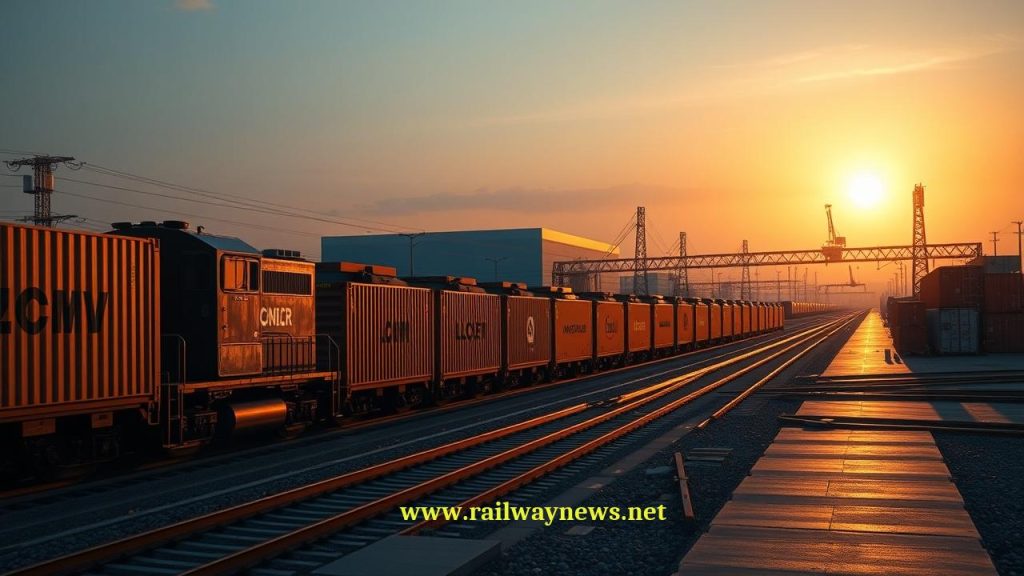
⚡ In Brief
- A block train is defined by what it avoids as much as by what it does: The defining characteristic of a block train — also called a unit train in North America — is that it runs from a single origin to a single destination without any intermediate shunting, marshalling, or wagon sorting. Every wagon in the train is bound for the same place. No marshalling yard touches it. No hump retarder slows it. No shunter couples or uncouples it mid-journey. This avoidance of the marshalling system eliminates the dominant source of delay and cost in traditional wagonload freight — the accumulation of waiting time and handling cost at each intermediate yard — and produces a transit time and cost structure that is qualitatively different from wagonload, not merely incrementally better.
- The mathematics of marshalling delay are the strongest argument for block trains: Network Rail’s analysis of freight transit times on UK wagonload services in 2010 found that a wagon travelling 400 km between two UK freight terminals spent, on average, 58% of its elapsed transit time stationary in marshalling yards — not moving, not being loaded or unloaded, simply waiting for sufficient wagons bound for the same next destination to accumulate before the next departure could be formed. On a 24-hour scheduled transit, 14 hours were yard dwell. A block train on the same corridor, with no intermediate marshalling stop, completes the same 400 km in 5–7 hours of running time. The difference between 24 hours and 6 hours is not a 4-fold improvement in operational efficiency — it is the difference between rail freight being competitive with road and being uncompetitive.
- Block trains are asymmetrically suited to bulk commodities and intermodal containers: The block train model requires a shipper who can fill an entire train with cargo bound for a single destination on a regular schedule — a volume and frequency requirement that eliminates most small and medium enterprise shippers. The natural block train customers are power stations (coal), steelworks (iron ore, coking coal, limestone), cement plants, oil refineries (petroleum products), automotive assembly plants (finished vehicles or components), and port-to-inland intermodal terminals (containers). These customers share a characteristic: they receive or dispatch enough cargo to fill multiple trains per week at predictable times, and the cargo is uniform enough that a single wagon type can serve the full flow.
- The coal unit train created the modern block train concept in the 1960s: The British Transport Commission’s “Merry-go-Round” (MGR) coal supply system, introduced in 1965 to supply coal from Yorkshire and Nottinghamshire collieries to the new generation of coal-fired power stations, was the first systematic application of the block train principle at national scale. MGR trains ran continuously between a colliery and a power station in a permanent cycle — loaded at the colliery through a rapid-loading facility without stopping (the train moved slowly under the loading hopper at 1 mph), ran to the power station, discharged through a slow-speed unloading facility without stopping (the HAA hoppers opened their bottom doors while moving over the power station’s discharge pit), and returned empty for the next load. A single MGR locomotive, wagons, and train path handled 1,000 tonnes of coal every 3 hours — a continuous material pipeline with no shunting, no yard time, and no manual handling at either end.
- The “timetabled freight train” principle — operating block trains like passenger services on published schedules — is the current frontier of European freight rail: The European Commission’s Smart and Sustainable Multimodal Mobility Strategy (2020) identified reliable freight train scheduling — the publication and guarantee of specific departure and arrival times for freight block trains, equivalent to passenger timetable discipline — as the single most important operational improvement needed to shift European freight from road to rail. The “TEN-T Freight Corridor” concept, implemented through ERA’s Network Statement requirements, mandates that infrastructure managers publish pre-defined “freight train paths” and guarantee their availability. The gap between this mandate and operational reality — where freight trains routinely yield their path to late-running passenger trains — remains the primary reliability problem in European rail freight.
The quarterly report that British Railways freight division submitted to its Board in October 1967 contained a table that described, with unintentional precision, the central problem of the wagonload freight system that had dominated British railways since the 1840s. The report analysed the movements of 18,000 individual wagon journeys made in the preceding quarter and found that the average wagon had spent 73% of its elapsed transit time standing still — in sidings, in marshalling yards, on reception roads, waiting for enough wagons bound for the same next destination to accumulate into a train. The average wagon travelled at an effective speed of 7.3 km/h from origin to destination: not 7.3 km/h when moving, but 7.3 km/h averaged across all the hours it spent stationary. A lorry on the same journey averaged approximately 45 km/h. The response to this finding — accelerated after the Beeching Report of 1963 had already identified wagonload freight as structurally uneconomic — was the strategic decision to abandon the universal wagonload system and concentrate British freight investment on a smaller number of high-volume, point-to-point block train flows where the economics were fundamentally different. The Freightliner container service (launched 1965), the Merry-go-Round coal trains (1965), the Speedlink network of faster wagonload paths (ultimately unsuccessful, withdrawn 1991), and ultimately the privatised Freightliner, EWS (now DB Cargo), and GB Railfreight structure that emerged from privatisation — all trace their conceptual DNA to that 1967 analysis of 7.3 km/h wagons standing in marshalling yards. Understanding block trains means understanding what they were designed to replace, and why the replacement — despite its enormous efficiency advantage — still faces the structural challenge of finding customers who can fill a complete train with uniform cargo at regular intervals on a predictable schedule.
What Is a Block Train?
A block train — called a “unit train” in North America, “train complet” in French, “Ganzzug” in German — is a freight train composed entirely of wagons bound for the same destination, operated as a complete unit from origin to destination without any intermediate shunting, marshalling, or wagon sorting operations. The entire train is reserved for a single customer or commodity flow, runs to a fixed timetable (or on demand, depending on the operating model), and returns — either loaded or empty — to the origin for the next cycle. It is the railway equivalent of a dedicated delivery vehicle: no shared capacity, no hub-and-spoke intermediate stops, no handling cost between loading and unloading.
The contrast with Single Wagon Load (SWL) or wagonload freight — in which individual wagons from many different origins and bound for many different destinations are collected, sorted at multiple marshalling yards, and individually forwarded to their destinations — defines the economic logic of the block train. SWL provides flexibility (any origin, any destination, any volume) at the cost of handling time and expense. Block trains provide efficiency (minimum handling, minimum transit time, predictable schedule) at the cost of flexibility (requires enough cargo from one origin to one destination to fill an entire train at predictable frequency).
The Economics: Why Block Trains Are Rail Freight’s Most Efficient Model
The Marshalling Cost That Block Trains Eliminate
The marshalling and sorting operations that a block train bypasses represent the dominant cost component of traditional wagonload freight — not in fuel or rolling stock depreciation, but in time and handling. The cost breakdown of a typical 400 km UK wagonload freight journey in 2010 (Network Rail analysis) allocated costs as follows: running costs (fuel, locomotive crew, track access charge per km) approximately 35% of total; yard reception, sorting, and despatch costs approximately 28%; wagon standing time (financing cost of wagon fleet held stationary during yard dwell) approximately 22%; terminal loading and unloading approximately 15%. The two yard-related cost categories (28% + 22% = 50%) are entirely eliminated by the block train model — they are replaced by the loading and unloading costs at origin and destination terminals only. For a 400 km journey with two intermediate yards (typical for UK wagonload in 2010), this cost elimination reduces the per-wagon cost by approximately 45–50% versus the equivalent wagonload journey.
Block train vs wagonload cost comparison (400 km, 50 wagons):
Wagonload route (2 intermediate yard stops):
Running cost: £8,000 (locomotive + track access, 400 km)
Yard 1 reception + sorting: £3,500
Wagon standing in Yard 1 (8 hours avg × 50 wagons × £1.20/wagon-hour): £480
Yard 2 reception + sorting: £3,500
Wagon standing in Yard 2 (8 hours avg × 50 wagons × £1.20/wagon-hour): £480
Total wagonload cost: £15,960
Cost per wagon: £319
Elapsed transit time: ~28–36 hours
Block train route (direct):
Running cost: £8,000 (same locomotive + track access)
Origin loading (already priced into shipper’s terminal cost): £0
No yard stops → £0
Total block train cost: £8,000
Cost per wagon: £160
Elapsed transit time: 5–7 hours
Block train saving vs wagonload:
Cost: (£319 − £160) / £319 = 49.8% lower cost per wagon
Time: (30 hours − 6 hours) / 30 hours = 80% shorter transit time
Caveat: Block train requires 50 wagons of uniform cargo bound for same
destination → only viable for high-volume, single-commodity flows
Wagonload serves low-volume multi-destination flows → necessary
even if inefficient vs block train on same distance.
The Asset Utilisation Advantage
Block trains achieve dramatically higher wagon asset utilisation than wagonload freight because the wagon spends far less time stationary. If a wagonload wagon spends 73% of its elapsed transit time in yards (as the 1967 BR analysis found), it completes approximately 1.3 “journeys” (loading at origin + transit + unloading at destination) per day averaged over 365 days. A block train wagon on a continuous cycle (loaded transit + immediate return for next loading) may complete 3–4 journeys per day — 2.5–3 times higher utilisation. Since wagon fleet cost (capital depreciation + maintenance) is fixed regardless of utilisation, the higher-utilisation block train wagon earns approximately 2.5–3 times more revenue per pound of wagon fleet cost — a capital efficiency advantage that reinforces the operational cost advantage.
The Merry-Go-Round (MGR): The Block Train That Powered Britain
The British Railways Merry-go-Round coal supply system — introduced in 1965 to supply coal from the East Midlands coalfields to the new generation of large coal-fired power stations (Drax, Ferrybridge, Ratcliffe, Didcot) — remains the most elegant demonstration of block train principles ever implemented at national scale, and the system that directly influenced all subsequent bulk commodity block train design worldwide.
The MGR Operating Principle
The MGR concept, developed by British Railways engineer Frank Plane and the Central Electricity Generating Board (CEGB), was based on a single insight: if the loading and unloading operations can be performed without stopping the train, the wagon’s transit time reduces to only the running time between colliery and power station. The colliery’s rapid-loading facility (a loading point over the track, fed by a conveyor from the coal storage area) could load a train at 1,000 tonnes per hour if the train moved at approximately 1 mph (1.6 km/h) under it continuously. The power station’s unloading facility (a discharge pit beneath the track, with automatic bottom-door opening triggered by track sensors) could discharge 1,000 tonnes per hour from wagons moving at the same 1 mph. The HAA hopper wagon — designed specifically for MGR service — had an automatic bottom door that opened in response to a track-mounted trigger at the discharge point and closed automatically when the wagon cleared the pit.
MGR cycle analysis — Silverhill Colliery to Ratcliffe Power Station:
Route distance (one way): approximately 56 km
Train composition: 32 × HAA hopper wagons, each 32.5 tonnes payload
Total payload per train: 32 × 32.5 = 1,040 tonnes
Loading time (moving at 1 mph under conveyor, 32 wagons × 20 m = 640 m):
Train length through loading point at 1.6 km/h: 640 / 1,600 = 24 minutes
Transit loaded to power station at average 60 km/h:
Time = 56 / 60 = 56 minutes
Discharge time (moving at 1 mph over pit):
Same geometry as loading: 24 minutes
Return (empty) at 70 km/h:
Time = 56 / 70 = 48 minutes
Total cycle time: 24 + 56 + 24 + 48 = 152 minutes ≈ 2.5 hours
Tonnes delivered per cycle: 1,040
Tonnes per hour: 1,040 / 2.5 = 416 tonnes/hour continuous
Tonnes per 24-hour day: 416 × 24 = 9,984 tonnes ≈ 10,000 tonnes/day
Equivalent lorry fleet requirement:
Each lorry: 20 tonnes × 60 km/h → 2 hours round trip = 3 loads/6 hours
Lorries needed for 10,000 t/day: 10,000 / (20 × 12 loads/day) = 42 lorries
→ 1 block train locomotive + 32 wagons + 1 driver replaces 42 HGVs + 42 drivers
The MGR’s Legacy
At its peak in the 1970s, the MGR system supplied approximately 120 million tonnes of coal per year to UK power stations using approximately 800 dedicated locomotive diagrams and 14,000 HAA hopper wagons — without a single additional marshalling yard, without any manual wagon coupling at either end, and with transit times of typically 3–5 hours for the 50–100 km colliery-to-power station flows. The system ran 24 hours a day, 7 days a week, adapting its frequency to the power stations’ demand through a simple dispatch control system that called trains to the loading point as the power station’s coal stockpile fell below a set level. The MGR was not automated in the modern sense — it had drivers, loading plant operators, and discharge facility operators — but its cycle eliminated the complex human co-ordination of marshalling that was the dominant source of delay and cost in traditional freight. When the UK’s coal-fired power station fleet was progressively retired between 2015 and 2023, the MGR flow — which had already declined from 120 million tonnes to approximately 8 million tonnes — ceased entirely. The HAA hopper wagons were scrapped. But the block train principle they demonstrated survives in every bulk commodity flow on every railway in the world that has adopted the point-to-point operating model.
Block Train Types: Bulk, Automotive, Intermodal, and Temperature-Controlled
| Type | Cargo | Typical Train Length | Frequency | Key Characteristic |
|---|---|---|---|---|
| Bulk mineral (coal, iron ore, aggregates) | Uniform loose material, open-top hopper wagons | 500–3,000 m (30–120 wagons) | Multiple per day (MGR-style) to weekly | Highest payload-per-train; often automated loading/discharge; continuous cycle possible; rapid loading facilities essential |
| Petroleum products (oil, LPG, chemicals) | Liquid bulk in tank wagons; hazmat classification | 400–600 m (20–40 wagons) | Daily to 3× weekly | RID (regulations for dangerous goods by rail) compliance; loading and unloading at dedicated tank farm facilities; flow from refineries to distribution depots |
| Automotive (finished vehicles) | Cars and light commercial vehicles on bi-level or tri-level car carrier wagons | 300–600 m (15–30 wagons × 10 vehicles) | Daily (factory to distribution compound) | High value, low weight; dedicated loading/unloading ramps at factory and compound; Dagenham–Purfleet-Garston is UK example; continental: Wolfsburg to multiple European distribution points |
| Intermodal containers | ISO containers and swap bodies on flat/well wagons | 500–750 m (30–50 wagons) | Daily (multiple per day on key corridors) | Port to inland terminal; overnight operation; fastest-growing block train segment; forms basis of China–Europe Iron Silk Road trains; see Intermodal Terminal article |
| Temperature-controlled / foodstuffs | Refrigerated containers or insulated tank wagons | 300–600 m | Daily (time-critical, fresh produce) | Most demanding transit time requirements; often overnight; Mercitalia Fast (Italy) fresh produce from south to north; UK: limited examples due to short distances |
| High cube / mail / express parcel | Parcels and express freight in dedicated wagons or containers | 200–400 m | Nightly (overnight dispatch) | DB Cargo Night Jump (Germany); Royal Mail Travelling Post Office (UK, withdrawn 2004); SNCF La Poste trains; high slot value — requires guaranteed path with passenger-train priority |
Timetabled Block Trains: The Reliability Challenge
The block train’s economic advantage over wagonload freight is fully realised only when the train operates on a reliable, predictable schedule — when the shipper can integrate the train departure into their production and logistics planning with the same confidence as a road delivery booking. A block train that departs “around 20:00” and arrives “sometime the next morning, subject to pathing” is commercially inferior to a road vehicle that departs at 20:00 and arrives at 06:00 reliably. This is not a theoretical concern — it is the documented primary reason cited by freight shippers for choosing road over rail in market research conducted by the European Commission (2019 Transport White Paper consultation) and by the UK DfT (2021 Freight Carbon Review).
The Freight Path Problem
On a mixed-traffic railway — where passenger trains, freight trains, and maintenance windows compete for the same infrastructure — freight trains are structurally disadvantaged in the pathing hierarchy. Passenger trains operate to published timetables that passengers have bought tickets against; any delay to a passenger train has immediate, visible, monetised consequences (delay compensation, press coverage, political visibility). A delayed freight train has consequences only to the freight operator’s customer — a contractual issue, not a public one. The incentive structure therefore systematically pushes freight trains to yield their paths to delayed passenger trains, accumulating delays that may total 2–6 hours on a 400 km overnight journey. The result is that on mixed-traffic routes, freight trains’ on-time performance is typically 55–70% (within 30 minutes of scheduled arrival), compared to 80–90% for equivalent passenger services on the same infrastructure.
The European solution — mandated by the Railway Freight Regulation (EU) 913/2010 and its successor provisions in the Single European Railway Area framework — is the designation of “Rail Freight Corridors” on which specific train paths are reserved for freight in the network statement, protected from yield to passenger trains except in defined exceptional circumstances, and published with guaranteed availability up to 12 months in advance. The nine EU Rail Freight Corridors (RFCs) covering major freight arteries (Rotterdam–Genoa, North Sea–Baltic, Rhine–Alps, etc.) implement this protection in principle. In practice, compliance varies significantly between infrastructure managers, and the enforcement mechanism — referral to the national regulatory body — is too slow to be useful for the individual freight operator whose path was taken this morning.
Virtual Block Trains: The Digital Wagonload Revolution
The fundamental tension in rail freight — block trains are economically efficient but commercially restrictive; wagonload is commercially flexible but economically inefficient — has driven investment in a concept sometimes called the “virtual block train” or “intelligent wagonload”: a system in which individual wagons from different customers and different origins are coordinated digitally to move point-to-point in aggregated batches, mimicking the efficiency of a block train without requiring each shipper to fill an entire train.
The enabling technology is the Digital Automatic Coupling (DAC), combined with onboard telematics (GPS tracking, shock sensors, temperature monitoring) and a central network optimization algorithm. DAC allows wagons to be coupled and uncoupled automatically at intermediate points without a shunter, reducing the handling cost at each intermediary stop to near zero. Telematics provides real-time visibility of each wagon’s position, condition, and estimated arrival time — creating the scheduling confidence that wagonload currently lacks. The optimisation algorithm, operating on a fleet of DAC-equipped wagons with telematics, can identify batches of wagons bound for sufficiently overlapping destinations, route them together as a block for the shared portion of their journey, and dispatch them individually only for the final segment — achieving the cost structure of a block train for much of the journey while preserving the flexibility of wagonload service.
DB Cargo’s “Digitale Automatische Kupplung + Intelligent Network” (DAKIA) programme, Innofreight’s smart wagon ecosystem, and the European CONCAT project (DAC-equipped wagon tests on multiple national networks, 2022–2025) are all pursuing variants of this virtual block train model. Commercial deployment at scale is targeted for 2030–2035, aligned with the EU’s DAC rollout mandate. If successful, the virtual block train concept would address the market gap that has caused wagonload freight to decline from approximately 40% of European rail freight in 1990 to approximately 12% in 2024 — potentially reversing a 35-year structural decline.
Block Train vs Wagonload vs Virtual Block Train: Full Comparison
| Parameter | Block Train (Unit Train) | Single Wagon Load (SWL) | Virtual Block Train (DAC + telematics) |
|---|---|---|---|
| Routing | Single origin → single destination (direct) | Hub-and-spoke via marshalling yards | Dynamic — aggregated for shared portions, individual for final leg |
| Intermediate shunting | None | 2–5 intermediate yard stops typical | Minimal (automated DAC coupling, no manual shunter) |
| Minimum viable volume | Full train (typically 30–80 wagons) at regular frequency | 1 wagon | 1 wagon (target) — network effect improves with volume |
| Transit time (400 km) | 5–7 hours | 18–36 hours (yard waits) | 8–14 hours (target, with partial blocking) |
| Cost per wagon (relative) | ~50% of wagonload | Baseline (100) | ~65–75% of wagonload (target) |
| Schedule predictability | High (fixed timetable or demand-triggered) | Low (yard accumulation variable) | Medium-high (DAC enables automated dispatch scheduling) |
| Market served | Large single-commodity shippers (power, steel, automotive, ports) | SME shippers; multi-destination; small volumes | SME shippers at scale; multiple commodities; diverse origins/destinations |
| Current European market share | ~88% of rail freight tonne-km (dominant) | ~12% of rail freight tonne-km (declining) | Not yet commercial (target deployment 2030–2035) |
Block Train Operations: Key Examples
| Service | Route | Cargo | Frequency | Notable Feature |
|---|---|---|---|---|
| Drax Power Station Coal Trains (DB Cargo UK) | Immingham Port → Drax (Yorkshire), 140 km | Imported coal (70 tonne HTA wagons) | Up to 8 trains/day at peak | Last major UK coal block train flow until 2023; MGR-style design (now port import rather than pit); 2023 converted to biomass pellets on same wagons after Drax’s coal phase-out |
| Corus/Tata Steel Iron Ore Trains (DB Cargo UK) | Port Talbot Harbour → Llanwern / Port Talbot Steelworks, 35 km | Iron ore (iron ore tippler hopper wagons) | 10–15 trains/day | Continuous loop operation; automated discharge at steelworks; ore bridges at harbour; approximately 5 million tonnes/year; entirely captive fleet |
| Volkswagen Automotive (DB Cargo Germany) | Wolfsburg → Munich / Leipzig / Emden and European destinations | Finished VW group vehicles (Laads bi-level car carriers) | Multiple daily services per destination | One of Europe’s largest automotive block train networks; approximately 500,000 vehicles/year by rail from Wolfsburg; dedicated sidings within Wolfsburg plant; VW’s own DB Cargo contracts provide guaranteed paths |
| Freightliner container trains (Felixstowe–UK) | Felixstowe → Birmingham, Manchester, Leeds, Doncaster | ISO containers (ISO flats and wagons) | 14+ trains/day from Felixstowe alone | UK’s original block train network (1965); core of UK intermodal; expanded by 75% during 2021 Felixstowe congestion; night-running to avoid passenger conflicts; 400 TEU per train |
| China–Europe Block Train (COSCO, Yiwu–Madrid etc.) | Yiwu (China) → Madrid (Spain), ~13,000 km via Kazakhstan–Russia or Middle Corridor | Consumer goods, electronics, automotive parts (ISO containers) | ~15,000 trains/year (peak 2021); ~12,000 trains in 2023 | World’s longest block train service; 18 days vs 35 days sea; 3 gauge changes (Chinese, Russian/Kazakh, European); Cold War infrastructure repurposed for global supply chain; post-2022 geopolitical routing via Middle Corridor (Kazakhstan–Caspian–Azerbaijan–Turkey) |
| BNSF Coal (Powder River Basin to Gulf Coast) | Wyoming PRB coalfields → Texas Gulf Coast, 2,400 km | Sub-bituminous coal (134-car trains, ~15,000 tonnes) | Multiple trains per day; 24/7 operation | World’s largest block train operation by volume; continuous loop trains; automated rotary dumpers at both ends; train never uncoupled; replaces crew at intermediate points only; approximately 400 million tonnes/year PRB total |
Editor’s Analysis
The 1967 British Railways analysis of 7.3 km/h effective wagon speed was not a revelation — BR’s freight managers knew their wagonload system was slow. What it did was quantify the slowness in a form that made the strategic choice unavoidable: a freight mode whose effective speed is one-sixth of a road vehicle’s is not competing on speed; it can only compete on price. And on price, rail’s advantage over road exists only when the train length is sufficient to amortise the fixed costs of locomotive, crew, and infrastructure access charge across enough wagon-loads that the per-unit cost falls below the road equivalent. For small flows (a few wagons), the amortisation doesn’t work. For large flows (a full train), it works dramatically. The structural conclusion — that rail freight should concentrate on large, uniform, predictable flows and abandon the attempt to provide universal wagonload service — was correct in 1967 and has been vindicated by 60 years of commercial experience. What remains unresolved is the consequences of that concentration: the 88% of European rail freight that is now block trains serves approximately 15–20% of the total freight market by shipment count — the large shippers. The other 80–85% of freight shipments (by count, though a smaller percentage by volume) go by road because no viable rail option exists for their volume and frequency. The virtual block train — if DAC deployment and network optimisation algorithms can reduce the minimum viable unit from “a full train” to “a wagon” — would be the most significant expansion of rail freight’s addressable market since the introduction of the Freightliner service in 1965. The challenge is that the DAC rollout, the telematics investment, and the network optimisation infrastructure must all happen simultaneously and reach sufficient scale before the virtuous network effect kicks in — the more wagons in the smart network, the more routing options, the more efficient the batching. Getting from zero to critical mass is the deployment challenge that the CONCAT and DAKIA programmes are working to solve. Whether the 2030–2035 target is achievable, or whether the European freight market will still be dominated by block trains serving a fraction of its addressable volume in 2040, depends on whether the investment programme can be sustained through the regulatory and funding cycles of the next decade.
— Railway News Editorial
Frequently Asked Questions
1. What is the minimum volume required to make a block train economically viable — and what happens when demand falls below that threshold?
The minimum viable block train volume is not a fixed number but a function of the cost structure of the specific service, the distance, and the competitive alternative. A useful rule of thumb is that a block train service becomes economically attractive to a shipper when they can fill a minimum of 25–30 wagons in a single direction at least three times per week — roughly equivalent to 1,500–2,000 tonnes per week for a bulk mineral flow or 75–90 TEU per week for a container flow. Below this threshold, the fixed cost per wagon (locomotive amortisation, crew, track access minimum charge) rises above the point at which rail can compete with road haulage on cost per tonne. When demand falls below the minimum, several options exist. The most common is “short-forming” — operating with fewer wagons but accepting a higher cost per wagon while the market recovers. A second option is “back-loading” — finding a return flow on the same path so that the locomotive earns revenue in both directions rather than running empty on the return. A third option is “aggregating” — combining two or three smaller flows to different but nearby destinations into a single train that splits at an intermediate point (a “trip working”), partially sacrificing the pure block train efficiency for sufficient volume to justify rail operation at all. When no option is commercially viable, the block train service is withdrawn and the freight reverts to road — a decision that is difficult to reverse because once the dedicated loading/unloading infrastructure at origin and destination is decommissioned, reconstituting the rail flow requires a new capital investment that may not be sanctioned.
2. What is a “captive train” and how does it differ from a regular block train service?
A captive train (also called a dedicated fleet or committed flow) is a block train service in which a specific set of wagons — sometimes even a specific locomotive — is permanently allocated to a single customer flow, never being used for any other service. The extreme example is the Drax/Immingham coal circuit, where a fleet of approximately 200 HTA hopper wagons ran continuously between Immingham dock and Drax power station on a roster that was determined by the power station’s coal consumption rate. These wagons never left this circuit; their maintenance was timed around the circuit cycle; their fleet size was calculated from the cycle time and the required delivery rate. A captive fleet provides the shipper with complete certainty about wagon availability (the wagons exist only for their flow), simplifies train planning (the locomotive diagram is fixed), and allows the rolling stock to be optimised specifically for the loading/unloading conditions (the HAA hoppers’ automatic bottom doors were designed specifically for the Drax discharge system). The trade-off is inflexibility: a captive wagon fleet that cannot be redeployed when demand falls below the break-even level becomes stranded capital. This is exactly what happened to much of the UK’s MGR hopper wagon fleet when coal power generation declined — the wagons had no other use and were scrapped rather than redeployed, representing a write-off of their remaining asset value. Rail freight operators managing captive fleets therefore focus intensely on contract length (the shipper must commit to a minimum volume for the duration of the wagon amortisation period) and early termination penalties (to recover the stranded asset value if the shipper withdraws before the fleet is fully depreciated).
3. How does the China–Europe block train service manage the gauge change between Chinese, Russian/Kazakh, and European standard gauges?
The China–Europe rail corridor crosses three track gauges: Chinese and European standard gauge (1,435 mm) and Russian/Kazakh broad gauge (1,520 mm). The management of these gauge changes — the single most complex logistics challenge in the entire 13,000 km journey — is handled through two methods depending on which border crossing is used. At the principal crossing point on the Russia/Kazakhstan–Poland boundary at Brest-Litovsk (Belarus) or Małaszewicze (Poland), container blocks are transferred from broad-gauge wagons to standard-gauge wagons by crane — the container is lifted off its broad-gauge wagon at the gauge-change terminal, placed on a standard-gauge wagon, and continues. This crane-transfer process takes approximately 4–6 hours per train at large terminals equipped with overhead cranes, and adds approximately 6–8 hours of elapsed time to the train’s journey including terminal entry/exit. At Dostyk/Altynkol (Kazakhstan/China boundary) and at Khorgos, the same crane transfer process operates in the reverse direction. The alternative method — used on some wagon types and at some crossings — is bogie exchange: the wagon body is raised on jacks, the broad-gauge bogies are rolled out and replaced with standard-gauge bogies, and the wagon body is lowered onto the new bogies. This takes longer per wagon (approximately 10–15 minutes per wagon, versus 3–5 minutes per container for crane transfer) but avoids the need to handle the container separately and preserves any specialised cargo securing inside the container. Since the 2022 Russian sanctions, routing through Russia has been largely abandoned by Western shippers, with traffic redirecting through the Middle Corridor (Kazakhstan–Caspian Sea ferry to Azerbaijan/Georgia–Turkey/Bulgaria), which avoids the Brest gauge change entirely but adds a maritime ferry crossing and its associated loading/unloading time.
4. What is “balancing” in block train operations — and what happens when the return flow is empty?
Balancing refers to the challenge of ensuring that block train wagons are productively used in both the loaded direction and the return direction — rather than running empty on one leg of the circuit. In a perfectly balanced flow, both the outbound and inbound loads are commercially chargeable — the wagons earn revenue in both directions. The Drax coal circuit was partially balanced: loaded southbound (coal from Immingham to power station), empty northbound (returning for the next load) — a classic unidirectional bulk flow where the empty return is unavoidable because there is no commodity at the power station that the wagons could profitably carry back to the port. The financial consequence of an empty return is that the locomotive, crew, and track access cost of the return journey is charged against the loaded journey’s revenue — effectively doubling the cost per tonne-kilometre of the loaded leg compared to a fully balanced flow. Rail freight operators attempt to balance flows wherever commercially possible: a grain train running southbound from East Anglian farms to London grain terminal may be able to carry aggregates or building materials northbound from London quarries, using the same wagons. Finding and securing these backload commercial arrangements is a significant part of freight operator commercial activity. When no backload exists and the empty return is unavoidable, the shipper’s freight rate must be set high enough to recover the cost of both the loaded and the empty leg — which is why unidirectional bulk flows (coal, iron ore, aggregates from one source to one user) tend to have higher rail freight rates per tonne-km than bidirectional flows (containers, which can often carry import goods inbound and export goods outbound in the same wagon).
5. What is the “Speedlink” network and why did it fail — what does its failure tell us about the limits of the wagonload system?
British Rail’s Speedlink network, operating from 1977 to 1991, was an attempt to create a faster, more reliable wagonload freight service by concentrating wagonload traffic into a smaller number of purpose-designed hub yards operating on a fixed-timetable, rapid-transit basis — essentially imposing block train discipline on the wagonload network. The concept was innovative: rather than the random accumulation approach of traditional marshalling (wait until enough wagons bound for the same direction accumulate), Speedlink operated a “clipper” model — trains departed from hub yards at fixed times regardless of whether they were full, carrying whatever wagons were available for their destination zone. This improved reliability (departure times were predictable) and transit time (the fixed-time departures prevented wagons waiting indefinitely for a full train), but it introduced a new problem: many departures were half-full or less, because the volume of wagonload traffic on most corridors was insufficient to fill a train at each scheduled departure. The cost per wagon-load on a half-full train is approximately twice that of a full train — eliminating the cost advantage over road that makes rail freight viable. British Rail attempted to address this through aggressive commercial development (winning new wagonload customers to increase utilisation), but the intrinsic problem — that any system designed to provide flexible, any-volume wagonload service on a fast timetable requires either very high volumes (enough to fill trains at each departure) or very high prices (to recover the cost of under-utilisation) — was never solved. Speedlink was withdrawn in 1991, the year its losses reached £50 million annually, and its failure is often cited as evidence that scheduled wagonload rail freight cannot be made commercially viable at scale in the UK market. The virtual block train concept revisits this problem with different technology (DAC automation eliminating the manual handling cost that made each intermediate stop expensive) rather than different scheduling discipline — a potentially more fundamental solution to the same structural challenge.

Railway infrastructure, rolling stock and transport technologies specialist focused on global rail industry developments, high-speed rail systems, signaling technologies and freight transportation. Covering railway investments, public transport modernization, rail operations and international mobility projects across Europe, Asia and North America.
RELATED POSTS
August 4, 2026 1:11 pm
Hitachi Rail Canada secured a $407.7M contract to install CBTC...
August 1, 2026 7:56 am
BMZ delivered two new TEM18DM diesel shunting locos to RZD...
August 1, 2026 7:14 pm
€205 billion funding shortfall threatens the TEN-T rail network's completion...
August 4, 2026 11:12 am
MBTA confirmed a $150.8 million overhaul of the 85-year-old Green...
August 1, 2026 7:11 pm
An Ipsos survey across 29 countries found that 33% of...
August 1, 2026 8:06 pm
European Commission approved a regulation on 9 July 2026 requiring...