
Bogie (Truck) Explained: The Heart of Rolling Stock
The bogie is experiencing its most significant design evolution in decades, driven by three converging pressures.
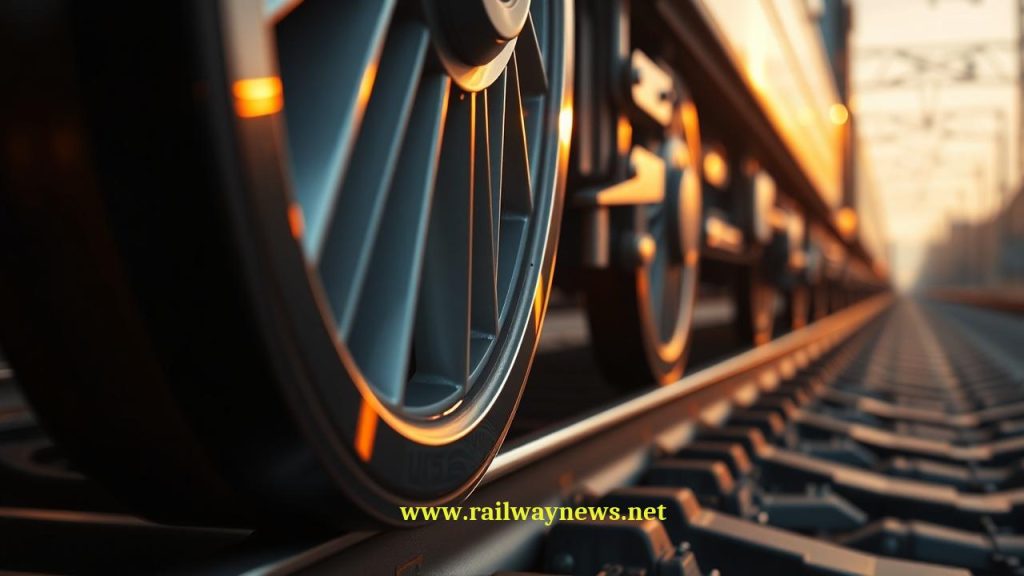
⚡ In Brief
- A bogie (called a truck in North America) is a steerable wheel assembly beneath a railway vehicle that carries the vehicle body, provides suspension, and enables curve negotiation.
- A standard passenger bogie weighs 5–8 tonnes and contains over 200 individual components including wheelsets, suspension systems, braking equipment, and the bogie frame.
- Two suspension stages — primary (between wheelset and frame) and secondary (between frame and vehicle body) — work together to isolate passengers from track irregularities.
- Powered bogies (motored bogies) carry traction motors and are the defining component of electric multiple unit (EMU) and diesel multiple unit (DMU) trains.
- Jacobs bogies, shared between two adjacent vehicle bodies, are used on TGV, Talgo, and many modern LRV designs to reduce weight and improve derailment safety.
The bogie is the single most complex mechanical assembly on a railway vehicle. It weighs as much as a family car, contains hundreds of precision-engineered components, operates continuously at speeds up to 350 km/h, and must simultaneously perform three contradictory tasks: support loads of up to 20 tonnes, isolate the vehicle body from every track imperfection, and steer itself around curves without any external guidance other than the shape of the rails.
Understanding the bogie is understanding how railway engineering actually works. Almost every performance characteristic of a train — its ride quality, its maximum speed, its curve-taking ability, its braking distance, its energy consumption — is determined by bogie design.
What Is a Bogie?
A bogie is a framework carrying two or three wheelsets that pivots beneath a railway vehicle body. The pivot point — the bogie centre — allows the bogie to rotate relative to the vehicle body as the train negotiates curves, enabling the wheels to follow the track geometry while the vehicle body continues in a smooth path.
The term “bogie” is used in British English and internationally. In North American English, the same assembly is called a “truck.” The two terms are interchangeable in technical literature.
Most passenger vehicles sit on two bogies, one near each end of the vehicle. Freight wagons may use bogies or, for shorter vehicles, a simpler two-axle rigid arrangement without bogies.
Key Components of a Railway Bogie
| Component | Function | Notes |
|---|---|---|
| Bogie frame | Structural backbone connecting all components | Steel or aluminium; welded box section construction |
| Wheelsets | Contact with rail; transmit traction and braking forces | Two wheels press-fitted to a common axle; wheel profile critical |
| Primary suspension | Isolates bogie frame from wheelset vibrations | Coil springs or rubber chevrons between axlebox and frame |
| Secondary suspension | Isolates vehicle body from bogie movements | Air springs on most modern passenger vehicles; softer and self-levelling |
| Axleboxes | House the bearings; connect wheelset to primary suspension | Roller bearings standard; sealed for life on modern designs |
| Brake system | Decelerates the vehicle | Disc brakes standard on passenger bogies; tread brakes on some freight |
| Traction motors | Drive the wheelsets (powered bogies only) | One or two motors per bogie; nose-suspended or frame-mounted |
| Bogie pivot / centre plate | Connects bogie to vehicle body; allows rotation | Transmits vertical load; lateral forces via side bearers |
Primary vs Secondary Suspension: How They Work Together
The two-stage suspension system is the key to both ride quality and high-speed stability. The two stages have different roles and different natural frequencies.
Primary suspension operates between the wheelset axlebox and the bogie frame. Its job is to absorb the high-frequency, short-wavelength inputs that come from rail joints, minor surface irregularities, and wheel out-of-roundness. Primary suspension stiffness must be relatively high — if it is too soft, the wheelsets will hunt (oscillate laterally) at speed, which is both uncomfortable and potentially dangerous.
Secondary suspension operates between the bogie frame and the vehicle body. Its job is to provide a smooth ride for passengers by isolating the body from the lower-frequency, longer-wavelength movements of the bogie as it responds to curves, gradients, and larger track irregularities. Air springs — essentially inflatable rubber bags — are the dominant secondary suspension technology on modern passenger vehicles. They are self-levelling (maintaining constant floor height regardless of passenger load), provide a very soft ride, and can be adjusted in real time.
Types of Bogies: A Comparison
| Type | Description | Advantages | Typical Application |
|---|---|---|---|
| Conventional (2-axle) | Standard bogie with two wheelsets | Proven, widely available, maintainable | Most passenger and freight vehicles |
| 3-axle bogie | Three wheelsets per bogie | Higher load capacity per bogie | Heavy freight locomotives |
| Jacobs bogie | Shared between two adjacent vehicle bodies | Fewer bogies, lower weight, better derailment safety | TGV, Talgo, Alstom Coradia, many LRVs |
| Powered (motored) bogie | Carries traction motors on at least one axle | Distributed traction; no locomotive required | EMUs, DMUs, high-speed trains |
| Trailer bogie | No traction motors; carries vehicle weight only | Lighter; lower maintenance cost | Non-powered vehicles in EMU sets |
| Steered bogie | Wheelsets actively steered into curves | Reduced wheel and rail wear on sharp curves | Urban and suburban vehicles on tight radius networks |
| Variable gauge bogie | Wheelsets adjust width between gauges | Cross-border operation without bogie change | Talgo trains at Spain-France border |
Jacobs Bogies: Why TGV and Talgo Use Them
A conventional train with N vehicles needs 2N bogies — two per vehicle. A train using Jacobs bogies needs only N+1 bogies, because each intermediate bogie is shared between two adjacent vehicles. A 10-car train needs 20 conventional bogies but only 11 Jacobs bogies.
The weight saving is significant — typically 10–15% of total bogie mass for a full trainset. But the more important advantage is derailment behaviour. In a conventional derailment, a vehicle that leaves the rails can jackknife relative to its neighbours, with catastrophic results. In a Jacobs-bogie train, each vehicle is constrained at both ends by the shared bogies, making jackknifing geometrically much more difficult. The TGV’s safety record in high-speed derailment incidents is partly attributed to this design.
The disadvantage of Jacobs bogies is maintenance complexity: because each bogie is shared between two vehicles, removing it for maintenance requires separating the two vehicles, which typically means taking the entire trainset out of service. For high-frequency urban fleets where individual vehicle swap-out is important, conventional bogies are often preferred.
Powered Bogies and Distributed Traction
The shift from locomotive-hauled trains (where one or two bogies at the front provide all traction) to multiple unit trains (where powered bogies are distributed throughout the trainset) has been one of the defining trends in passenger rolling stock over the past 40 years.
Distributed traction — where traction motors are spread across many bogies along the train — offers several advantages over concentrated power:
- Better adhesion: More powered axles means traction force is spread over a longer rail contact length, reducing the risk of wheelslip on wet or contaminated rails.
- Redundancy: A single traction motor failure does not strand the train — the remaining motors continue to provide adequate traction.
- Lower axle loads: Spreading the weight of traction equipment across more bogies reduces the load per axle, allowing operation on lighter track.
- Better energy recovery: More motors means more regenerative braking capacity, feeding energy back into the overhead supply.
Bogie Standards and Key Specifications
| Parameter | Typical Passenger Bogie | High-Speed Bogie | Heavy Freight Bogie |
|---|---|---|---|
| Bogie weight | 5–8 tonnes | 6–10 tonnes | 8–12 tonnes |
| Axle load (max) | 17 tonnes | 15–17 tonnes | 22.5–27 tonnes |
| Max speed | 160–200 km/h | 300–350 km/h | 100–120 km/h |
| Wheelbase | 2,500–2,700 mm | 2,900–3,000 mm | 1,800–1,900 mm |
| Secondary suspension | Air springs | Air springs (active on some) | Coil springs or none |
| Key standard | EN 13749, EN 14363 | EN 14363, TSI RST HS | EN 13749, AAR M-214 (NA) |
Major Bogie Manufacturers
The global bogie market is dominated by a small number of specialist manufacturers, most of whom are subsidiaries of major rolling stock groups:
- Siemens Mobility — SF7000 family; used on Velaro and Desiro platforms worldwide
- Alstom — FLEXX Eco and FLEXX Power bogies (from Bombardier acquisition); fitted to Coradia, Talent, and TRAXX platforms
- Stadler Rail — proprietary bogies for FLIRT, KISS, and GTW platforms
- Bonatrans (TRANSA) — major independent wheelset and bogie frame supplier in Europe
- Wabtec (formerly Faiveley/Workhorse) — freight bogie specialist; dominant in North America
- CRRC — largest volume bogie producer globally; supplies Chinese domestic market and increasingly international projects
Editor’s Analysis
The bogie is experiencing its most significant design evolution in decades, driven by three converging pressures. First, the shift to battery and hydrogen traction is adding weight to bogies that must accommodate energy storage or fuel cell systems, challenging the axle load limits that govern track access across most European networks. Second, the drive for lower lifecycle costs is pushing operators towards modular bogie designs where worn components — wheelsets, brake discs, suspension elements — can be replaced without removing the entire bogie from the vehicle. Third, digital monitoring is transforming bogie maintenance from time-based to condition-based: accelerometers and acoustic sensors embedded in axleboxes can detect bearing defects weeks before failure, and track geometry irregularities can be mapped in real time from bogie sensor data. The bogie is becoming as much a data platform as a mechanical assembly — and the manufacturers who master that transition will have a significant competitive advantage in the next generation of rolling stock procurement. — Railway News Editorial
Frequently Asked Questions
- Q: What is the difference between a bogie and a truck?
- There is no technical difference — they are the same component described using different regional terminology. “Bogie” is the standard term in British English, European engineering, and international standards. “Truck” is the standard term in North American English. Both refer to the pivoting wheel assembly beneath a railway vehicle.
- Q: Why do trains use bogies instead of fixed axles?
- Fixed axles — where the wheels are rigidly attached directly to the vehicle underframe — work on short vehicles and trams but create problems on longer vehicles. A long rigid vehicle cannot negotiate tight curves because the geometry of the wheelsets forces the rails apart. Bogies solve this by pivoting beneath the vehicle, allowing each bogie to steer independently into curves while the vehicle body takes a smooth curved path above. Fixed-axle two-axle wagons are still used for short freight vehicles, but any vehicle over approximately 14 metres requires bogies for safe curve negotiation.
- Q: What causes wheel squeal on tight curves?
- Wheel squeal on curves is caused by the wheel flange making contact with the rail gauge face and sliding laterally under the combined effect of the vehicle’s tendency to travel in a straight line and the curved track geometry forcing it to turn. The squeal is the acoustic result of this stick-slip friction. Steered bogies, which actively rotate the wheelsets to better align them with the curve, can significantly reduce squeal. Lubrication systems on the rail or wheel flange also mitigate it. Squeal is particularly common on metro and tram networks where curves are tight and speeds are low.
- Q: How often do bogies need to be overhauled?
- Bogie overhaul intervals depend on vehicle type, operating intensity, and national maintenance regimes. A typical heavy-use commuter EMU bogie may require intermediate examination every 300,000–600,000 km and full overhaul every 1.2–1.8 million km. For high-speed trains, intervals are typically distance-based but with additional condition monitoring. Modern condition-based maintenance systems using onboard sensors are extending effective maintenance intervals by detecting anomalies before they reach critical thresholds.
- Q: What is wheelset hunting and why is it dangerous?
- Hunting is a self-excited lateral oscillation of a wheelset at speed, caused by the interaction between the conical wheel profile and the rail. As speed increases, a wheelset that is displaced slightly from the track centreline tends to oscillate back and forth across the track. Below a critical speed, these oscillations damp out. Above the critical speed — the hunting threshold — they amplify, causing violent lateral forces on the track and vehicle. Hunting is controlled through primary suspension stiffness, wheel profile maintenance, and bogie design. It is one of the fundamental speed limits in railway dynamics and why maintaining correct wheel profile is a safety-critical maintenance task.

Railway infrastructure, rolling stock and transport technologies specialist focused on global rail industry developments, high-speed rail systems, signaling technologies and freight transportation. Covering railway investments, public transport modernization, rail operations and international mobility projects across Europe, Asia and North America.
RELATED POSTS

October 1, 2026 7:09 am
United States regulators confirmed a September 30 deadline for the...

October 1, 2026 12:13 am
Illinois approved $1.5 billion annually for the Northern Illinois Transit...

October 4, 2026 5:14 pm
Alstom secured a CA$4.7 billion order from VIA Rail Canada...

October 1, 2026 6:10 am
Amtrak approved a System Expansion Committee on July 30 to...
October 1, 2026 3:12 am
Greenbrier confirmed Brian Comstock as new president and CEO effective...
October 6, 2026 2:14 am
Union Pacific launched export rail shipments with Ferromex to deliver...