
Why EN 14865-1 Changes European Rail Safety
EN 14865-1 rigorously tests railway axlebox grease, ensuring critical lubrication performance. This vital standard prevents bearing failures, enhancing rail safety and operational reliability.
Understanding EN 14865-1: The Standard for Testing Axlebox Grease Lubrication
EN 14865-1 is a crucial European Standard that specifies the laboratory test method for determining the lubrication capability of greases intended for railway vehicle axleboxes. This standard provides a rigorous, repeatable procedure to simulate the demanding operational conditions faced by axlebox bearings, ensuring that only qualified lubricants are used in these safety-critical components.
The primary goal of this standard is to evaluate a grease’s ability to provide effective lubrication, prevent excessive wear, and maintain thermal stability under controlled load, speed, and temperature conditions that mimic real-world railway service.
The Critical Role of Axlebox Grease in Rail Safety
Railway axleboxes are subjected to one of the most demanding environments in any mechanical system. They must support the entire weight of the wagon or locomotive while enduring constant vibration, significant shock loads from track imperfections, and a wide spectrum of operating temperatures. A failure in the axlebox bearing due to inadequate lubrication can have catastrophic consequences, leading to bearing seizure, axle failure, and potentially derailment. Therefore, a standardized method like EN 14865-1 is essential for the industry to:
- Qualify new lubricating greases for railway use.
- Ensure consistent quality and performance from grease manufacturers.
- Provide a common benchmark for railway operators and vehicle builders.
- Mitigate risks associated with bearing and axle failure, enhancing operational safety.
Core Principles of the EN 14865-1 Test Method
The standard outlines a detailed procedure using a specific test rig, designed to replicate the stresses on an axlebox bearing. The method focuses on measuring key performance indicators like frictional torque and operating temperature over an extended period.
Test Apparatus
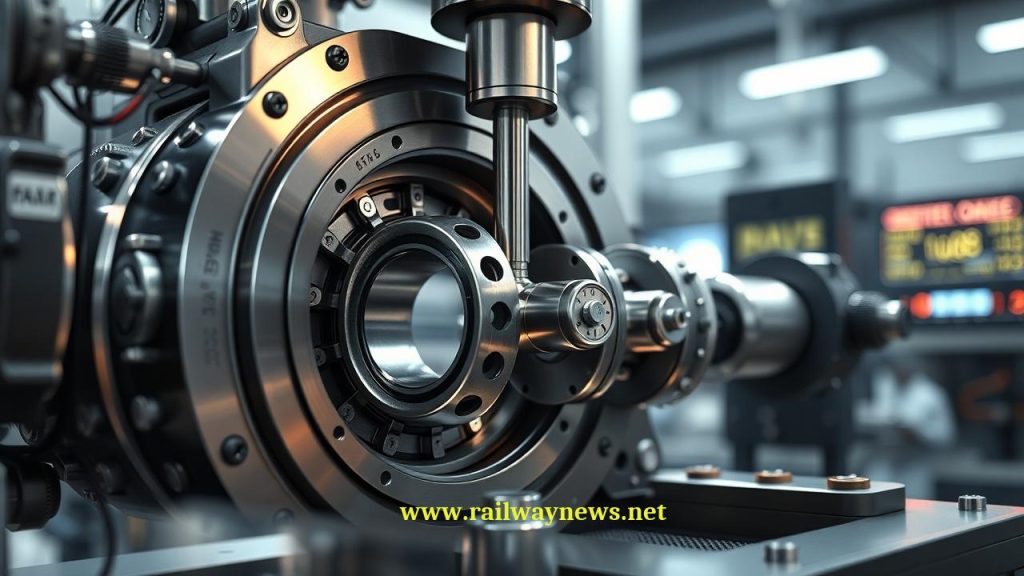
The test is typically performed on a specialized test rig (often an FAG FE-8 rig or equivalent) which consists of the following key components:
- Test Bearings: The standard specifies the use of two cylindrical roller bearings of a particular size and type, which are installed in a test housing. These are the components that the grease must protect.
- Housing and Shaft: A robust housing encloses the bearings, and a central shaft is driven by a motor to simulate the rotation of the axle.
- Loading System: A system applies a constant radial load to the bearing housing, simulating the weight of the railway vehicle.
- Heating and Cooling System: An external system controls the temperature of the outer ring of the bearings, allowing the test to be run under specific thermal conditions.
- Instrumentation: Precision sensors continuously monitor the frictional torque required to rotate the shaft and the temperature of the bearings.
Test Procedure
The procedure is meticulously defined to ensure repeatability and comparability of results. It generally involves the following stages:
- Preparation: The test rig and new test bearings are thoroughly cleaned to remove any residual oils or contaminants. A precise, specified quantity of the test grease is then carefully applied to the bearings and housing.
- Running-in Phase: The test begins with a running-in period at a lower speed and load. This allows the grease to distribute evenly throughout the bearings and establish a stable lubricating film before the main test phase begins.
- Main Test Phase: Following the running-in period, the test parameters are adjusted to the full specified conditions. This typically involves a set rotational speed, a high radial load, and a controlled elevated temperature. The test runs for a predetermined duration, often several hundred hours.
- Monitoring: Throughout the main test phase, frictional torque and bearing temperature are continuously recorded. These two data points are the primary indicators of the grease’s performance.
- Post-Test Inspection: After the test is completed, the rig is disassembled. The condition of the grease (checking for excessive oil bleed, hardening, or contamination) and the state of the bearings (looking for signs of wear, scuffing, pitting, or corrosion) are carefully examined and documented.
Key Test Phases and Evaluation Criteria
The performance of the grease is judged against a set of strict criteria defined within the standard. A stable and successful test is characterized by predictable and controlled behavior, whereas a failure is often indicated by sudden, dramatic changes in the monitored parameters.
| Test Phase | Primary Objective | Key Monitored Parameters |
|---|---|---|
| Running-in | To allow for proper grease distribution and the formation of a stable lubricating film. | Gradual stabilization of frictional torque and bearing temperature. |
| Main Test | To assess the grease’s long-term performance under simulated operational stress (load, speed, temperature). | Low and stable frictional torque. Bearing temperature remaining below a specified maximum limit. Absence of sudden spikes. |
| Post-Test Inspection | To evaluate the physical condition of the bearings and the remaining grease after the test. | Minimal wear on rollers and raceways. Grease should not show signs of severe degradation, oxidation, or hardening. Minimal grease leakage. |
Interpreting the Results: Pass/Fail Criteria
A grease is considered to have passed the EN 14865-1 test if it meets all the specified performance criteria. Failure can be determined by several factors:
- Excessive Frictional Torque: If the torque required to rotate the shaft rises above a predefined limit, it indicates that the grease is failing to provide adequate lubrication.
- Thermal Runaway: A rapid, uncontrolled increase in bearing temperature is a critical failure indicator. It signifies that the heat generated by friction is exceeding the system’s ability to dissipate it, a precursor to catastrophic bearing seizure.
- Significant Wear: If the post-test inspection reveals significant wear, scoring, or damage to the bearing surfaces, the grease has failed to provide sufficient anti-wear protection.
- Grease Degradation: If the grease has hardened, excessively separated (oil bleeding), or become contaminated to a degree that compromises its lubricating properties, it is deemed a failure.
Conclusion: A Gatekeeper for Railway Reliability
EN 14865-1 serves as an essential quality gatekeeper for lubricants in the railway industry. It provides a standardized, data-driven method for assessing a grease’s fundamental ability to lubricate and protect critical axlebox bearings. By subjecting greases to this rigorous test, railway operators and equipment manufacturers can have a high degree of confidence that the products they use are fit for purpose, directly contributing to the overall safety, reliability, and efficiency of their rolling stock operations.

Railway infrastructure, rolling stock and transport technologies specialist focused on global rail industry developments, high-speed rail systems, signaling technologies and freight transportation. Covering railway investments, public transport modernization, rail operations and international mobility projects across Europe, Asia and North America.