
UK Railway Line Protected: 18,000 Tonne Coastal Defence Begins
Folkestone Warren’s railway line gets a 30-year shield! 18,000 tonnes of rock armour will protect against erosion, ensuring uninterrupted train services.
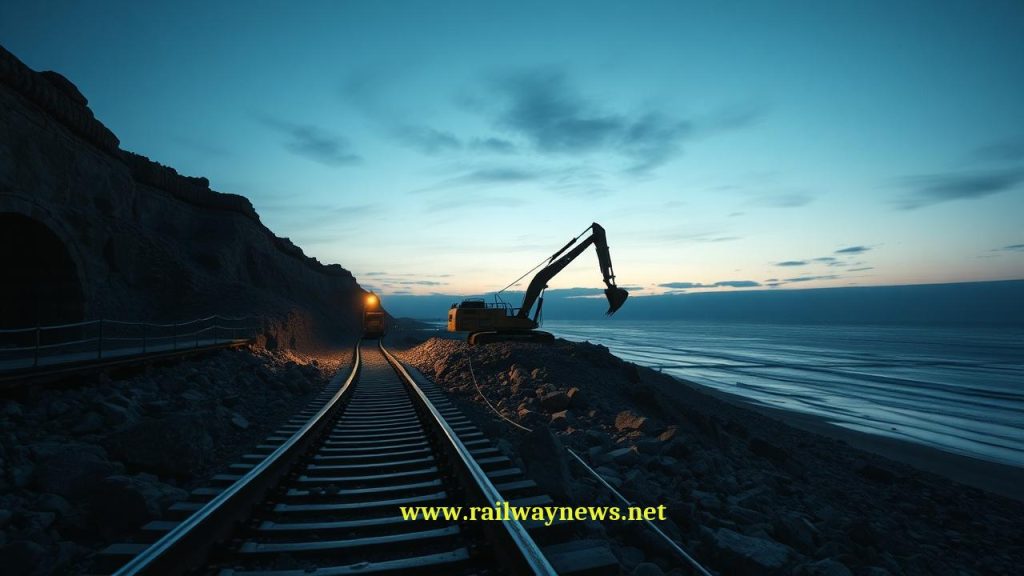
FOLKESTONE, UK – Major coastal defence works have commenced to protect the critical railway line at Folkestone Warren, a historically unstable stretch of coastline in southeast England. The multi-year project will see the installation of 18,000 tonnes of rock armour to safeguard the infrastructure against erosion and landslips for the next three decades, ensuring operational resilience with no disruption to passenger services.
| Category | Details |
|---|---|
| Project Name | Folkestone Warren Coastal Defence Reinforcement |
| Location | Folkestone, Kent, United Kingdom |
| Key Material | 18,000 tonnes of Boulogne Limestone |
| Primary Objective | 30-year stabilisation of railway and cliffs against coastal erosion |
| Public Access Impact | Western beach and walkway closed until April 2026 |
| Train Service Impact | Services to run as normal throughout the project |
Work has officially begun on a critical project to future-proof the railway line running through the geologically volatile Folkestone Warren. The first delivery of Boulogne Limestone, a tough, crystalline rock selected for its durability in marine environments, arrived on site this week. These rocks will be strategically placed along a 300-metre section of the shoreline to create a robust sea defence, shielding the base of the cliffs from wave action and preventing further erosion.
The engineering intervention is detailed, addressing multiple points of failure. In addition to the 18,000 tonnes of rock armour, engineers will install approximately fifty steel sheet piles directly behind the existing sea wall. This measure is designed to prevent seawater from penetrating and undermining the railway’s supporting abutments. Additionally, the project includes significant repairs to the area’s drainage systems, which have subsided by as much as a metre due to persistent cliff movement, exacerbating instability.
Folkestone Warren has long been a known area of concern, with a history of landslips impacting the railway. According to David Davidson, Chief Operating Officer at the South Eastern Railway, the area is continuously monitored by hundreds of ground sensors that provide real-time stability data. “This major intervention is a proactive step to protect both the railway and the Warren,” Davidson stated, emphasizing that the work is a preventative measure to ensure long-term safety and service reliability. While the project necessitates the full closure of the Western beach and its popular walkway until April 2026, all construction activity has been planned to occur away from the track, allowing train services to continue without interruption.
Key Takeaways
- Long-Term Resilience: The project is designed to provide 30 years of protection for a vital rail link against coastal erosion and landslips.
- Zero Passenger Disruption: Despite the scale of the works, train services will operate normally throughout the construction period.
- Multi-faceted Engineering: The solution combines rock armour sea defences, sheet piling to protect foundations, and extensive drainage repairs to address the complex geological challenges.
Editor’s Analysis
This project at Folkestone Warren is a microcosm of a much larger challenge facing the global railway industry: climate adaptation. As sea levels rise and extreme weather events become more frequent, coastal and cliff-side railway lines are increasingly vulnerable. Proactive, capital-intensive engineering projects like this are shifting from being ‘desirable upgrades’ to ‘essential investments’ for maintaining network integrity. While the immediate cost and local disruption are significant, the long-term value lies in avoiding a catastrophic failure, which would result in far greater economic and social costs. For network operators worldwide, the Folkestone model demonstrates the necessity of investing heavily in preventative geotechnical and coastal engineering to ensure the viability of critical infrastructure for decades to come.
Frequently Asked Questions
- Will my train journey be affected by the works at Folkestone Warren?
- No. The project has been carefully planned to take place away from the live railway line. South Eastern Railway has confirmed that trains will continue to run as normal throughout the duration of the works.
- Why is the beach and walkway closed for so long?
- The Western beach and walkway are closed to the public to ensure safety during the large-scale engineering project. The closure, scheduled until April 2026, allows heavy machinery to deliver and place 18,000 tonnes of rock and carry out repairs without risk to the public.
- What makes Boulogne Limestone suitable for this project?
- Boulogne Limestone is a tough, crystalline rock known for being hard-wearing. Its density and resistance to weathering make it an ideal material for coastal protection, as it can withstand the constant force of wave action and harsh marine conditions over a long period.

Railway infrastructure, rolling stock and transport technologies specialist focused on global rail industry developments, high-speed rail systems, signaling technologies and freight transportation. Covering railway investments, public transport modernization, rail operations and international mobility projects across Europe, Asia and North America.
RELATED POSTS

October 1, 2026 7:09 am
United States regulators confirmed a September 30 deadline for the...

October 1, 2026 12:13 am
Illinois approved $1.5 billion annually for the Northern Illinois Transit...

October 4, 2026 5:14 pm
Alstom secured a CA$4.7 billion order from VIA Rail Canada...

October 6, 2026 2:14 am
Union Pacific launched export rail shipments with Ferromex to deliver...

October 1, 2026 6:10 am
Amtrak approved a System Expansion Committee on July 30 to...

October 1, 2026 3:12 am
Greenbrier confirmed Brian Comstock as new president and CEO effective...