
UK Rail: Transpennine Upgrade Speeds Ahead After Holiday Blitz
Transpennine Route Upgrade accelerates with holiday works, including new signalling and track upgrades, promising faster, more reliable train services across the North.
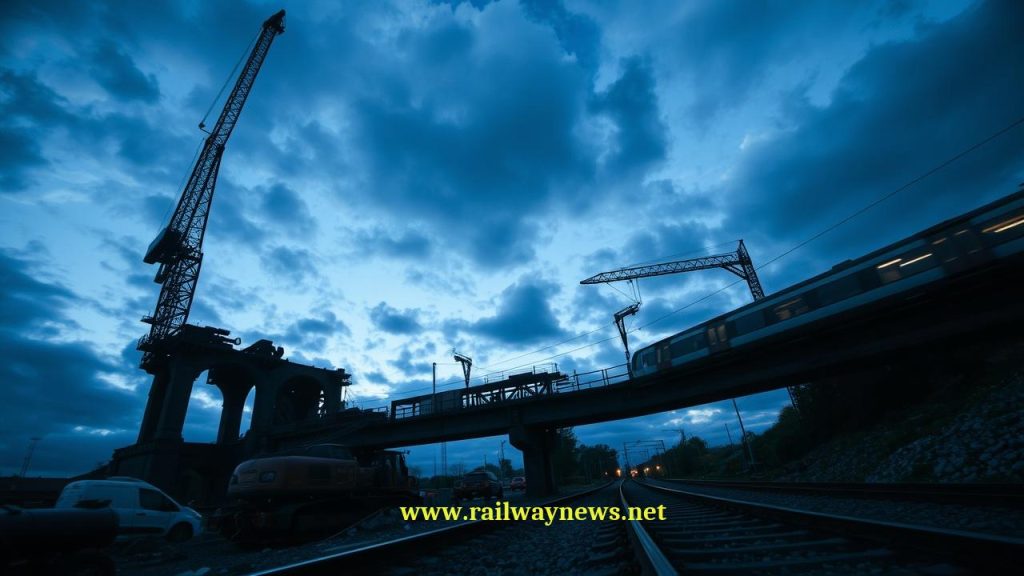
MANCHESTER, UK – Network Rail has announced the successful completion of a major phase of the Transpennine Route Upgrade (TRU) over the Christmas and New Year period, delivering vital improvements across West Yorkshire. The intensive engineering blockade saw significant progress at key sites including Mirfield, Huddersfield, and Deighton, alongside a full line closure between Leeds and York to install and test new-generation signalling and track.
| Category | Details |
|---|---|
| Project Name | Transpennine Route Upgrade (TRU) |
| Lead Organisation | Network Rail |
| Work Period | Christmas & New Year 2025/2026 |
| Key Locations | Mirfield, Deighton, Huddersfield, Leeds-York Corridor |
| Core Objectives | Increase speed, frequency, reliability; Full electrification |
Engineers delivered a significant package of upgrades across the route over the festive period, a time strategically chosen to minimise passenger disruption. At Mirfield station, teams realigned tracks, installed new signalling equipment, and constructed longer platforms to accommodate more carriages. Customer facilities were also enhanced with new lighting, information systems, and CCTV. New lifts are set to be commissioned later this month, providing step-free access to the platforms for the first time. In parallel, work continued at Huddersfield station on the restoration of its historic roof canopy and strengthening of the adjacent viaduct, while at Deighton, the demolition of the Whitacre Street overbridge commenced.
The closure of the line between Leeds and York, which necessitated train diversions and rail replacement bus services, was a critical component of the holiday works. This blockade enabled a major programme of signalling renewals and track remodelling, essential for allowing services to travel through the area at higher speeds and increasing overall network reliability. The demolition of the bridge in Deighton is a key enabling work for one of the project’s most significant upgrades: the expansion of the line from two to four tracks. This will create the capacity for faster express services to overtake local stopping trains, a fundamental change that will help reduce delays and increase timetable flexibility across the entire corridor.
These works form part of the multi-billion-pound Transpennine Route Upgrade, a landmark project to transform journeys between Manchester, Huddersfield, Leeds, and York. The programme’s ultimate vision is to deliver a fully electrified, digitally signalled railway capable of supporting more frequent trains, increased seating capacity, and faster end-to-end journeys. James Richardson, a senior project official, stated, “Over Christmas and New Year, we have successfully delivered an immense amount of work. We are committed to delivering this incredible programme, supporting our passengers and communities, and making a real difference to the North of England.” He added that 2026 will see further major milestones achieved as the project pushes forward.
Key Takeaways
- Accelerated Progress: A major engineering blitz over the holiday period has advanced key civil and technical elements of the Transpennine Route Upgrade.
- Capacity & Speed Boost: Bridge demolition at Deighton paves the way for four-tracking the line, while new signalling between Leeds and York will enable faster services.
- Enhanced Passenger Experience: Mirfield station has received significant upgrades, including longer platforms and future step-free access, directly improving journeys for local passengers.
Editor’s Analysis
The successful execution of this complex, multi-site engineering blockade highlights the growing momentum behind the Transpennine Route Upgrade. For the global rail market, the TRU serves as a critical case study in modernizing a heavily used, Victorian-era railway corridor while balancing operational and passenger needs. The project’s holistic approach—combining civil engineering for capacity, new digital signalling for efficiency, and full electrification for sustainability—represents the gold standard for route modernization. Its progress is a vital indicator of the UK’s commitment to upgrading its regional infrastructure and improving economic connectivity in the North of England.
Frequently Asked Questions
- What is the primary goal of the Transpennine Route Upgrade?
- The project aims to transform the railway between Manchester, Huddersfield, Leeds, and York by delivering full electrification, modern signalling, and increased track capacity. This will result in faster, more frequent, and more reliable train services with more seats for passengers.
- Which specific locations saw upgrades during the recent works?
- Significant work was undertaken at Mirfield station (track, platforms, signalling), Deighton (bridge demolition for line expansion), Huddersfield (station roof restoration), and along the entire line between Leeds and York (new signalling and track remodelling).
- How were passengers affected during the upgrades?
- To facilitate the works, the line between Leeds and York was closed. Network Rail advised passengers to plan ahead, with services being diverted or replaced by buses throughout the period, a necessary disruption to deliver long-term improvements for a more reliable railway.

Railway infrastructure, rolling stock and transport technologies specialist focused on global rail industry developments, high-speed rail systems, signaling technologies and freight transportation. Covering railway investments, public transport modernization, rail operations and international mobility projects across Europe, Asia and North America.
RELATED POSTS

October 1, 2026 7:09 am
United States regulators confirmed a September 30 deadline for the...

October 8, 2026 1:15 pm
Alstom secured a €1bn contract to build 13 automated trains,...

October 4, 2026 5:14 pm
Alstom secured a CA$4.7 billion order from VIA Rail Canada...

October 1, 2026 12:13 am
Illinois approved $1.5 billion annually for the Northern Illinois Transit...

October 6, 2026 2:14 am
Union Pacific launched export rail shipments with Ferromex to deliver...

October 1, 2026 6:10 am
Amtrak approved a System Expansion Committee on July 30 to...