
Railway Construction: Future Trends & Global Rail Insights
Here are a few voiceover-friendly excerpts tailored for railway professionals, incorporating the core elements:
**Option 1 (Focus on Innovation):**
> Modern railway construction demands precision. We’re unveiling the innovative technologies and expert management shaping the future of railway projects.
**Option 2 (Focus on Complexities):**
> From planning to commissioning, the construction of modern railways is complex. Explore the intricacies and challenges in railway infrastructure today.
**Option 3 (Focus on the Future):**
> Building the railways of tomorrow requires a deeper understanding of today’s innovations. Learn how technology is revolutionizing railway construction.
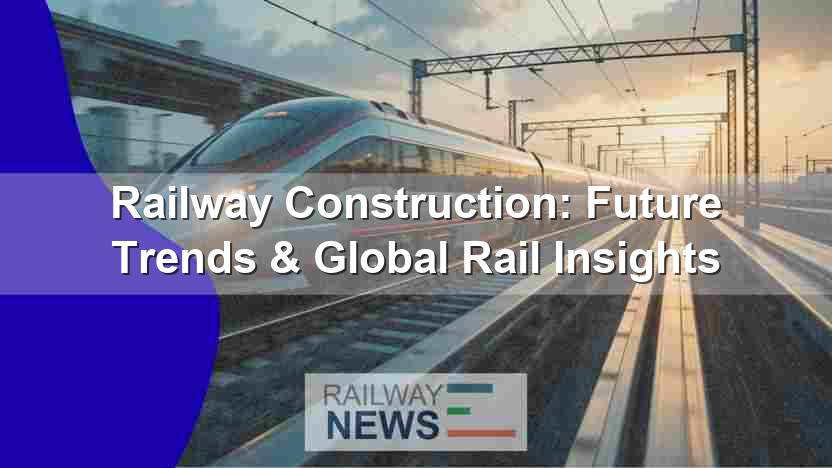
Unveiling the Complexities of Modern Railway Construction: A Deep Dive
The construction of modern railways is a monumental undertaking, demanding intricate planning, cutting-edge technology, and a deep understanding of engineering principles. This article explores the multifaceted aspects of railway construction, from the initial planning stages to the final commissioning of the infrastructure. We will explore the challenges inherent in designing and building railways, including navigating complex terrains, managing environmental impacts, and integrating advanced signaling and control systems. Additionally, we’ll examine the crucial role of project management, risk assessment, and the collaborative efforts required to bring these ambitious projects to fruition. The goal is to provide a detailed overview of the railway construction process, highlighting its complexities, and the innovative solutions employed to overcome them. We will see how projects are constantly being modernized to meet the increasing demand of passengers and goods, and also how to be safe, quick and sustainable.
Railway Construction: A Symphony of Planning and Execution
The journey of a new railway begins long before the first track is laid. It all starts with detailed planning, which encompasses route selection, feasibility studies, and environmental impact assessments. Route selection considers factors such as terrain, population density, and existing infrastructure. Feasibility studies analyze the economic viability of the project, evaluating potential ridership, revenue projections, and operational costs. Environmental impact assessments are critical for mitigating the project’s effect on the surrounding ecosystem, and compliance with all relevant regulations.
* Detailed surveys and geological investigations are also required to understand the subsurface conditions and identify potential challenges, such as unstable ground or the presence of underground utilities.
* The design phase involves developing detailed plans for the track, signaling systems, stations, and other infrastructure elements.
* Advanced computer-aided design (CAD) software is used to create precise models and simulations, optimizing the design and ensuring its compatibility with existing systems.
Construction then begins, involving earthworks, track laying, and the installation of signaling and communication systems.
Railway Infrastructure: The Backbone of Modern Transportation
Railway infrastructure encompasses all the physical components necessary for the operation of a railway system. This includes the track itself, which consists of rails, sleepers, ballast, and the underlying formation. The track must be designed to withstand the heavy loads and stresses imposed by trains, ensuring the safety and efficiency of operations. Signaling systems play a vital role in controlling train movements, preventing collisions, and optimizing the capacity of the railway network.
* These systems utilize a combination of signals, sensors, and communication networks to provide train drivers with real-time information about track conditions and the location of other trains.
* Stations and depots are essential infrastructure elements, providing facilities for passengers, freight handling, and train maintenance.
* The design and construction of these facilities must consider factors such as passenger flow, accessibility, and operational efficiency.
The Role of Technology: Driving Innovation in Railway Construction
Technology plays an increasingly crucial role in all aspects of railway construction. Advanced surveying techniques, such as LiDAR (Light Detection and Ranging) and GPS (Global Positioning System), are used to create highly accurate 3D models of the terrain and existing infrastructure. These models are used to optimize the design of the railway and ensure its compatibility with the surrounding environment. Construction equipment has also become more sophisticated, with the development of specialized machines for tasks such as track laying, tamping, and ballast distribution. These machines can significantly improve the efficiency and quality of construction.
* In addition, Building Information Modeling (BIM) is increasingly used to create digital representations of the entire railway project, allowing for better collaboration, coordination, and clash detection.
* The use of digital twins, which are virtual replicas of physical assets, enables engineers to simulate the performance of the railway and identify potential problems before they occur.
* Additionally, advancements in materials science have led to the development of stronger, more durable, and more sustainable materials for railway construction.
You might be interested in:
Last October 2018, we published an article about the Grand Paris Express Line 15 South electrification project. Click here to read – Grand Paris Express Line 15: VINCI Energies’ Electrification Project
Navigating the Complexities: Project Management and Future Trends
Effective project management is critical for the successful completion of any railway construction project. This involves careful planning, scheduling, and cost control, as well as managing risks, coordinating the work of multiple contractors, and ensuring compliance with all relevant regulations. Risk assessment is an important part of project management, identifying and mitigating potential problems that could delay the project or increase its costs.
* The future of railway construction is likely to be shaped by several trends, including the increasing use of automation, artificial intelligence, and data analytics.
* Automated construction processes, such as automated track laying and tamping, will improve efficiency and reduce the need for manual labor.
* Artificial intelligence can be used to optimize train schedules, predict equipment failures, and improve the overall performance of the railway network.
* Data analytics will be used to analyze vast amounts of data collected from sensors and other sources, providing insights into the performance of the railway and identifying areas for improvement.
As cities grow, projects such as the **Sydney Harbour rail tunnel** will become increasingly common.
Conclusion: Building the Railways of Tomorrow
To summarize, railway construction is a complex and demanding endeavor that requires meticulous planning, cutting-edge technology, and expert project management. From the initial route selection and design phases to the final commissioning of the infrastructure, every step of the process demands precision and attention to detail. The integration of advanced technologies, such as LiDAR, BIM, and AI, is transforming the way railways are designed, built, and operated, leading to greater efficiency, safety, and sustainability. The ability to overcome challenges, such as difficult terrain, environmental regulations, and the need for innovation is paramount. Effective project management, including risk assessment and collaboration, is essential for delivering projects on time and within budget. The future of railway construction is bright, with ongoing advancements in automation, data analytics, and materials science. This will continue to enhance the performance and sustainability of railway networks worldwide, making them an even more vital part of modern transportation systems. The continuous evolution and adaptation of these systems is what will make railways remain relevant for the generations to come.

Railway infrastructure, rolling stock and transport technologies specialist focused on global rail industry developments, high-speed rail systems, signaling technologies and freight transportation. Covering railway investments, public transport modernization, rail operations and international mobility projects across Europe, Asia and North America.
RELATED POSTS

October 8, 2026 1:15 pm
Alstom secured a €1bn contract to build 13 automated trains,...

October 5, 2026 6:12 pm
AECOM and Jacobs secured a contract in September 2026 to...

October 1, 2026 12:13 am
Illinois approved $1.5 billion annually for the Northern Illinois Transit...

October 4, 2026 11:08 pm
Sound Transit confirmed the September 30 opening of Seattle Pinehurst...
October 5, 2026 1:13 pm
New York MTA confirmed a late 2026 DEIS release for...
October 6, 2026 9:17 am
Illinois approved $1.1M in state funds to upgrade two McHenry...