
Rail Freight: The Future: Guide to Net-Zero Logistics & Railway Tech
EU study highlights rail freight’s key role in Europe’s net-zero logistics, boosting efficiency and reducing CO2 emissions.
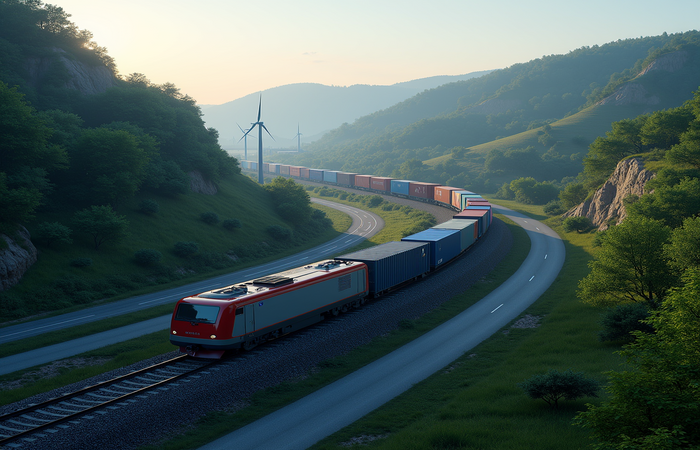
Rail Freight: Paving the Path to Net-Zero Logistics in Europe
A new study commissioned by Europe’s Rail Joint Undertaking (EU-Rail) underscores the pivotal role of rail freight in achieving net-zero logistics chains across Europe. The detailed analysis, conducted by Ernst & Young in collaboration with a steering committee of European rail and logistics stakeholders, reveals significant benefits from increased rail freight integration. The study, titled “Net-Zero Logistics: The Contribution of Rail Transport,” was released recently and examines three ambitious scenarios – low, moderate, and high – across five major freight corridors (representing 65% of EU rail freight volumes), extrapolating findings to the entire EU for the period 2025-2060. This article will delve into the study’s key findings, exploring how strategic investments and policy decisions can position rail as the backbone of sustainable logistics, reducing CO₂ emissions, improving efficiency, and boosting European competitiveness.
Decarbonisation Through Strategic Investment
The core objective of the study, funded by EU-Rail, was to quantify the impact of rail freight on decarbonization efforts. The analysis of the “high ambition scenario” reveals that investments in several key areas, including rail freight innovations, multimodal hubs, international rule harmonization, enhanced capacity and traffic management, and the implementation of digital automatic coupling (DAC), can yield substantial environmental and socio-economic returns. The study highlights that rail freight significantly reduces CO₂ emissions and other negative externalities, such as congestion and accidents. Moreover, it emphasizes that these benefits remain substantial even when compared to an ambitious baseline scenario in which other transport modes, like road and inland waterways, fully decarbonize over the study period. Therefore, it represents a conservative estimate of what a shift to net-zero logistics can achieve. These findings are based on modeling that was endorsed by independent academia, lending credibility to the study’s conclusions.
The Economic and Efficiency Benefits of Rail Freight
Beyond environmental benefits, the study demonstrates the considerable socio-economic advantages of investing in rail freight. Increased rail usage improves overall logistics efficiency, leading to lower transport costs, reduced congestion, and the generation of long-term energy savings. The study emphasizes the importance of integrated logistics solutions. The development of multimodal hubs is critical. These hubs facilitate the seamless transfer of goods between rail, road, and potentially water transport, thus optimizing the entire supply chain. Investments in digitalization, such as the implementation of DAC, are vital. Digital automatic coupling (DAC) promises to automate critical processes, improve efficiency and increase capacity. These innovations contribute to greater flexibility and responsiveness in freight transport operations.
Policy and Regulatory Framework for Rail Freight Growth
Achieving the high-ambition scenario, and thus the full potential of rail freight, necessitates robust policy and regulatory support. The study underscores the need for streamlined international rule harmonization to simplify cross-border operations. Harmonized standards across the European rail network will ensure smooth and efficient freight transport, reducing delays and costs. Additionally, investment in capacity and traffic management improvements is critical. This includes upgrading existing rail infrastructure, implementing advanced signaling systems, and optimizing train routing. Improved traffic management helps to maximize network utilization and reduce delays, which are currently major challenges. These strategic investments will support a move towards net-zero logistics.
Key Stakeholders and Collaboration
The study was produced in close collaboration with a Steering Committee comprised of key industry representatives. These include the Community of European Railway and Infrastructure Companies (CER), the European Association for Forwarding, Transport, Logistics and Customs Services (CLECAT), the European Rail Freight Association (ERFA), and several other prominent rail and logistics organizations. By involving a diverse range of stakeholders, the study ensures that its findings are practical and relevant to the entire industry. The European Commission (DG MOVE) and EU-Rail also provided their expertise and support. This collaborative approach is essential for identifying and addressing the complex challenges facing the rail freight sector. A group of academics was formed to frame the development of the methodology, ensuring the study’s rigor and credibility.
Conclusion
The EU-Rail study presents a compelling case for prioritizing investment in rail freight as a cornerstone of net-zero logistics in Europe. The findings underscore the economic and environmental benefits of shifting goods from road to rail, leading to reduced CO₂ emissions, decreased congestion, and improved efficiency. The study’s analysis, validated by academic expertise, offers a robust evidence base for policymakers and industry stakeholders to guide strategic decisions, particularly in the context of the Clean Industrial Deal and the Sustainable and Smart Mobility Strategy. The need for investment in rail freight innovations, the development of multimodal hubs, international rule harmonization, and the implementation of digital automatic coupling (DAC) cannot be overstated. The positive outlook shows that even in scenarios where other transport modes achieve deep decarbonization, the contribution of rail remains substantial, providing a solid foundation for European competitiveness. The path forward requires coordinated action, involving both public and private sectors, to fully realize rail freight’s potential for a sustainable and prosperous future.

Railway infrastructure, rolling stock and transport technologies specialist focused on global rail industry developments, high-speed rail systems, signaling technologies and freight transportation. Covering railway investments, public transport modernization, rail operations and international mobility projects across Europe, Asia and North America.
RELATED POSTS

October 1, 2026 7:09 am
United States regulators confirmed a September 30 deadline for the...

October 8, 2026 1:15 pm
Alstom secured a €1bn contract to build 13 automated trains,...

October 4, 2026 5:14 pm
Alstom secured a CA$4.7 billion order from VIA Rail Canada...

October 1, 2026 12:13 am
Illinois approved $1.5 billion annually for the Northern Illinois Transit...

October 6, 2026 2:14 am
Union Pacific launched export rail shipments with Ferromex to deliver...

October 8, 2026 12:18 pm
Siemens Mobility signed an agreement with VinSpeed to supply 350...