
Prague Metro Launches €1.2B Line D Section
Prague Metro launched construction of a 6-km, €1.2+ billion Line D section between Olbrachtova and Nové Dvory, with a 72-month timeline and service by H2 2032.
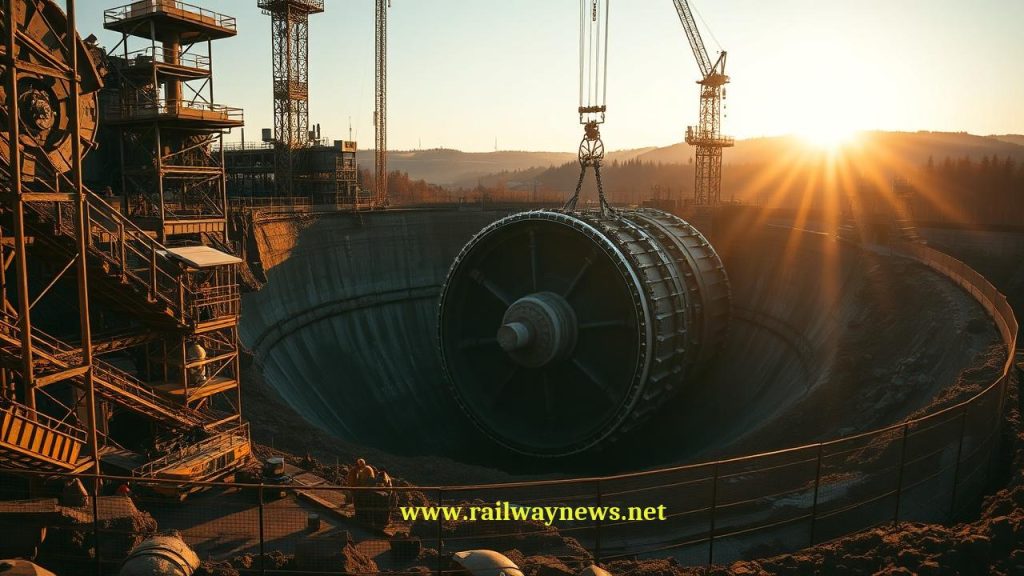
⚡ In Brief: Prague officially launched construction of a EUR 1.2+ billion, 6-km Metro Line D section between Olbrachtova and Nové Dvory, awarded to a Czech-German consortium comprising Subterra, Hochtief CZ, Hochtief Infrastructure, and BeMo Tunneling, with a 72-month timeline and passenger service expected by H2 2032.
PRAGUE, CZECH REPUBLIC – Construction of a new 6-km section of Prague Metro Line D officially began in mid-2025, linking Olbrachtova station to the future Nové Dvory station. The contract, valued at over EUR 1.2 billion, was awarded to a four-member Czech-German consortium: Subterra, Hochtief CZ, Hochtief Infrastructure, and BeMo Tunneling. First underground excavations are scheduled for the second half of August 2025, marking the project’s entry into its visible technical phase.
What Is the Full Scope of This Project?
The new 6-km section includes three stations — Nové Dvory, Nemocnice Krč, and Nádraží Krč — and forms part of the first construction stage of Metro Line D running from Pankrác to Nové Dvory, totalling 4.6 km with five stations. The section requires 9.6 km of TBM-bored tunnels, 2.6 km excavated using the New Austrian Tunnelling Method (NATM), and more than 100 metres of cut-and-cover open excavation. Nové Dvory station, at 33 metres below ground, will be the deepest on the route, while Nádraží Krč will be the only above-ground station. Two Herrenknecht tunnel boring machines, specially designed for the route’s geological conditions, are scheduled for delivery in 2026, with each machine requiring approximately three months to assemble on site. Across the project, 13 construction zones will be established, seven of which will remain active long-term, with the largest — a nearly four-hectare site at Nové Dvory — serving as the primary logistics hub. Once the full Line D corridor is completed across three stages, it will span 10.6 km with 10 stations and carry an estimated 45 million passengers annually.
Key Project Data
| Parameter | Value |
|---|---|
| Project / Contract Name | Prague Metro Line D – Section Olbrachtova to Nové Dvory |
| Total Value | Exceeds EUR 1.2 billion (exact figure not disclosed) |
| Parties Involved | Subterra, Hochtief CZ, Hochtief Infrastructure, BeMo Tunneling (Czech-German consortium) |
| Timeline / Completion | 72 months (6 years); first operational section Pankrác–Nové Dvory expected H2 2032 |
| Country / Corridor | Czech Republic / Prague, southern districts to city centre |
How Does This Compare to Similar Projects?
At over EUR 1.2 billion for a 6-km metro section, Prague’s Metro Line D contract substantially exceeds the value of several comparable European rail infrastructure awards in 2024–2025. By comparison, the Port of Luleå expansion in Sweden — a dredging and civil works project awarded to Boskalis and Van Oord — carries a contract value exceeding EUR 500 million, which itself surpassed the value of multiple rail projects tendered during the same period (Source: MarineLink, 2025). The Prague metro contract, more than double that figure, ranks among the largest urban rail investments in Central Europe in recent years. Across the broader region, Hungary’s GYSEV is simultaneously advancing its InterCity EMU fleet programme, indicating sustained capital flows into Central European rail infrastructure despite macroeconomic headwinds (Source: Railvolution, 2025). Individual consortium member shares and the precise financial breakdown of the EUR 1.2+ billion contract were not publicly disclosed at time of publication.
Editor’s Analysis
Prague’s commitment of over EUR 1.2 billion to a single metro section reflects a strategic bet on high-capacity rail as the backbone of district-scale urban development, with Deputy Mayor Jaromír Beránek explicitly linking the stations to new residential and service-area growth. The 72-month construction window places the first ridership returns no earlier than 2032, a timeline that demands political continuity and stable municipal budgeting across multiple electoral cycles. This long-horizon approach mirrors the aggressive infrastructure posture seen in markets such as India, where Indian Railways is pursuing a broad modernisation drive to support urbanisation and freight demand (Source: Construction World, 2025). Meanwhile, the contrast with Ukraine — where more than 200 railway locomotives have reportedly been damaged by Russian attacks in 2026, straining Ukrzaliznytsia’s repair capacity and export logistics — underscores how Central Europe’s rail investment map is being redrawn along both development and security fault lines (Source: Reuters, 2026).
FAQ
Q: When will the first passengers be able to ride Prague Metro Line D?
A: The first fully operational section, between Pankrác and Nové Dvory, is expected to enter passenger service in the second half of 2032, according to the Prague Public Transit Company (DPP).
Q: How deep is the deepest station on the new Metro Line D section?
A: Nové Dvory station will be the deepest, with platforms situated approximately 33 metres below ground level. Nemocnice Krč station will descend to around 17 metres, while Nádraží Krč will be the only above-ground station on the section.
Q: What is the total length of the full Metro Line D when all phases are complete?
A: The full Line D corridor will measure approximately 10.6 kilometres and include 10 stations, delivered across three construction stages: Pankrác–Nové Dvory (4.6 km, five stations), extension to Písnice (3.8 km, three stations plus a depot), and the final leg from Pankrác to Náměstí Míru (2.7 km, two stations).

Railway infrastructure, rolling stock and transport technologies specialist focused on global rail industry developments, high-speed rail systems, signaling technologies and freight transportation. Covering railway investments, public transport modernization, rail operations and international mobility projects across Europe, Asia and North America.
RELATED POSTS

October 8, 2026 1:15 pm
Alstom secured a €1bn contract to build 13 automated trains,...

October 1, 2026 7:09 am
United States regulators confirmed a September 30 deadline for the...

October 8, 2026 12:18 pm
Siemens Mobility signed an agreement with VinSpeed to supply 350...

October 4, 2026 5:14 pm
Alstom secured a CA$4.7 billion order from VIA Rail Canada...

October 5, 2026 6:12 pm
AECOM and Jacobs secured a contract in September 2026 to...

October 1, 2026 12:13 am
Illinois approved $1.5 billion annually for the Northern Illinois Transit...