
Hungary Approves €9.76B Railway Modernisation Plan to 2035
Hungary approved the €9.76B Baross Gábor plan for 2026–2035 covering InterCity EMUs, 42 HÉV trainsets, main line upgrades and the new station works in Budapest.
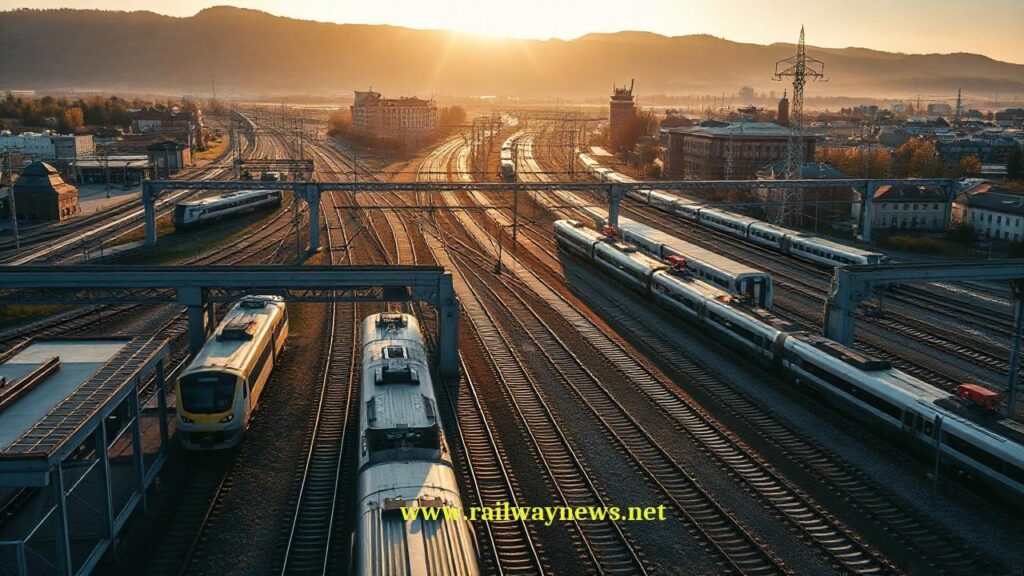
⚡ In Brief: The Hungarian government approved the Baross Gábor railway plan in Budapest, a 3,550 billion forint (€9.76 billion) programme to modernise main lines, suburban rail, stations and rolling stock through 2035.
BUDAPEST, Hungary – The Hungarian government approved the 3,550 billion forint (€9.76 billion) Baross Gábor railway plan for 2026–2035, announced at Rákospalota-Újpest station by Prime Minister Péter Magyar and Minister for Transport and Investment Dávid Vitézy.
What Is the Full Scope of This Project?
The Baross Gábor plan covers rolling stock procurement, line modernisation, station upgrades, regional reopenings, and preparatory work for high-speed links to Vienna and Warsaw. It includes at least 35 InterCity EMUs valued at 450 billion forints (€1.24 billion), each with 400–500 seats, and 42 HÉV suburban trainsets valued at 300 billion forints (€824 million).
The programme also funds modernisation of the H5 line to Szentendre (174.5 billion forints / €480 million) and first-phase works on H6 to Ráckeve and H7 to Csepel (226 billion forints / €621 million). The Budapest–Miskolc line section receives 200–230 billion forints (€550–632 million), and the Veresegyház–Fót–Őrbottyán suburban line is budgeted at 174 billion forints (€478 million). The plan targets hourly InterCity service on main routes, 15-minute peak frequencies around Budapest, 30-minute service for Debrecen, Miskolc, Szeged and Győr, and at least five daily services to towns with more than 500 inhabitants.
The financial structure combines national budget funds, EU Cohesion Funds, the EU Recovery and Resilience Facility, European Investment Bank loans, concession-based investments, and projects in the EU 2028–2034 funding cycle. The government has not disclosed the exact allocation of sources beyond the headline total.
Key Project Data
| Parameter | Value |
|---|---|
| Project / Contract Name | Baross Gábor railway plan 2026–2035 |
| Total Value | HUF 3,550 billion (approx. €9.76 billion) |
| Parties Involved | Hungarian Government; Prime Minister Péter Magyar; Minister for Transport and Investment Dávid Vitézy; MÁV; HÉV |
| Timeline / Completion | 2026–2035; first InterCity EMUs by 2030; HÉV production could begin by 2030; H5 line works estimated by 2030 |
| Country / Corridor | Hungary; Budapest suburban network; Budapest–Vienna and Budapest–Warsaw high-speed corridors |
How Does This Compare to Similar Projects?
Hungary’s €9.76 billion ten-year programme averages about €976 million per year, while BNSF’s 2025 capital investment plan totalled $3.8 billion for a single year, roughly €3.5 billion at 2025 exchange rates (Source: BNSF, 2025). That US freight railroad spends approximately 3.6 times Hungary’s annual average, although the scopes and network sizes differ substantially.
On rolling stock unit costs, Hungary’s planned 35 InterCity EMUs at €1.24 billion imply about €35.4 million per trainset. Alstom’s €1.7 billion contract to supply 96 additional RER NG trainsets for SNCF Voyageurs averages about €17.7 million per unit, but those are suburban double-deck EMUs with different capacity and configuration (Source: Alstom, 2025-2026). The 42 HÉV trainsets at €824 million average about €19.6 million per unit for 120-metre low-floor trains.
Exact funding splits between national budget, EU Cohesion Funds, Recovery and Resilience Facility, EIB loans and private concessions were not disclosed in the Hungarian government’s presentation.
Editor’s Analysis
Hungary’s plan arrives as the global rail freight market grows from USD 370.0 billion in 2025 to a projected USD 602.7 billion by 2036, driven partly by sustainability policies and infrastructure spending (Source: Future Market Insights, 2025). The Budapest programme’s dependence on EU 2028–2034 funds and private capital means the 2026–2035 timeline may slip if negotiations or concession structures stall. If delivered, the plan replaces a fleet with an average age of 43 years and positions Budapest as a future through-station for Vienna–Warsaw high-speed services.
FAQ
Q: What is the total value of Hungary’s rail modernisation plan?
A: The Baross Gábor railway plan is valued at 3,550 billion forints, approximately €9.76 billion, covering the 2026–2035 period.
Q: How many new trains are included in the programme?
A: The plan includes at least 35 InterCity EMUs and 42 HÉV suburban trainsets. The first InterCity trains could enter service by 2030.
Q: How is the programme funded?
A: Funding combines national budget resources, EU Cohesion Funds, the EU Recovery and Resilience Facility, European Investment Bank loans, concession-based investments, and projects in the 2028–2034 EU funding cycle. The exact allocation was not disclosed.

Railway infrastructure, rolling stock and transport technologies specialist focused on global rail industry developments, high-speed rail systems, signaling technologies and freight transportation. Covering railway investments, public transport modernization, rail operations and international mobility projects across Europe, Asia and North America.
RELATED POSTS

October 8, 2026 1:15 pm
Alstom secured a €1bn contract to build 13 automated trains,...

October 1, 2026 7:09 am
United States regulators confirmed a September 30 deadline for the...

October 4, 2026 5:14 pm
Alstom secured a CA$4.7 billion order from VIA Rail Canada...

October 5, 2026 6:12 pm
AECOM and Jacobs secured a contract in September 2026 to...

October 1, 2026 12:13 am
Illinois approved $1.5 billion annually for the Northern Illinois Transit...

October 4, 2026 11:08 pm
Sound Transit confirmed the September 30 opening of Seattle Pinehurst...