
Pacific Northwest High-Speed Rail: A $300,000 Vision
The Pacific Northwest region aims to revolutionize its transportation infrastructure with a high-speed rail study connecting Vancouver, Seattle, and Portland, driven by significant funding from British Columbia, marking a pivotal step towards fostering economic growth, regional collaboration, and addressing sustainability concerns.
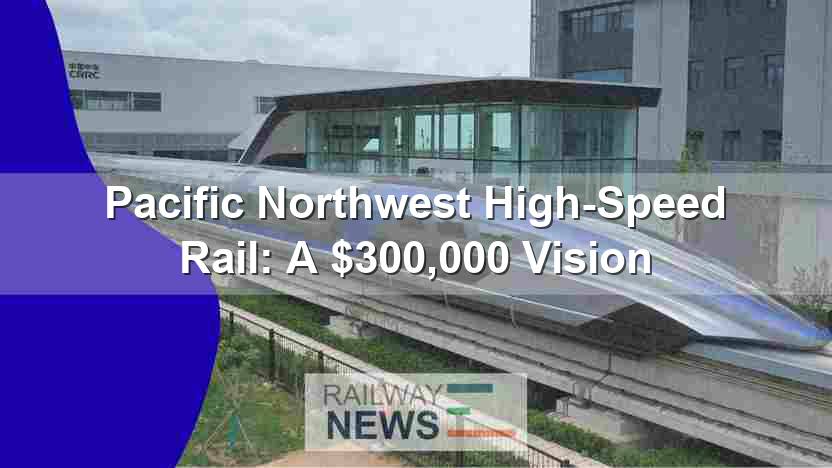
The Pacific Northwest region stands at a crossroads, poised to potentially revolutionize its transportation infrastructure. This article explores the recently announced funding for a high-speed rail study connecting Vancouver, Seattle, and Portland, a project with the potential to reshape economic landscapes and significantly improve inter-regional connectivity. British Columbia’s (BC) commitment of $300,000 marks a crucial step in advancing the Ultra High-Speed Ground Transportation (UHST) Project. This investment isn’t merely about faster travel; it represents a strategic move to foster economic growth, enhance regional collaboration, and address critical sustainability concerns. The study, led by the Washington State Department of Transportation (WSDOT) in partnership with BC, Oregon, and local agencies, will explore crucial aspects of project feasibility, including financial planning, environmental impact assessments, and community engagement strategies. This detailed examination promises to illuminate the path forward for this ambitious undertaking, detailing the complexities and opportunities inherent in developing a truly transformative transportation system.
Defining the Scope of the Ultra High-Speed Rail Project
The UHST Project envisions a high-speed rail network connecting major Pacific Northwest cities. This isn’t merely an incremental improvement to existing rail lines; it necessitates the construction of a dedicated, high-speed corridor designed for speeds significantly exceeding those of conventional passenger rail. This requires detailed planning across jurisdictional boundaries, demanding cooperation between BC, Washington, and Oregon. The project’s scope extends beyond simply laying tracks; it encompasses a detailed assessment of land acquisition, station placement, rolling stock specifications, and the integration of the new system with existing transportation networks. Moreover, the project must address the need for robust signaling and communication systems to ensure safe, efficient, and reliable high-speed operation. The challenges are substantial, but the potential benefits – reduced travel times, enhanced trade, and economic stimulation – are equally significant.
Financial Planning and Funding Models
The current study phase critically examines the financial viability of the UHST Project. Securing sufficient funding will be a major hurdle. The initial $300,000 from BC is just a starting point. The study must explore diverse funding models, including public-private partnerships (PPPs), federal and state grants, and potential revenue streams generated by the rail system itself. A detailed cost-benefit analysis is crucial, considering construction costs, operational expenses, maintenance requirements, and potential revenue from ticket sales and freight transport. The study must also identify potential risks associated with each funding source and develop mitigation strategies to minimize financial instability. A transparent and detailed financial plan will be essential to attract investors and secure the necessary long-term funding for this monumental project.
Environmental Considerations and Community Engagement
A high-speed rail project of this magnitude necessitates a thorough environmental impact assessment (EIA). The study must meticulously evaluate the potential ecological impacts of construction and operation, including habitat disruption, noise pollution, and greenhouse gas emissions. Mitigation strategies to minimize the environmental footprint will be critical, and the EIA will inform the selection of optimal rail alignments and station locations. Additionally, successful project implementation depends on strong community engagement. The study must incorporate a robust public outreach program to ensure that local communities are informed about the project’s progress and can voice their concerns. Open communication and addressing potential disruptions proactively are essential for achieving community buy-in and minimizing opposition.
Engineering and Technological Challenges
The UHST Project presents significant engineering and technological challenges. The design and construction of a high-speed rail system require advanced engineering expertise and the implementation of cutting-edge technologies. This includes the selection of appropriate track materials, signaling systems, and train control technologies to ensure safety and efficiency at high speeds. The integration of this new system with existing transportation networks also presents a significant challenge, requiring careful consideration of interoperability and seamless passenger transfers. The study must explore potential technological advancements, such as maglev (magnetic levitation) technology, which could offer even higher speeds and enhanced efficiency but also involve greater complexity and potentially higher costs.
Conclusions
The allocation of $300,000 by British Columbia for the next phase of the Ultra High-Speed Ground Transportation (UHST) Project represents a significant commitment to improving regional connectivity and stimulating economic growth within the Pacific Northwest. The study, led by WSDOT, will be instrumental in assessing the feasibility and viability of this ambitious project. The success of the UHST Project hinges on several critical factors. A detailed financial plan, incorporating diverse funding models and thorough cost-benefit analysis, is paramount. Equally crucial is a commitment to minimizing environmental impact through rigorous environmental impact assessments and the implementation of appropriate mitigation strategies. Robust community engagement is essential to secure public support and minimize potential disruptions. Finally, the project requires innovative engineering solutions and the application of advanced technologies to overcome significant technical challenges. Addressing these crucial aspects—financial planning, environmental considerations, community engagement, and engineering challenges—will determine whether the UHST Project transitions from a promising concept to a transformative reality, reshaping transportation within the Pacific Northwest for decades to come. The study will provide the necessary information to inform decision-making, laying the groundwork for a future where high-speed rail not only connects cities but also strengthens regional economies and fosters sustainable growth.

Railway infrastructure, rolling stock and transport technologies specialist focused on global rail industry developments, high-speed rail systems, signaling technologies and freight transportation. Covering railway investments, public transport modernization, rail operations and international mobility projects across Europe, Asia and North America.
RELATED POSTS

October 8, 2026 1:15 pm
Alstom secured a €1bn contract to build 13 automated trains,...

October 1, 2026 7:09 am
United States regulators confirmed a September 30 deadline for the...

October 8, 2026 12:18 pm
Siemens Mobility signed an agreement with VinSpeed to supply 350...

October 4, 2026 5:14 pm
Alstom secured a CA$4.7 billion order from VIA Rail Canada...

October 5, 2026 6:12 pm
AECOM and Jacobs secured a contract in September 2026 to...

October 4, 2026 11:08 pm
Sound Transit confirmed the September 30 opening of Seattle Pinehurst...