
NTSB Probes Fatal CSX Alabama Crash: Track Clearance Rules Focus
NTSB investigates a fatal CSX train collision in Alabama, focusing on safety procedures after a conductor’s death. This highlights critical operational risks in freight rail.
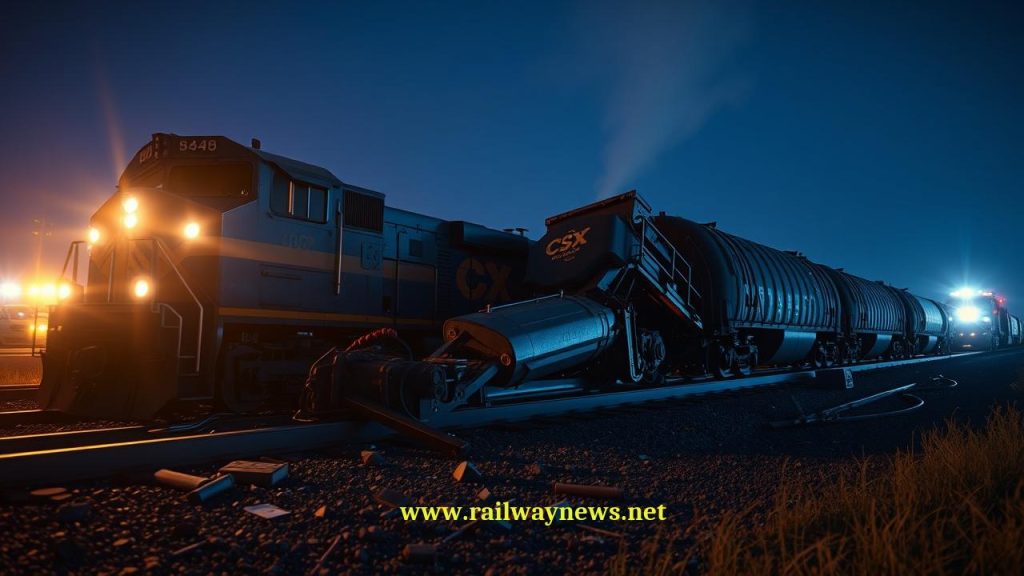
The U.S. National Transportation Safety Board (NTSB) has released its preliminary findings on the December 13, 2025, CSX train collision in Calera, Alabama, that tragically resulted in the death of a conductor. The ongoing investigation is set to scrutinize hazard mitigation strategies and operational procedures, placing a spotlight on safety protocols for switching operations that are fundamental to freight movement.
| Category | Details |
|---|---|
| Incident Type | Train Collision & Derailment |
| Date & Time | December 13, 2025, at 2:13 a.m. Local Time |
| Operator | CSX Transportation |
| Location | Near Calera, Alabama (S&NA Subdivision, MP 421.5) |
| Investigating Body | National Transportation Safety Board (NTSB) |
| Primary Investigative Focus | Rules & procedures for leaving rail cars clear of adjacent tracks |
Main Body:
According to the NTSB’s initial report, the fatal accident occurred in the early morning hours on CSX’s South and North Alabama (S&NA) subdivision. The conductor was riding on a rail car as part of a “shoving” maneuver, where the locomotive pushes cars from behind. The crew was moving the car from the main track onto an adjacent auxiliary track when it collided with a second rail car that had been previously detached from the train and left standing on the main track. The force of the collision derailed three cars, including the one the conductor was riding, which overturned and caused his fatal injuries.
The operation at the center of this incident, known as a shoving or pushing move, is a routine but inherently risky procedure in rail freight. It requires precise coordination and strict adherence to safety rules to prevent cars from “fouling” an adjacent track—meaning they obstruct the clearance required for safe passage on that track. The NTSB’s focus on “rules and procedures related to leaving rail cars clear of adjacent tracks” suggests investigators will closely examine the crew’s actions, communication, and training protocols leading up to the collision. This includes verifying whether the stationary car was properly secured and positioned to provide adequate clearance for the movement on the auxiliary track.
This incident in Alabama, while specific to yard-style operations, enters the global rail safety discourse at a time of heightened scrutiny. While the NTSB focuses on human factors and operational procedures in this case, other recent major accidents have highlighted different vulnerabilities. For instance, a high-profile fatal collision in Spain earlier in 2026 drew international attention to track infrastructure integrity after investigators reportedly found a broken joint on the rails. Together, these disparate incidents underscore the multifaceted nature of rail safety, where risks exist across the spectrum—from the high-tech components of high-speed lines to the fundamental human-led procedures of freight switching.
Key Takeaways
- A CSX conductor was killed in a collision and derailment near Calera, Alabama, during a nighttime switching operation.
- The NTSB has launched a full investigation, centering on procedural rules for ensuring tracks are clear and mitigating operational hazards.
- The accident highlights the persistent safety challenges in manual shunting and yard operations, which remain a critical component of the freight rail network.
Editor’s Analysis
While the industry invests heavily in advanced safety systems like Positive Train Control (PTC), this tragic incident is a stark reminder that foundational safety remains paramount. The NTSB’s focus on basic operating rules—ensuring a track is clear—highlights the critical role of the human element in the rail system. For global operators, this case serves as a powerful case study, reinforcing that technology alone cannot prevent all accidents. Robust training, a vigilant safety culture, and unwavering adherence to established procedures are the bedrock of safe railway operations, whether on a high-speed passenger line or a dark mainline track in rural Alabama.
Frequently Asked Questions
- What happened in the CSX accident in Alabama?
- On December 13, 2025, a CSX conductor was killed when the rail car he was riding during a switching move collided with another car left on an adjacent track. The collision caused a derailment, and the car the conductor was on overturned.
- What is the NTSB investigating?
- The NTSB’s ongoing investigation is focusing on three main areas: hazard identification and mitigation, the rules and procedures for leaving rail cars clear of adjacent tracks, and the effectiveness of internal (CSX) and external safety oversight.
- Where exactly did the accident occur?
- The incident took place near milepost 421.5 on CSX’s South and North Alabama (S&NA) subdivision, located near the town of Calera, Alabama.
RELATED POSTS

October 10, 2024 2:18 pm
Revolutionizing Southeastern US and Mexico Freight Transport: A New Intermodal...
November 19, 2022 3:30 am
This article explores the intersection of public art and urban...

December 15, 2024 2:02 am
EN 50562 is the European standard ensuring safety for railway...
March 1, 2025 7:28 pm
This article delves into the recent acquisition by KiwiRail (New...

January 16, 2026 6:39 am
Eurostar soars with 20 million passengers and a €2 billion...

March 8, 2025 12:41 am
Introduction This article examines the significant contract awarded to Stadler,...