
Newag Griffin Launches German Approval for 240 km/h Locomotive
Newag initiated German approval for its 240 km/h Griffin E4MSUa multi-system locomotive, targeting six European countries.
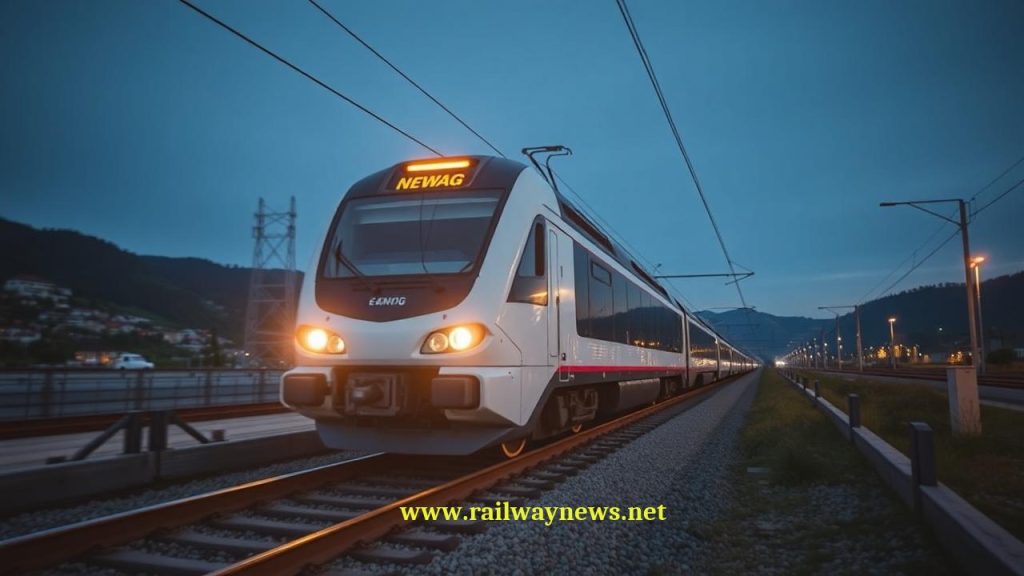
⚡ In Brief: Polish manufacturer Newag has initiated the German approval process for its Griffin E4MSUa multi-system locomotive, which achieved a test speed of 240 km/h and is designed for operation in six Central European countries, including Germany, Austria, and Poland.
WARSAW, POLAND – Polish rolling stock manufacturer Newag has officially commenced the approval process in Germany for its Griffin E4MSUa-002 multi-system electric locomotive. The vehicle is part of a larger order for PKP Intercity and is undergoing concurrent testing in Switzerland and the Czech Republic to secure authorisation for operation across a network of six European nations.
What Are the Technical Specifications?
The Newag Griffin E4MSUa is engineered for cross-border interoperability, capable of operating on three different electrification systems. The locomotive is compatible with 3 kV DC, 15 kV AC, and 25 kV AC power supplies, allowing it to traverse major European corridors without changeovers. All units are equipped with the European Train Control System (ETCS) Level 2 for enhanced safety and network compliance. During dynamic tests in October 2023, the E4MSUa-001 variant successfully reached a speed of 240 km/h.
Key Technical Data
| Parameter | Value |
|---|---|
| Technology / System Name | Newag Griffin E4MSUa |
| Total Value | Not disclosed |
| Parties Involved | Newag S.A., PKP Intercity, European Union Agency for Railways (ERA) |
| Timeline / Completion | Czech/Slovak ERA application submission in Q2 2024; German approval timeline not disclosed |
| Country / Corridor | Poland, Germany, Austria, Czech Republic, Slovakia, Hungary |
Where Does This Technology Stand in the Market?
The Newag Griffin enters a highly competitive European market for multi-system locomotives, dominated by established platforms from Siemens and Alstom. The Griffin’s tested speed of 240 km/h positions it directly against the Siemens Vectron MS, which has variants certified for speeds up to 230 km/h and is the market leader in European cross-border rail. (Source: Siemens Mobility, 2023). In comparison, the standard configuration of Alstom’s TRAXX MS3 locomotive is typically rated for 160 km/h, focusing more on freight and mixed-traffic applications, though higher-speed passenger versions are available. Newag’s key challenge will be to demonstrate comparable reliability and service support against these incumbents to gain market share beyond its domestic contracts.
Editor’s Analysis
Newag’s push for German certification is a strategic move to capitalize on significant infrastructure investment within the EU’s largest economy. Germany’s railway signalling market is expanding due to upgrades to ETCS and other digital systems, creating demand for modern, compliant rolling stock. (Source: Market Context). By securing approval for the Griffin, Newag can position itself as a viable alternative to Siemens and Alstom for operators seeking interoperable fleets to run on the increasingly harmonized European network, tapping into the broader policy-driven shift from road to rail.
FAQ
Q: Which countries will the Newag Griffin locomotive be certified for?
A: The Griffin E4MSUa locomotives are being produced to operate in six countries: Poland, Germany, Austria, the Czech Republic, Slovakia, and Hungary.
Q: What is the top speed of the Griffin E4MSUa?
A: The locomotive achieved a maximum speed of 240 km/h during dynamic testing. Its final operational service speed will be determined by the operator and route-specific regulations.
Q: Why is approval in Germany critical for Newag’s expansion?
A: Gaining approval in Germany, Europe’s largest rail market and a central transit hub, serves as a crucial technical and commercial validation. It opens access to a vast network and proves the locomotive’s compliance with some of the industry’s most stringent standards, enhancing its appeal to other European operators.

Railway infrastructure, rolling stock and transport technologies specialist focused on global rail industry developments, high-speed rail systems, signaling technologies and freight transportation. Covering railway investments, public transport modernization, rail operations and international mobility projects across Europe, Asia and North America.
RELATED POSTS

October 8, 2026 12:18 pm
Siemens Mobility signed an agreement with VinSpeed to supply 350...

October 4, 2026 5:14 pm
Alstom secured a CA$4.7 billion order from VIA Rail Canada...

October 5, 2026 6:12 pm
AECOM and Jacobs secured a contract in September 2026 to...

October 4, 2026 11:08 pm
Sound Transit confirmed the September 30 opening of Seattle Pinehurst...

October 5, 2026 1:13 pm
New York MTA confirmed a late 2026 DEIS release for...

October 6, 2026 5:12 pm
Cleveland RTA confirmed the deferral of planned bus and rail...