
Kazakhstan-China Rail: Trade Soars, Boosting Eurasian Hub
Kazakhstan’s railway sector is experiencing rapid growth due to increasing trade volumes with China, particularly in rail freight transport, as evidenced by a 13% rise in volume between January and April 2025. This surge highlights Kazakhstan’s strategic importance as a key transit hub for Eurasia and underscores the critical role of rail transport in facilitating increased agricultural exports from Kazakhstan.
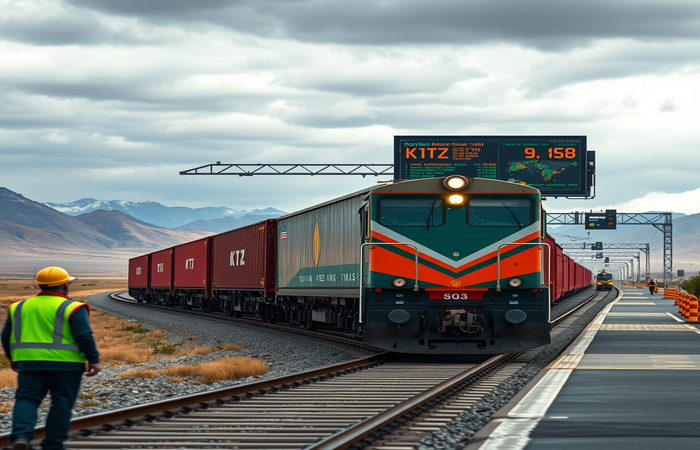
Kazakhstan, May 15, 2025 – The railway sector in Kazakhstan is experiencing a period of significant growth, fueled by increasing trade volumes with China. Recent data reveals a substantial rise in rail freight transport between the two countries, underscoring Kazakhstan’s strategic importance as a key transit hub in Eurasia. This article will delve into the specifics of this growth, examining the key drivers behind it, the infrastructure developments supporting it, and the strategic initiatives undertaken to enhance Kazakhstan’s position in the global logistics landscape. We will analyze the performance of key border crossings, explore the impact of agricultural exports, and highlight the ambitious infrastructure projects that are shaping the future of rail transport in the region. The article will also examine Kazakhstan’s commitment to expanding its transport links, particularly focusing on the Trans-Caspian International Transport Route (TITR) and the ongoing efforts to boost its connectivity with both Asian and European markets.
Surge in Rail Freight Volume
Between January and April 2025, the volume of rail freight transport between Kazakhstan and China witnessed a notable 13% increase, reaching 11.4 million tonnes. This surge demonstrates the escalating trade relationship between the two nations and the critical role of rail transport in facilitating it. The growth was not uniform across all border crossings. The Dostyk crossing, a primary gateway, saw a 5% increase, handling 6.2 million tonnes of cargo. Conversely, the Altynkol crossing experienced more substantial growth, with a 24% rise to 5.2 million tonnes. These variations highlight the importance of diversifying transport routes and optimizing capacity across different border points to accommodate increasing freight volumes. The continued expansion of rail freight underscores the reliability and efficiency of this mode of transport, making it a preferred option for a wide range of goods.
Agricultural Exports and Market Dynamics
The agricultural sector plays a significant role in the growth of Kazakhstan-China rail freight. In 2024, Kazakhstan exported over 3.3 million tonnes of grain cargo, with exports including 1.8 million tonnes of grain and 1.5 million tonnes of processed products. The processed products segment saw remarkable growth, particularly in flour and other milled goods, which increased by 30% to 600 thousand tonnes, and compound feed, which increased fivefold to 900 thousand tonnes. This surge in agricultural exports reflects rising demand in Asian markets and the strengthening of Kazakhstan’s role in regional agricultural trade. The efficient rail transport system ensures the timely and cost-effective delivery of these essential commodities, supporting Kazakhstan’s agricultural industry and promoting regional food security.
Long-Term Growth and Strategic Developments
Over the past five years, rail freight transport between Kazakhstan and China has expanded substantially, with a 48% increase, reaching a total volume of 32 million tonnes. This sustained growth is a testament to the strategic importance of the rail link for both countries. Since 2020, exports have grown by 25%, totaling 13.7 million tonnes. Significantly, grain exports have more than doubled, rising from 700 thousand tonnes to 1.8 million tonnes. Kazakhstan Temir Zholy (KTZ) (Kazakhstan Railways) is proactively undertaking large-scale infrastructure projects to augment the capacity of its national railway network. In 2024, KTZ repaired over 1,400 km of railway tracks and is constructing approximately 1,000 km of new lines. Key projects include the Dostyk–Moiynty and Darbaza–Maktaaral lines, along with the Almaty station bypass, launched in November 2023. These initiatives are critical for improving operational efficiency and accommodating the escalating freight volumes.
Trans-Caspian Route and Future Prospects
Kazakhstan is keenly focused on the development of the Trans-Caspian International Transport Route (TITR) (Middle Corridor), which enhances its connectivity to European and Middle Eastern markets. In 2024, the inauguration of a Kazakh–Chinese terminal at the Xi’an Dry Port resulted in a 30-fold increase in transit volumes along the TITR. This development significantly enhances Kazakhstan’s connectivity to European and Middle Eastern markets. KTZ is also actively engaged in expanding infrastructure on the border with China, with a third border crossing under construction. This expansion will ease pressure on existing crossings and support the sustainable growth of freight transport. This strategic move is part of a broader effort to establish Kazakhstan as a major logistics hub in Eurasia, facilitating trade flows and boosting economic growth. The ongoing investment in infrastructure, coupled with strategic partnerships, positions Kazakhstan to capitalize on the increasing demand for efficient and reliable rail transport, further solidifying its role in global trade.
Conclusion
The substantial increase in rail freight transport between Kazakhstan and China signals a robust growth trajectory for the railway sector and highlights the strategic importance of Kazakhstan as a transit hub. The impressive 13% rise in freight volume between January and April 2025 underscores the efficiency and reliability of rail transport. The growth is further fueled by the expansion of agricultural exports, particularly of processed goods, demonstrating Kazakhstan’s pivotal role in regional trade. Over the past five years, a 48% surge in rail freight volumes reflects sustained growth, underpinned by strategic infrastructure investments. The repair of over 1,400 km of tracks and the construction of approximately 1,000 km of new lines are key initiatives aimed at improving operational efficiency and accommodating rising freight volumes.
The development of the Trans-Caspian International Transport Route (TITR) is a game-changer. The inauguration of a Kazakh-Chinese terminal at the Xi’an Dry Port led to a 30-fold increase in transit volumes along the TITR. Additionally, the ongoing construction of a third border crossing with China, KTZ’s strategic initiatives, are pivotal in consolidating Kazakhstan’s status as a major logistics hub in Eurasia. This proactive approach, combining infrastructure development with strategic partnerships, ensures that Kazakhstan is well-positioned to meet the escalating demand for efficient and reliable rail transport. As trade volumes continue to rise, Kazakhstan’s commitment to enhancing its rail infrastructure will be crucial in fostering economic growth and strengthening its position in the global logistics landscape.
Company Summary
Kazakhstan Temir Zholy (KTZ): The national railway company of Kazakhstan, responsible for the operation and development of the country’s railway infrastructure. KTZ plays a critical role in facilitating rail freight transport between Kazakhstan and China, undertaking large-scale infrastructure projects, and expanding its network to support increasing trade volumes.

Railway infrastructure, rolling stock and transport technologies specialist focused on global rail industry developments, high-speed rail systems, signaling technologies and freight transportation. Covering railway investments, public transport modernization, rail operations and international mobility projects across Europe, Asia and North America.
RELATED POSTS

October 1, 2026 7:09 am
United States regulators confirmed a September 30 deadline for the...

October 4, 2026 5:14 pm
Alstom secured a CA$4.7 billion order from VIA Rail Canada...

October 6, 2026 2:14 am
Union Pacific launched export rail shipments with Ferromex to deliver...

October 1, 2026 3:12 am
Greenbrier confirmed Brian Comstock as new president and CEO effective...

October 1, 2026 10:14 am
HS2 installed a 55-metre steel span in Birmingham, completing phase...

October 1, 2026 11:14 pm
CATS confirmed a six-mile streetcar route in Charlotte to add...