
Illinois High-Speed Rail Project: Chicago-St. Louis Corridor Upgrade
Illinois’ high-speed rail project upgrades the Chicago-St. Louis line, slashing travel time and boosting Midwest connectivity. Faster, more sustainable travel is on the way!
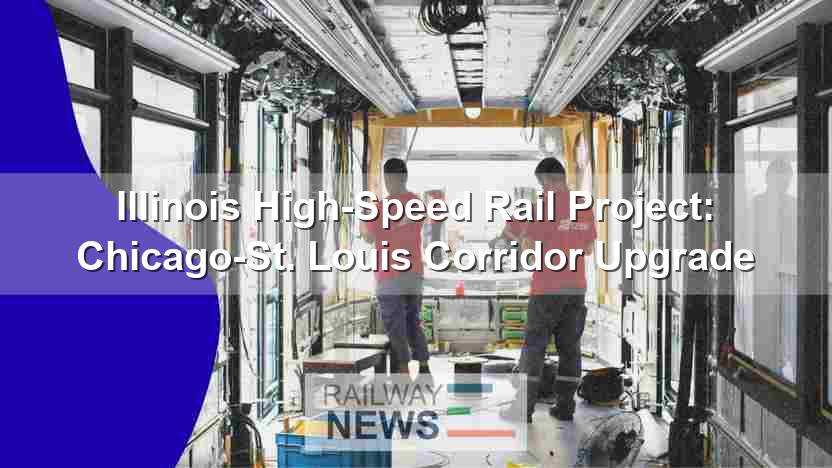
This article explores the Illinois High-Speed Rail (HSR) project, a significant infrastructure undertaking aimed at improving passenger rail travel between Chicago and St. Louis. The project addresses the critical need for efficient and environmentally friendly transportation options in the Midwest, where current road and air travel between these two major cities is heavily congested and environmentally unsustainable. Annually, approximately 35 million trips are made between Chicago and St. Louis, with a staggering 99% utilizing road and air travel. This reliance on automobiles and airplanes contributes significantly to traffic congestion, air pollution, and overall environmental degradation. The Illinois HSR project seeks to alleviate these issues by offering a faster, more sustainable alternative. This project, spearheaded by the Illinois Department of Transportation (IDOT) and the Federal Railroad Administration (FRA), with project management provided by PB Americas, aims to reduce travel time significantly, from approximately five and a half hours to four hours, while creating a more resilient and efficient transportation network. This analysis will delve into the project’s history, implementation phases, technological advancements, and overall economic and environmental impact, concluding with an assessment of its future potential.
Project History and Planning
The concept of a high-speed rail link between Chicago and St. Louis has been explored for decades. Initial studies, dating back to 1979, proposed a new electrified, double-tracked line capable of speeds up to 240 km/h. However, the substantial cost of this ambitious plan (estimated at $2.2 billion in 1994 dollars) led to a reevaluation. Subsequent feasibility studies (1992-1994) determined that a more cost-effective approach would involve upgrading the existing infrastructure to accommodate diesel-powered trains operating at speeds of 180-200 km/h. This revised plan, deemed commercially viable in 1996, significantly altered the project’s scope and timeline. The final environmental impact statement received approval in 2003 from the Federal Highway Administration (FHWA), FRA, and IDOT, paving the way for the project’s implementation.
Implementation Phases and Infrastructure Upgrades
The project’s execution is divided into phases, focusing on incremental track improvements. Phase I (September-December 2010) concentrated on upgrading 76.5 miles of track between Brighton and Elkhart, excluding Springfield. Phase II (commencing April 2011), supported by a partnership between Union Pacific Railroad and the federal government, involves upgrading a further 96 miles of track from Elkhart to Dwight. This phase, expected to be completed by the third quarter of 2011, includes the construction of 20km of double track, 35km of freight siding, and improvements to numerous grade crossings. The project also includes the procurement of six new seven-car train sets to provide enhanced passenger services, initially utilizing Lincoln Trains until the new rolling stock is delivered.
The project utilizes state-of-the-art Track Renewal Train (TRT) machinery for efficient track renewal, including the installation of new concrete ties and other track components. Phase II alone necessitates the use of 23,000 tons of rail material and 250,000 new concrete ties. The implementation also incorporates advanced safety technologies, such as Positive Train Control (PTC), to enhance passenger safety.
Funding and Economic Impact
The Illinois HSR project benefits from significant federal and state funding. A federal grant of $1.1 billion was awarded in 2010, with approximately $900 million allocated to Phase I track improvements. Further federal funding of $1.2 billion was secured in March 2011 for Phase II, alongside a $42 million state contribution. The project is expected to generate numerous jobs during its construction and operational phases, stimulating economic activity across the Chicago-St. Louis corridor. While initial cost estimates were high, the phased approach and focus on upgrading existing infrastructure have helped to control costs and make the project more financially sustainable.
Project Summary and Future Outlook
The Illinois HSR project represents a significant investment in Midwest transportation infrastructure. The project aims to significantly reduce travel time between Chicago and St. Louis, offering a more efficient and sustainable alternative to existing road and air travel. It involves a detailed program of track upgrades, safety enhancements (PTC), and the procurement of new rolling stock. The success of the project hinges on effective project management, securing sufficient funding, and adherence to the proposed timelines. The completion of the project is expected to boost regional economic activity, reduce reliance on environmentally damaging modes of transport, and enhance the overall connectivity of the Midwest. While the initial target of a two-hour travel time at 220mph (354 km/h) may represent a long-term goal, the current phases successfully lay the foundation for future expansion towards a true high-speed rail network.
| Project Feature | Details |
|---|---|
| Project Length (Chicago-St. Louis) | ~300 miles (approx.) |
| Total Project Budget (estimated) | ~$2.3 Billion (including state and federal funding) |
| Project Type | High-Speed Rail Corridor Upgrade |
| Connecting Cities | Chicago, IL – St. Louis, MO |
| Number of Stations (planned) | To be determined based on final route alignment |
| Target Travel Time Reduction | From ~5.5 hours to ~4 hours |
| Top Speed (Phase II) | 177 km/h (South of Dwight), 127 km/h (North of Dwight) |
Company Information:
- Illinois Department of Transportation (IDOT): The state agency responsible for planning, constructing, and maintaining Illinois’ transportation infrastructure.
- Federal Railroad Administration (FRA): The U.S. government agency responsible for railroad safety and regulation.
- PB Americas: A global consulting and engineering firm providing project management services for the Illinois HSR project.
- Union Pacific Railroad: A major freight railroad company in the United States, partnering with the federal government on the project.

Railway infrastructure, rolling stock and transport technologies specialist focused on global rail industry developments, high-speed rail systems, signaling technologies and freight transportation. Covering railway investments, public transport modernization, rail operations and international mobility projects across Europe, Asia and North America.