
HŽPP Completes 70-Train Fleet Upgrade, Boosts Croatia’s Rail Network
Croatia’s HŽPP completes rollout of 70 new **low-floor trains**, a major EUR 360 million investment. This boosts **railway** modernization and enhances passenger experience across the nation.
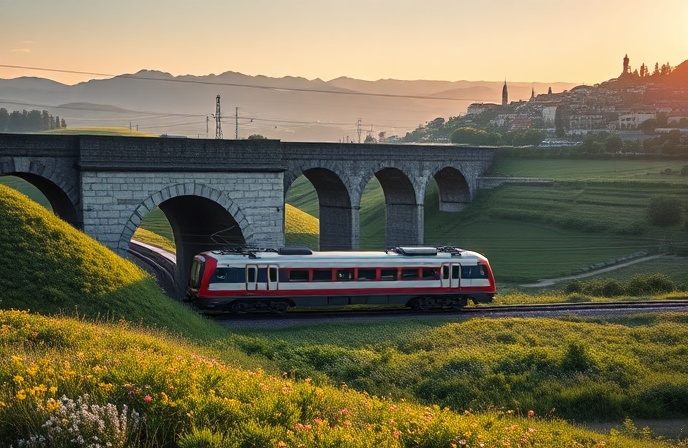
Croatia’s HŽ Passenger Transport (HŽPP) has officially completed the introduction of all 70 new low-floor diesel trains into service, marking the culmination of a significant EUR 360 million investment. This milestone, celebrated with a ceremony attended by the Minister of Transport and Infrastructure, Žarko Tušek, underscores a detailed modernization program aimed at revitalizing the nation’s railway sector and enhancing passenger experience, particularly for those with mobility challenges.
| Key Entity | Critical Detail |
|---|---|
| HŽ Passenger Transport (HŽPP) | Introduced all 70 low-floor diesel trains into service. |
| Varaždin – Čakovec – Varaždin route | Launch ceremony for the 70th low-floor diesel train. |
| EUR 360 million | Purchase of 70 low-floor trains. |
| 19 new trains (battery, battery-electric, electro-diesel) | Končar. |
| By 2026 | Expected contract for nearly 40 more new trains. |
The commissioning of the 70th low-floor diesel train on the Varaždin – Čakovec – Varaždin route served as the backdrop for a ceremony attended by Minister Žarko Tušek, who lauded the initiative as the conclusion of an extensive investment cycle for HŽPP and a pivotal component of a broader national railway modernization program. The total investment of EUR 360 million for these 70 trains signifies a substantial commitment to upgrading Croatia’s rail fleet. This strategic procurement directly addresses the need for more modern, accessible, and efficient rolling stock, aiming to significantly boost passenger numbers, which reached approximately 1.3 million in the Varaždin and Međimurje counties alone last year. The success of free transport projects further validates the demand for improved rail services.
Strategic Impact and Future Expansion
Beyond the 70 low-floor trains, HŽPP has already secured contracts for an additional 19 new trains, encompassing battery-powered, battery-electric, and electro-diesel variants, all supplied by the domestic manufacturer Končar. Minister Tušek indicated that some of these units will operate in the northern part of the country, with plans to contract for nearly 40 more new trains by 2026. This aggressive expansion strategy is designed not only to replace aging stock but also to introduce cutting-edge, environmentally friendly technologies across the network. The successful integration of new rolling stock, including diesel-electric railcars facilitating cross-border travel with Slovenia, highlights Croatia’s dedication to improving interoperability and connectivity within the European Union.
Technological Advancements and Environmental Focus
A notable development within HŽPP’s rolling stock renewal strategy was the official launch of the first battery-powered train in September 2025. Manufactured by Končar, this train boasts a range of 200 km and was initially deployed on the Zagreb to Bjelovar route. HŽPP plans to introduce another battery-powered train this month for non-electrified lines in the Split region. The company has also ordered 13 trains for this year, including five diesel-electric, four hybrid (electric-battery), and four battery-powered units. Supporting this technological shift, Croatia is establishing charging infrastructure, with stations planned for Varaždin, Lupoglav, and Velika, operational by 2027-2028. A project for battery-powered railcars and a charging station in Kotoriba is also underway.
Infrastructure Modernization and EU Funding
Complementing the fleet renewal, Croatia is undertaking extensive railway infrastructure modernization and expansion projects, significantly bolstered by over EUR 400 million from the European Investment Bank (EIB) last year. These funds are earmarked for rehabilitating and upgrading approximately 500 km of suburban and regional lines, particularly in the Slavonia and Podravina regions, as well as in cities like Zadar, Knin, and Karlovac. The EIB is also financing the modernization of 30 stations nationwide to enhance passenger comfort and safety. Additionally, European funds are supporting the acquisition of 14 new trains, including six for long-distance traffic between Zagreb and Split, and eight battery-powered or hybrid trains, all contributing to Croatia’s goal of promoting sustainable rail transport. The recent launch of a EUR 190 million EIB-financed project to modernize the Kloštar–Koprivnica–Varaždin line, including the Varaždin–Čakovec section, signifies a renewed focus on regional development and the introduction of emission-free services, as highlighted by Anđelko Stričak, Prefect of Varaždin County. The National Recovery and Resilience Plan (RRP) further reinforces Croatia’s long-term rail strategy with an allocation of EUR 6.2 billion for sector-wide modernization and sustainability improvements.
Last June 2025, we published an article about Renfe’s cutting-edge Aranjuez maintenance hub. Click here to read – Future of Rail: Renfe’s Railway Technology Hub, Aranjuez: Essential Guide

Railway infrastructure, rolling stock and transport technologies specialist focused on global rail industry developments, high-speed rail systems, signaling technologies and freight transportation. Covering railway investments, public transport modernization, rail operations and international mobility projects across Europe, Asia and North America.
RELATED POSTS

October 8, 2026 1:15 pm
Alstom secured a €1bn contract to build 13 automated trains,...

October 1, 2026 7:09 am
United States regulators confirmed a September 30 deadline for the...

October 8, 2026 12:18 pm
Siemens Mobility signed an agreement with VinSpeed to supply 350...

October 4, 2026 5:14 pm
Alstom secured a CA$4.7 billion order from VIA Rail Canada...

October 5, 2026 6:12 pm
AECOM and Jacobs secured a contract in September 2026 to...

October 1, 2026 12:13 am
Illinois approved $1.5 billion annually for the Northern Illinois Transit...