
Hungary’s EUR 1B Air-Rail: Rail Infrastructure Boost for Budapest
Hungary to build EUR 1B air-rail link, new cargo airport, boosting Budapest railway sector.
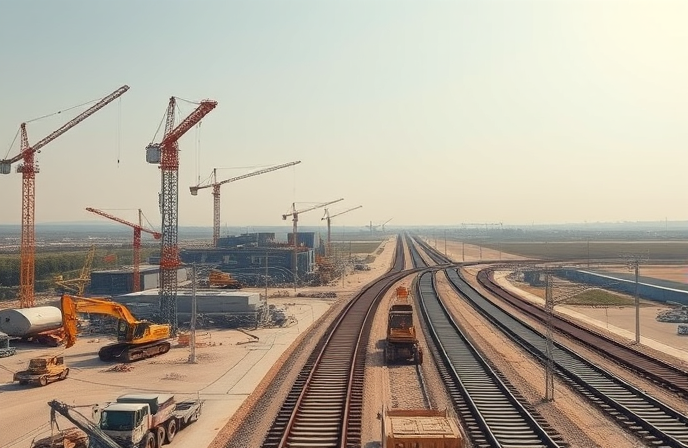
Hungary Announces EUR 1 Billion Air-Rail Link and New Cargo Airport for Budapest
The Hungarian government has unveiled plans to construct a EUR 1 billion air-rail link connecting Budapest’s Ferenc Liszt International Airport with the city center, alongside a new cargo airport. Announced by Márton Nagy, Minister of Economy and Transport, the project aims to alleviate transport demand, enhance airport capacity, and boost the country’s international connectivity. The investment will be carried out through a concession model, with tenders expected to be issued later this year and construction slated to commence within approximately one and a half years. This initiative is driven by the rapid growth in passenger and cargo traffic at Budapest Airport and will significantly impact the accessibility and efficiency of both passenger and freight transport in the region.
Boosting Airport Accessibility: The Air-Rail Link
The core of the project is the development of a dedicated railway line connecting Ferenc Liszt International Airport (BUD) with the Budapest Nyugati railway station, located in the city center. The new railway line is designed to begin from the airport to the Kőbánya district, approximately 13 kilometers north of the airport. From Kőbánya, the line will integrate with the national railway network, providing direct access to Nyugati station. This station currently offers Metro Line 3 (Blue Line) connections, enhancing the overall accessibility of the airport. The new line will use a concession model, where a private company builds and runs the railway over a period of time. The government will then pay the company over that period. Plans call for the construction of a new 13-track, two-story station at Nyugati, as well as an underground eight-track station, with the latter also accommodating trains from Buda via the planned Danube railway tunnel.
Leveraging Existing Infrastructure: Strategic Route Planning
The proposed air-rail link will utilize, in part, existing railway infrastructure along the 100a railway line, one of Hungary’s most important mainlines, running from Budapest Nyugati station to Szolnok, passing through Cegléd. A 2016 feasibility study proposed a new 27-kilometer double-track line, allowing for speeds of 120-160 km/h, branching from the main railway. This line will facilitate the separation of long-distance and suburban traffic, potentially reducing journey times and improving the regularity and reliability of both passenger and freight services. The feasibility study also considered constructing an underground four-track railway station at the airport. Currently, the airport already has a rail link via the Ferihegy train station, located near Terminal 2, providing frequent connections to Nyugati station. This existing service, however, will be improved with the new, direct link.
Meeting Rising Demand: Addressing Passenger and Cargo Growth
The impetus behind the project is the substantial growth in passenger traffic at Budapest Airport. In 2024, the airport registered 17.6 million passengers, with projections exceeding 20 million by 2030. In the first months of 2025, passenger numbers saw a steady rise, with 1.3 million passengers registered in January and 1.7 million in April, indicating a strong demand for expanded transport connections. Additionally, the existing airport is nearing its maximum annual cargo capacity of 400,000-450,000 tonnes, necessitating the construction of a new cargo airport to accommodate further growth. Minister Nagy has highlighted the need to develop terminal facilities to accommodate passenger flow and accelerate connections between the city and the airport. The planned new cargo airport is crucial for allowing expansion of air cargo services, which is increasingly difficult at the airport.
Conclusion
The Hungarian government’s commitment to the EUR 1 billion air-rail link and the new cargo airport demonstrates a proactive approach to the burgeoning demand for air travel and cargo transport. This investment has significant implications for the rail industry. The concession model, which involves private investment and operation, has the potential to modernize and expand infrastructure effectively, bringing about improvements in rail network capacity and quality. The project will further increase the reliability and efficiency of the rail network by allowing long-distance and suburban traffic to be separated and ensuring the airport has better, more connected services. The success of this project hinges on its ability to deliver faster journey times, more efficient passenger flow, and increased capacity to meet current and future demands. The project will also contribute to enhancing Hungary’s appeal as a tourist destination and will further contribute to its growth.

Railway infrastructure, rolling stock and transport technologies specialist focused on global rail industry developments, high-speed rail systems, signaling technologies and freight transportation. Covering railway investments, public transport modernization, rail operations and international mobility projects across Europe, Asia and North America.
RELATED POSTS

October 1, 2026 7:09 am
United States regulators confirmed a September 30 deadline for the...

October 8, 2026 1:15 pm
Alstom secured a €1bn contract to build 13 automated trains,...

October 4, 2026 5:14 pm
Alstom secured a CA$4.7 billion order from VIA Rail Canada...

October 1, 2026 12:13 am
Illinois approved $1.5 billion annually for the Northern Illinois Transit...

October 6, 2026 2:14 am
Union Pacific launched export rail shipments with Ferromex to deliver...

October 1, 2026 6:10 am
Amtrak approved a System Expansion Committee on July 30 to...