
HS2 UK: Viaduct Spans Installed Over Christmas Railway Closure
HS2’s Delta Junction hits a milestone! Engineers installed viaduct spans over Christmas, using innovative methods to advance this complex project.
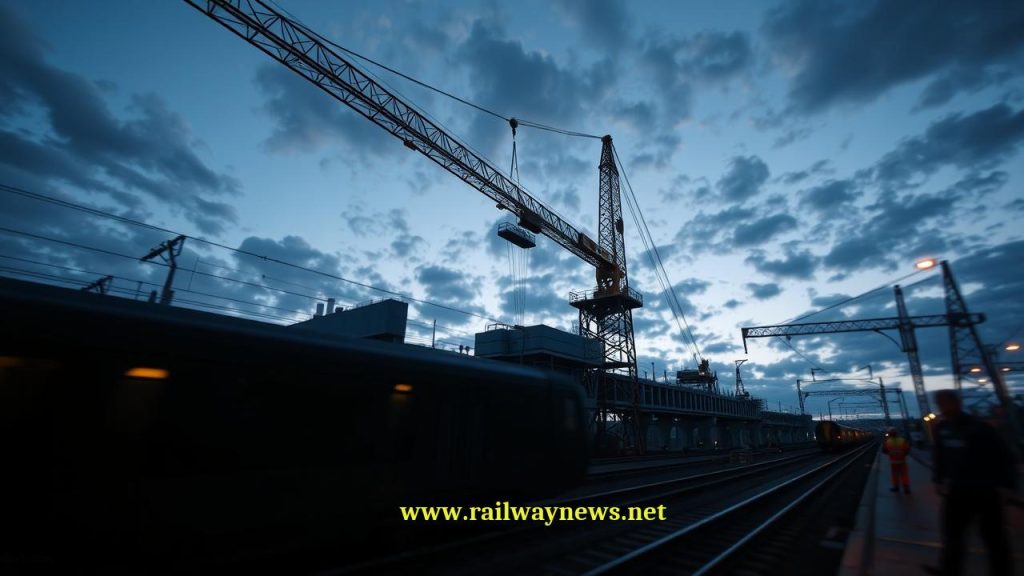
BIRMINGHAM, UK – Engineers on the UK’s High Speed 2 (HS2) project have successfully installed two major viaduct spans over a live railway line near Birmingham, marking a critical achievement in the construction of the line’s vast Delta Junction. The complex operation was strategically completed during a five-day Christmas closure, a common industry practice to minimise disruption on the national network during periods of major engineering works.
| Category | Details |
|---|---|
| Project Component | Water Orton Viaducts (part of the Delta Junction) |
| Main Works Contractor | Balfour Beatty VINCI (BBV) |
| Milestone Achieved | Installation of two parallel spans over the Birmingham-Peterborough railway |
| Timeline | Five-day closure over the 2025 Christmas period |
| Construction Method | Pre-cast segmental cantilever process, a first-of-its-kind UK application |
HS2 Ltd has confirmed the successful completion of a significant engineering challenge at the northern end of its ‘Delta Junction’—a complex triangular intersection east of Birmingham designed to handle high-speed services. Working around the clock, contractor Balfour Beatty VINCI (BBV) utilised a planned five-day possession of the existing Birmingham to Peterborough line to install two spans of the new Water Orton viaducts. The closure, which saw buses replace trains between Birmingham New Street and Coleshill, enabled teams to safely complete the crossing. Sam Hinkley, HS2 Ltd’s Senior Project Manager, praised the teams, stating, “It’s great to see the Water Orton viaducts in place across the railway and I’d like to thank everyone who gave up their Christmas to help us reach this important milestone.”
The operation showcases a highly specialised construction method, described by BBV as a first for a UK project. The viaducts are assembled from 2,742 individual pre-cast concrete segments, all manufactured at a dedicated temporary factory in nearby Lea Marston. For this specific crossing, a cantilever technique was employed using a 22-metre-high mast and a 14-metre-high swivel crane to lift and position each segment. Once a span is formed, permanent post-tensioned steel cables are fed through the hollow core to provide its structural integrity. The twin Water Orton viaducts will ultimately stretch for 1.4km, supported by 32 concrete piers up to 20 metres tall, and are designed to carry trains at speeds of around 200km/h as they approach Birmingham Curzon Street station.
This milestone is a key step forward for the Delta Junction, one of the most intricate sections of the entire HS2 route. Likened to the nearby ‘Spaghetti Junction’ motorway interchange for its complexity, the junction features 2.6 miles of track and 3.7 miles of viaducts designed to allow HS2 trains to travel seamlessly between London, the North, and a dedicated spur into central Birmingham. The strategic use of the quieter Christmas holiday period for such a disruptive but essential task reflects a standard approach across the UK rail industry, where network-wide upgrades are often scheduled during festive seasons to minimise impact on commuters and supply chains. With the railway crossing complete, focus now shifts to extending the viaducts over the adjacent A446 road and M42 motorway.
Key Takeaways
- Critical Milestone Achieved: The successful installation of two spans for the Water Orton viaducts marks tangible progress on the highly complex Delta Junction section of HS2.
- Innovative Engineering on Display: The project utilised a cantilever segmental construction technique described as a first-of-its-kind application in the UK, highlighting advanced civil engineering capabilities.
- Strategic Planning Minimises Disruption: The work was completed during a planned Christmas railway closure, a proven industry strategy for executing major infrastructure works with the least possible impact on the travelling public.
Editor’s Analysis
In the global landscape of high-speed rail development, where projects are often scrutinised for delays and budget overruns, the successful execution of a technically demanding milestone like the Water Orton viaduct installation is a significant vote of confidence. This achievement is not just about concrete and steel; it’s about demonstrating logistical and engineering prowess on one of Europe’s largest infrastructure projects. The use of innovative, UK-first construction methods and meticulous planning around network availability shows a maturing delivery capability. For the international rail market, this signals that despite political and economic headwinds, the UK’s flagship HSR project is capable of overcoming complex physical obstacles, building momentum and generating valuable engineering expertise that can be exported globally.
Frequently Asked Questions
- What is the HS2 Delta Junction?
- The Delta Junction is a large, triangular railway intersection being built east of Birmingham for the HS2 high-speed line. It is a highly complex structure of viaducts, underpasses, and flyovers designed to connect HS2 services to Birmingham city centre and to the mainline running north and south, allowing trains to operate at speeds up to 360km/h.
- Why was this construction work carried out over the Christmas period?
- The Christmas period typically has significantly fewer rail passengers. By scheduling a five-day closure during this quieter time, engineers could safely work above the existing Birmingham to Peterborough line with minimal disruption to train services and the public, a common practice for major railway upgrades in the UK.
- What is unique about the construction of the Water Orton viaducts?
- The viaducts are being built using a specialist cantilever technique to assemble pre-cast concrete segments. According to the project’s contractor, this specific application, involving a tall mast and swivel crane system to place each segment, has not been used in the UK before this project, representing an innovative approach to viaduct construction over existing infrastructure.

Railway infrastructure, rolling stock and transport technologies specialist focused on global rail industry developments, high-speed rail systems, signaling technologies and freight transportation. Covering railway investments, public transport modernization, rail operations and international mobility projects across Europe, Asia and North America.
RELATED POSTS

October 1, 2026 7:09 am
United States regulators confirmed a September 30 deadline for the...

October 1, 2026 12:13 am
Illinois approved $1.5 billion annually for the Northern Illinois Transit...

October 4, 2026 5:14 pm
Alstom secured a CA$4.7 billion order from VIA Rail Canada...

October 1, 2026 6:10 am
Amtrak approved a System Expansion Committee on July 30 to...
October 1, 2026 3:12 am
Greenbrier confirmed Brian Comstock as new president and CEO effective...
October 6, 2026 2:14 am
Union Pacific launched export rail shipments with Ferromex to deliver...