
HS2 Completes 880-Metre Copthall Green Tunnel in West Ruislip
HS2 Ltd completed the 880-metre Copthall green tunnel in West Ruislip, using 1.2 million cubic metres of excavated material and eliminating 100,000 truck movements.
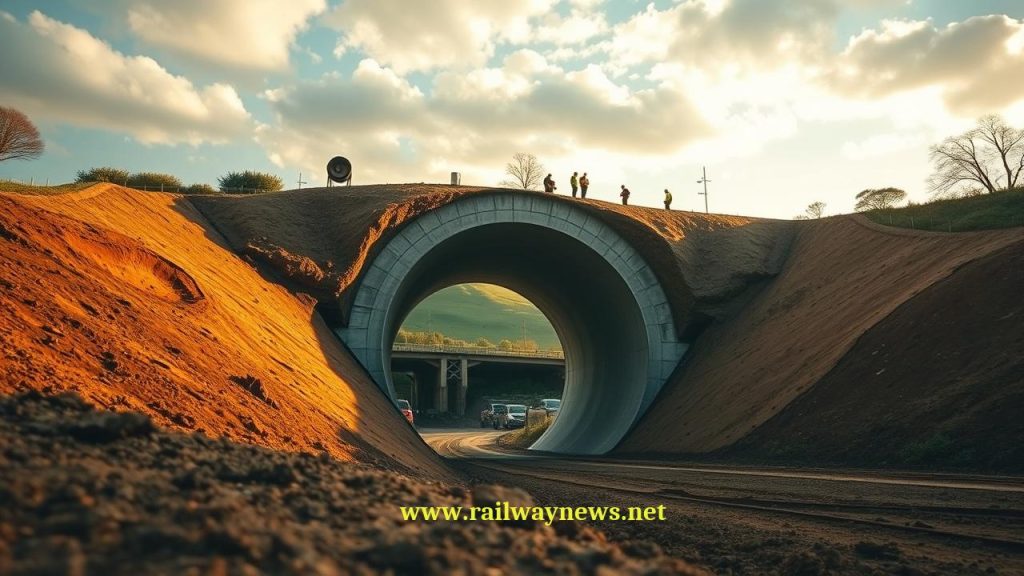
⚡ In Brief: HS2 Ltd completed the 880-metre Copthall green tunnel near West Ruislip—the first of five cut-and-cover tunnels on the London–West Midlands route—using 1.2 million cubic metres of excavated material and eliminating an estimated 100,000 truck movements.
WEST RUISLIP, UK – HS2 Ltd announced completion of civil works on the 880-metre Copthall green tunnel in July 2026, the first of five cut-and-cover tunnels on the 140-mile high-speed railway to reach structural completion. The structure consumed 1.2 million cubic metres of material excavated from the adjacent twin-bore Northolt tunnel. Planting of trees, shrubs, and vegetation across the tunnel’s earth covering will proceed over the next two years.
What Is the Full Scope of This Project?
Copthall tunnel is the only single-bore tunnel on the entire HS2 route, engineered with a cavernous cross-section up to 16 metres wide and 12 metres high internally to accommodate aerodynamic forces generated by trains passing at 200mph. Five natural ventilation shafts reach a maximum depth of 17 metres from the newly created surface to the tunnel roof. SCS—the Skanska, Costain, STRABAG joint venture delivering HS2’s southern section—used travelling formwork and falsework systems advancing 20 metres at a time to achieve the tunnel’s curved alignment. The structure sits between the Northolt tunnel portal and the Colne Valley viaduct, Britain’s longest railway bridge, which was completed in 2025. Construction also required relocating Harvil Road and rebuilding it with a new overbridge spanning the high-speed line. The four remaining cut-and-cover tunnels—including Chipping Warden in Northamptonshire, where the structure was completed earlier in July 2026 ahead of backfilling—are described by HS2 Ltd as “well advanced.”
Key Project Data
| Parameter | Value |
|---|---|
| Project / Contract Name | Copthall Green Tunnel (HS2 Phase 1) |
| Total Value | Not disclosed as a standalone contract value; overall HS2 programme expenditure reached approximately £46bn according to parliamentary reporting (Source: Express, 2026) |
| Parties Involved | HS2 Ltd (client); SCS JV—Skanska, Costain, STRABAG (main civil engineering contractor, southern section) |
| Timeline / Completion | Construction commenced early 2021; civil works completed July 2026; planting and landscaping to continue through mid-2028 |
| Country / Corridor | United Kingdom; HS2 Phase 1 corridor, West Ruislip, Greater London |
How Does This Compare to Similar Projects?
HS2 Ltd’s cut-and-cover approach at Copthall mirrors design strategies employed on European high-speed networks, notably France’s LGV lines where covered trenches are standard in peri-urban sections to limit land take and noise. The decision to retain 1.2 million cubic metres of spoil on site—avoiding roughly 100,000 HGV movements—represents a material logistics saving that few comparable UK rail projects have achieved at this scale. By contrast, Crossrail’s tunnelling programme exported approximately 7 million tonnes of excavated material to locations including Wallasea Island in Essex via a combination of rail and river transport, rather than retaining it adjacent to the excavation site. On the high-speed rail comparator, Japan’s Shinkansen network continues to attract sustained infrastructure investment: the Japanese hydraulics, pneumatics, and actuator market—a proxy for railway automation and tunnel systems expenditure—is projected to expand at a mid-single-digit compound annual rate from 2026 to 2035, while hardline cable demand tied to 5G and rail corridor telecoms is forecast at 4–6% CAGR over the same period (Source: IndexBox, 2026). HS2’s programme reset, announced in May 2026, targets up to £2.5bn in savings partly by aligning operating speeds with Japanese and mainland European standards. Separately, an independent review identified £77.8 million in consultancy fees allocated for the 2025–2026 period specifically to support the project’s fundamental reset after concerns about progress and expenditure (Source: UK Government disclosure, 2026).
Editor’s Analysis
The Copthall completion demonstrates tangible construction progress at a moment when HS2’s governance and cost baseline remain under intense scrutiny. The £77.8 million in reset consultancy fees—running parallel to on-site milestones—raises a question about whether engineering momentum is being matched by programme controls. A six-day closure of HS2 West Midlands sites in early July 2026 following a worker being struck by a vehicle (Source: Construction News, July 2026) further complicates the narrative of improving productivity that CEO Mark Wild cited in his reset update. For the supply chain, the shift toward simplified operating specifications that mirror Japanese and European standards could narrow the gap between HS2 requirements and off-the-shelf rolling stock and signalling systems, potentially lowering bid costs for future procurement packages.
FAQ
Q: How long is the Copthall green tunnel and where exactly is it located?
A: The tunnel is 880 metres long—over half a mile—and sits near West Ruislip in Greater London, between the Northolt tunnel’s southern portal and the Colne Valley viaduct.
Q: What is a cut-and-cover tunnel and why was this method chosen instead of an open cutting?
A: A cut-and-cover tunnel is built by excavating a trench, constructing the tunnel structure within it, and then backfilling with earth. HS2 Ltd opted for this design to keep 1.2 million cubic metres of spoil from the Northolt tunnel on site, eliminating around 100,000 truck movements that would have been required to remove it by road.
Q: When will the Copthall tunnel be fully landscaped and operational?
A: Planting of trees, plants, and shrubs across the tunnel’s earth covering will take place over the next two years following the July 2026 civil works completion. An exact date for commencement of rail services through the tunnel has not been officially confirmed as part of the ongoing programme reset.

Railway infrastructure, rolling stock and transport technologies specialist focused on global rail industry developments, high-speed rail systems, signaling technologies and freight transportation. Covering railway investments, public transport modernization, rail operations and international mobility projects across Europe, Asia and North America.
RELATED POSTS

October 8, 2026 1:15 pm
Alstom secured a €1bn contract to build 13 automated trains,...

October 1, 2026 7:09 am
United States regulators confirmed a September 30 deadline for the...

October 8, 2026 12:18 pm
Siemens Mobility signed an agreement with VinSpeed to supply 350...

October 4, 2026 5:14 pm
Alstom secured a CA$4.7 billion order from VIA Rail Canada...

October 5, 2026 6:12 pm
AECOM and Jacobs secured a contract in September 2026 to...

October 1, 2026 12:13 am
Illinois approved $1.5 billion annually for the Northern Illinois Transit...