
Global Rail Advancements: Alstom, Network Rail, & Autonomous Trains
Rail’s future is now! From autonomous trains to predictive maintenance, groundbreaking technologies are revolutionizing railway operations – discover how!
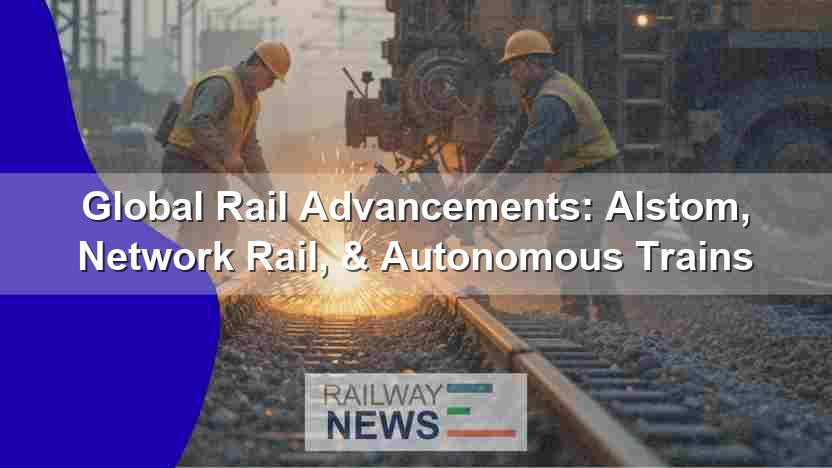
The global railway industry is experiencing a period of significant transformation, driven by technological innovation and substantial infrastructure investment. This article examines several key developments, focusing on recent major contracts awarded to leading players such as Alstom and Network Rail, and exploring the emerging field of autonomous train technology as exemplified by the collaboration between IPS TABOR, PKP Cargo, and Pesa Bydgoszcz. Additionally, we will delve into the increasing importance of predictive maintenance and its potential to revolutionize railway operations and reduce costs. The analysis will highlight the trends shaping the future of rail transport, from the procurement of rolling stock and track materials to the implementation of cutting-edge technologies designed to enhance efficiency, safety, and sustainability. This examination will provide insights into the strategic decisions and technological advancements driving the modernization of railway systems worldwide, underscoring the industry’s commitment to improving passenger and freight services.
Alstom’s Grand Paris Express Contract: A Significant Rolling Stock Order
Alstom secured a substantial €280 million contract from Société du Grand Paris for the supply of 150 rail cars, assembled into 25 six-car trains. These trains, destined for lines 15, 16, and 17 of the Grand Paris Express (GPE), represent a significant investment in expanding the Parisian metro system. The contract, finalized in 2018 but stemming from a 2014 agreement with Île-de-France Mobilités, underscores the ongoing expansion of major metropolitan rail networks and the significant demand for modern, high-capacity rolling stock. The trains’ capacity of 1000 passengers reflects the need for efficient and comfortable transportation solutions in densely populated urban areas. The scheduled delivery commencing in 2022, with entry into service in 2024, showcases the considerable lead times inherent in such large-scale projects.
Network Rail’s Long Steel Rail Procurement: Ensuring Track Infrastructure Longevity
Network Rail’s (NR) £200 million contract extension with British Steel highlights the critical role of track infrastructure in maintaining railway operations. The agreement ensures the supply of 200,000 tonnes of long steel rail – enough for approximately 4,000km of track – over a two-year period. This substantial order underscores the ongoing need for regular track maintenance and renewal to guarantee the safety and reliability of the UK’s railway network. The use of high-performance rails, such as HP335 and Zinco, emphasizes the railway industry’s ongoing commitment to enhancing rail lifespan and reducing lifecycle costs through material innovation and strategic procurement.
Autonomous Train Development in Poland: A Leap Towards Automation
The collaboration between the Institute of Rail Vehicles TABOR (IPS TABOR), PKP Cargo (PKP Cargo – Polish State Railways Freight), and Pesa Bydgoszcz signifies a major step toward the implementation of autonomous train technology. This partnership leverages the expertise of a research institute (IPS TABOR), a major freight operator (PKP Cargo), and a rolling stock manufacturer (Pesa Bydgoszcz) to develop an autonomous train based on Pesa’s Gama locomotive platform. The project aims to validate the technical design and develop a dual-system (electric and diesel) autonomous train. The anticipated commissioning in 2022, following rigorous testing by PKP Cargo, highlights the significant progress being made in this field and the potential for autonomous trains to revolutionize rail freight operations. This project provides a valuable case study in cross-sector collaboration for the development and implementation of cutting-edge railway technology.
Predictive Maintenance and the Internet of Things (IoT): Improving Efficiency and Reducing Costs
The partnership between Nokia and Altran underscores the growing importance of predictive maintenance in the railway industry. By leveraging the power of IoT and smart sensors, this new solution aims to collect data on rolling stock performance, enabling predictive maintenance strategies. This data-driven approach has the potential to significantly reduce maintenance costs, enhance train reliability by up to 30%, and minimize delays by as much as 20%. This highlights a broader trend toward leveraging digital technologies to improve operational efficiency and reduce downtime in railway systems.
Conclusions
The examples presented in this article demonstrate the dynamic nature of the global railway industry and the significant investments being made in both infrastructure and technology. Alstom’s large rolling stock contract for the Grand Paris Express exemplifies the continuous expansion of urban rail networks and the demand for high-capacity, modern trains. Network Rail’s commitment to long-term track infrastructure maintenance through its steel rail procurement contract underlines the critical importance of ensuring the long-term viability and safety of railway operations. The collaborative effort between IPS TABOR, PKP Cargo, and Pesa Bydgoszcz showcases a significant advancement towards autonomous train technology, promising increased efficiency and reduced operational costs in freight transportation. Finally, the Nokia and Altran partnership highlights the growing role of predictive maintenance and data analytics in optimizing rail operations, reducing delays, and improving overall reliability. These trends collectively indicate a clear shift towards a more technologically advanced, efficient, and sustainable railway sector. The future of rail transport will undoubtedly be shaped by continued investment in rolling stock, infrastructure maintenance, automation technologies, and the wider adoption of data-driven approaches to optimizing performance and reducing operational costs. This necessitates a continuous focus on innovation and collaboration across the industry to meet the challenges and opportunities presented by a rapidly evolving global transportation landscape.

Railway infrastructure, rolling stock and transport technologies specialist focused on global rail industry developments, high-speed rail systems, signaling technologies and freight transportation. Covering railway investments, public transport modernization, rail operations and international mobility projects across Europe, Asia and North America.
RELATED POSTS

October 8, 2026 1:15 pm
Alstom secured a €1bn contract to build 13 automated trains,...

October 1, 2026 7:09 am
United States regulators confirmed a September 30 deadline for the...

October 8, 2026 12:18 pm
Siemens Mobility signed an agreement with VinSpeed to supply 350...

October 4, 2026 5:14 pm
Alstom secured a CA$4.7 billion order from VIA Rail Canada...

October 5, 2026 6:12 pm
AECOM and Jacobs secured a contract in September 2026 to...

October 1, 2026 12:13 am
Illinois approved $1.5 billion annually for the Northern Illinois Transit...