
GB Railfreight Launches First Class 99 Hybrid Service
GB Railfreight launched the first Class 99 hybrid freight service between DP World London Gateway and Hams Hall, cutting journey carbon emissions by over 50%.
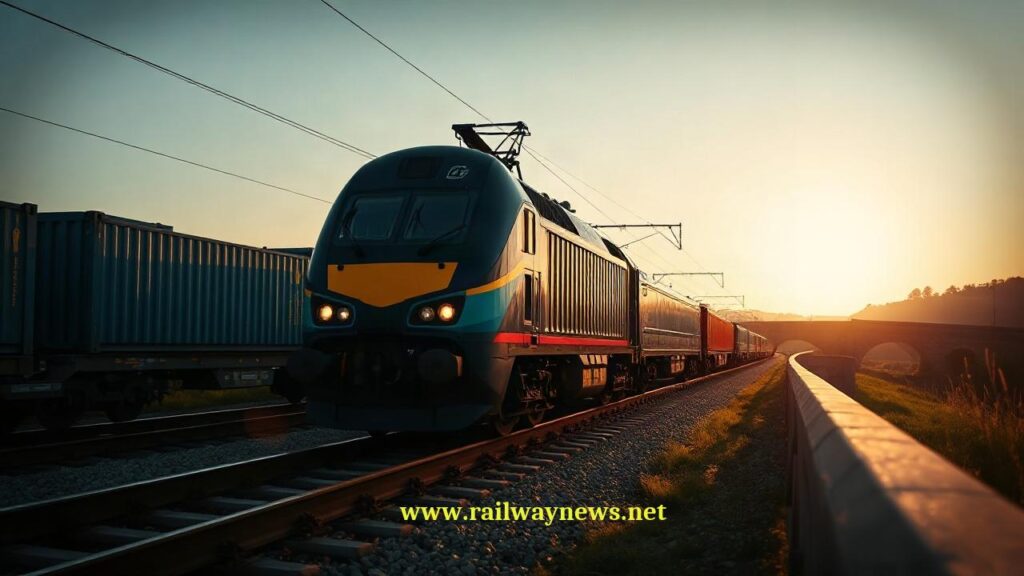
⚡ In Brief: GB Railfreight has begun the first commercial Class 99 hybrid service, using Stadler-built unit 99001 from DP World London Gateway to Hams Hall, cutting journey carbon emissions by more than half.
LONDON – GB Railfreight (GBRf), the United Kingdom’s largest rail freight operator, has placed its new Stadler Class 99 hybrid locomotive into revenue service on an intermodal corridor. Unit 99001 operated the first commercial run from DP World London Gateway to Maritime Transport’s Hams Hall Rail Freight Terminal in the West Midlands, following more than four and a half years of development. GBRf is positioning the dual-mode locomotive as a response to a network that is only about 40% electrified and to a government target of growing rail freight volumes by 75% by 2050.
What Are the Technical Specifications?
Class 99001 is a dual-mode freight locomotive designed to operate on 25 kV overhead electric power where available and switch to renewable-fuel traction on non-electrified route sections.
GBRf states the hybrid drivetrain reduces emissions by more than half on a typical journey compared with a conventional diesel locomotive. The improved acceleration profile is intended to help freight services fit more easily into passenger paths, increasing usable network capacity. Rail freight contributes about £2.5 billion (€2.9 billion) to the UK economy, and the launch route carries containerised maritime traffic inland from London Gateway to the West Midlands.
Traction power, maximum speed, fuel-tank capacity and fleet size were not disclosed in the launch announcement, and independent verification of the 50%-plus emission reduction was not available at time of publication.
Key Technical Data
| Parameter | Value |
|---|---|
| Technology / System Name | GB Railfreight Class 99 hybrid freight locomotive (unit 99001), built by Stadler |
| Total Value | Not disclosed |
| Parties Involved | GB Railfreight, Stadler, Beacon Rail, Network Rail |
| Timeline / Completion | First commercial service entered after more than 4.5 years of planning, engineering and testing; full fleet delivery schedule not disclosed |
| Country / Corridor | United Kingdom: DP World London Gateway – Hams Hall Rail Freight Terminal, West Midlands |
Where Does This Technology Stand in the Market?
The Class 99 enters service at a turning point for British rail freight, which reached 16.5 billion net tonne-kilometres in 2024–25 after two consecutive years of growth following more than a decade of decline (Source: UK Department for Transport, 2025).
Stadler’s earlier UK dual-mode freight locomotive, the Class 88 for Direct Rail Services, entered service in 2017 but was conceived primarily as a last-mile electro-diesel, limiting its usefulness for sustained running away from overhead wires (Source: Direct Rail Services, 2017). Rail Operations Group’s Stadler-built Class 93, a tri-mode design adding battery power, has been in testing but had not launched a comparable commercial freight service at time of publication (Source: Rail Operations Group, 2025).
Market projections support the investment case: analysts forecast the wider UK rail market reaching USD 115.36 billion in 2026 and USD 185.31 billion by 2034 (Source: Market Data Forecast, 2025). Growth is being driven partly by construction and intermodal maritime traffic, which are exactly the freight flows on the London Gateway–Hams Hall corridor.
Editor’s Analysis
By deploying the Class 99 on an intermodal maritime corridor, GBRf is targeting the fastest-growing segment of a freight market that only recently reversed a decade-long decline. The commercial launch also raises pressure on other British freight operators to show how their diesel fleets will meet the government’s 75% volume-growth target without relying on full network electrification.
What remains unproven is the economic case: without published data on fuel consumption, maintenance cost and fleet rollout, the Class 99’s advantage over existing Class 66 operation cannot yet be quantified. GBRf’s next milestone will be scaling from one successful path to multiple daily services without public subsidy or infrastructure priority.
FAQ
Q: What makes the Class 99 different from a fully electric locomotive?
A: A fully electric locomotive can only operate on the roughly 40% of Britain’s network that has overhead wires. The Class 99 switches to renewable fuel beyond the wires, allowing a full national route network while reducing emissions by more than half per typical journey.
Q: How many Class 99 locomotives are planned?
A: GBRf has not disclosed the total fleet size or delivery schedule in this announcement. The first unit, 99001, is now in commercial service between DP World London Gateway and Hams Hall, with Stadler, Beacon Rail and Network Rail listed as delivery partners.
Q: What cargo is the first Class 99 service carrying?
A: The first commercial duty is intermodal freight, moving containers from maritime services at DP World London Gateway to the West Midlands logistics hub at Hams Hall. This is the freight segment that has driven much of the recent growth in GB rail freight volumes.

Railway infrastructure, rolling stock and transport technologies specialist focused on global rail industry developments, high-speed rail systems, signaling technologies and freight transportation. Covering railway investments, public transport modernization, rail operations and international mobility projects across Europe, Asia and North America.
RELATED POSTS

October 8, 2026 1:15 pm
Alstom secured a €1bn contract to build 13 automated trains,...

October 1, 2026 7:09 am
United States regulators confirmed a September 30 deadline for the...

October 4, 2026 5:14 pm
Alstom secured a CA$4.7 billion order from VIA Rail Canada...

October 1, 2026 12:13 am
Illinois approved $1.5 billion annually for the Northern Illinois Transit...

October 5, 2026 1:13 pm
New York MTA confirmed a late 2026 DEIS release for...

October 6, 2026 9:17 am
Illinois approved $1.1M in state funds to upgrade two McHenry...