
Gautrain 2026: Expansion Plans, New Stations & R120bn Investment
Gautrain 2026 update: new concessionaire, R120bn expansion to Soweto & Mamelodi, 19 new stations, ridership challenges, and economic impact.
Gautrain is an 80-kilometre (50-mile) mass rapid transit system in Gauteng, South Africa, connecting Johannesburg, Pretoria, Kempton Park, and O. R. Tambo International Airport. Since opening in 2010, it has set a benchmark for public-private partnership (PPP) infrastructure projects in Africa. As of 2026, the system is undergoing a historic transition: the original concession with the Bombela Concession Company has ended, and a new 15-year PPP is being finalised. Simultaneously, the Gauteng government is planning a monumental expansion, adding over 150 km of track and 19 new stations to the network with a R120 billion investment.
🚄 2026 Critical Updates: New Concessionaire & Full Ownership
On 27 March 2026, the 19½-year concession agreement between the Gauteng Provincial Government and the Bombela Concession Company (BCC) officially concluded. As of 28 March 2026, the Gautrain system was formally handed over to the province as a fully paid asset, valued at approximately R45–50 billion. The Bombela Operating Company (BOC) continues to manage the system under a contractual holdover arrangement for up to six months while final negotiations with a new private partner are completed.
A preferred bidder has already been identified for the next 15-year concession, which will include operating, maintaining, refurbishing, upgrading, and modernising the entire rail system. Gautrain Management Agency CEO Tshepo Kgobe assured commuters that there would be no service disruption during this transition, stating: “Passengers can be fully assured that Gautrain services will continue without interruption, maintaining the high standards, reliability and efficiency that have defined the system since its inception”.
🗺️ R120 Billion Expansion: New Routes & Stations
In February 2026, Gauteng Premier Panyaza Lesufi announced the resumption of the long-awaited Gautrain expansion project, which will add approximately 150 km of new track to the existing 80 km network, extending total coverage to 230 km. The R120 billion investment is expected to create more than 125,000 construction jobs over five years while extending rail access to historically underserved areas.
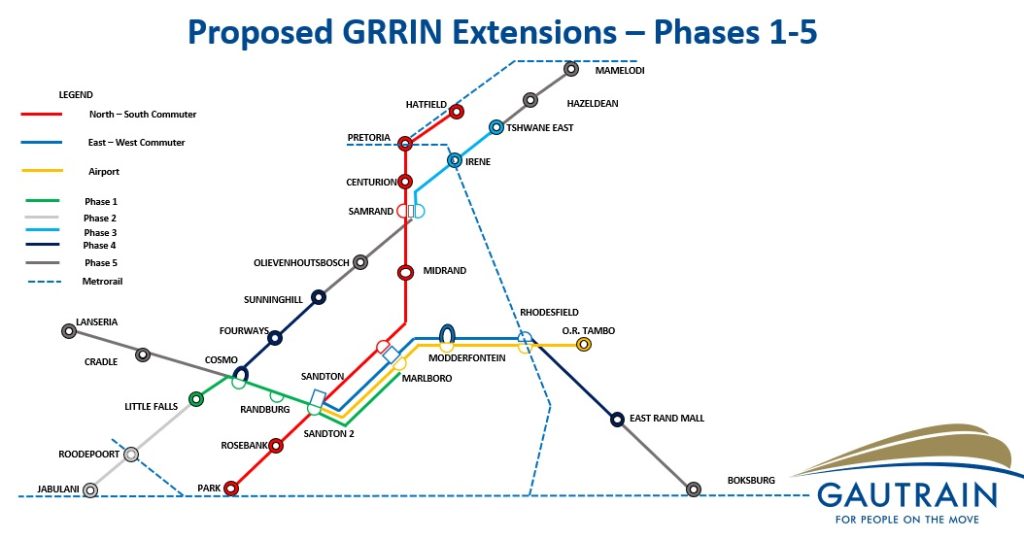
The new routes will connect the following areas to the Gautrain network: Soweto (via Fourways), Mamelodi, Atteridgeville, Lanseria, Springs, and parts of the West Rand, with later expansion to Sedibeng in the Vaal.
The proposed new stations, which have been officially gazetted under the Gauteng Transport Infrastructure Act, include: Jabulani Station, Roodepoort Station, Lanseria Station, Cradle Station, Smart City Station, Samrand Station, Fourways Station, Sunninghill Station, and Olievenhoutbosch Station.
A key feature of the expansion is a 19.9 km underground tunnel linking Little Falls Station to Jabulani Station in Soweto, designed to minimise surface disruption. Another major corridor will connect Cosmo City to Lanseria Airport via a 17.4 km route, with approximately 7 km on elevated viaducts.
Construction on the first phase is expected to begin in 2026, with full operation of the new routes targeted for 2030.
📉 Ridership Decline & Financial Challenges
Despite its success as an infrastructure project, the Gautrain has faced significant challenges in meeting ridership projections. Passenger numbers have declined from 13.9 million in 2019/20 to just 7.9 million in 2023/24, well below the originally projected 47 million by 2025. Pre-COVID, the system serviced an average of 55,000 passengers per day; that figure has now dropped to just over 13,000 — a staggering 76% decline.
Gautrain Management Agency CEO Tshepo Kgobe attributes this decline to permanent changes in commuting patterns: “The days of a predictable 9-to-5, Monday through Friday commute are over. Passengers are demanding frequent service throughout the day and dynamic pricing to suit hybrid work schedules”.
The shortfall in ridership has led to increased reliance on taxpayer subsidies through the Patronage Guarantee mechanism. The Gauteng Department of Roads and Transport paid Bombela R2.79 billion in the 2023/24 financial year, and R2.37 billion in 2022/23, due to actual revenue being significantly below minimum required projections.
The Automobile Association of South Africa (AA) has been a vocal critic of the expansion plans, labelling the Gautrain a “financial train wreck” and arguing that funds would be better spent on upgrading road infrastructure and supporting taxi and bus services, which serve the majority of commuters. In response, the GMA has emphasised that the expansion aims to address these challenges by increasing the customer base, boosting ridership, and enabling inclusive transport connectivity.
Project Profile: Gautrain Rapid Rail Link, South Africa
The Gautrain Rapid Rail Link is an 80-kilometre mass rapid transit system in Gauteng, South Africa, engineered to connect Johannesburg, Pretoria, and O. R. Tambo International Airport. This standard-gauge network represents a key benchmark for public-private partnership (PPP) infrastructure projects in Africa, integrating advanced signaling and rolling stock technologies to alleviate urban congestion and stimulate economic development.
| Attribute | Details |
|---|---|
| Project Name | Gautrain Rapid Rail Link |
| Location | Gauteng Province, South Africa |
| Expansion length | ~150 km new track (total network: 80 km → 230 km) |
| Maximum Speed | 160 km/h (100 mph) |
| Projected expansion cost | R120 billion (ZAR 120 billion / approx. $6.5bn USD) |
| Status as of 2026 | Operational under holdover arrangement; new 15-year PPP being finalised |
| Key Contractors | Bombela Consortium (Bombardier, Bouygues Travaux Publics, Murray & Roberts, Strategic Partners Group) |
| New stations planned | 19 new stations (including Soweto, Mamelodi, Atteridgeville, Springs, Fourways, Lanseria) |
| Construction jobs (expansion) | 125,000+ over five years |
| Full expansion target | 2030 (phase 1 operation) |
| Patronage Guarantee (2023/24) | R2.79 billion paid to Bombela |
Technical Specifications
The Gautrain’s infrastructure is built on a standard-gauge (1,435 mm) track, essential for achieving its design speed of 160 km/h and ensuring operational stability. The 80 km route includes significant tunnel sections, particularly through Johannesburg’s northern suburbs, which were constructed using a combination of Tunnel Boring Machines (TBMs) and conventional drill-and-blast methods. The rolling stock consists of 96 Bombardier Electrostar vehicles, configured into four and eight-car trainsets, featuring modern passenger information systems and universal access.
System control and safety are managed by a sophisticated, centralised Operations Control Centre (OCC) in Midrand. The network operates on Bombardier’s CITYFLO 250 solution, a fixed-block signaling system that provides robust safety and operational efficiency. This is integrated with an Automatic Train Protection (ATP) system, which continuously monitors train speeds, enforces signal compliance, and can automatically apply braking if a driver exceeds speed limits, ensuring a high degree of safety across the network.
Key Takeaways
- Successful PPP Model: The project serves as a successful blueprint for large-scale Public-Private Partnership (PPP) infrastructure development in Africa, demonstrating a viable model for financing, constructing, and operating complex rail systems over a 20-year concession period.
- Economic & Urban Catalyst: Gautrain’s strategic alignment connecting key economic hubs, residential areas, and O.R. Tambo International Airport has catalyzed transit-oriented development, boosting economic activity and property values along its corridor.
- Technological Benchmark: The implementation of advanced technologies, including the CITYFLO 250 signaling system, contactless RFID-based fare collection, and high-speed rolling stock, established a new standard for modern passenger rail on the continent.
Frequently Asked Questions (FAQ)
When did the Gautrain become fully operational?
The complete 80-kilometre Gautrain network, including all stations connecting Johannesburg, Pretoria, and O. R. Tambo International Airport, became fully operational in 2012.
Who built the Gautrain system?
The Gautrain was constructed, and is operated, by the Bombela Consortium, a public-private partnership comprising key international and South African companies including Bombardier (transportation technology), Bouygues Travaux Publics (construction), and Murray & Roberts (construction).
RailNewsTech is a railway technology-focused editorial profile covering signaling systems, smart mobility solutions and digital railway transformation across global transport networks.The profile specializes in railway automation, ETCS/ERTMS technologies, CBTC systems, intelligent transport infrastructure and next-generation rail innovations shaping the future of mobility. Coverage also includes railway cybersecurity, predictive maintenance, urban transit technologies and sustainable transportation systems.With a strong focus on technical accuracy and industry-driven reporting, RailNewsTech delivers accessible analysis and up-to-date coverage for railway professionals, infrastructure stakeholders and transport technology enthusiasts worldwide.