
FS Group Hupac Completes First 3 Crane Installations Milan Terminal
TerAlp installed the first three of six new electric gantry cranes for its EUR 120 million Milan terminal.
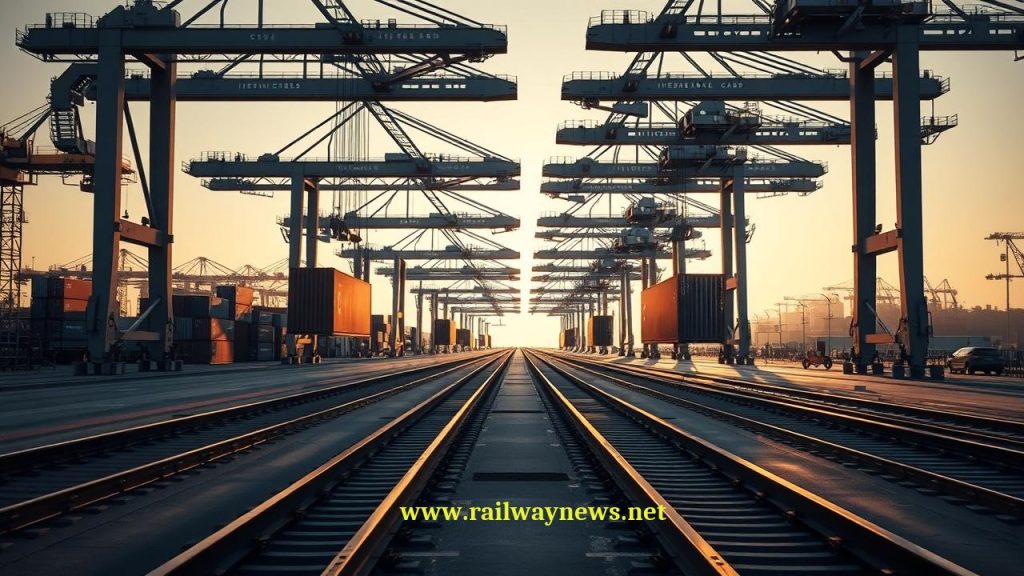
⚡ In Brief: FS Group and Hupac are advancing a EUR 120 million intermodal terminal project in Milan, Italy, with the installation of the first three of six new electric gantry cranes to handle an expected 395,000 intermodal units annually.
MILAN, ITALY – The first three of six new electric gantry cranes have been installed at the Milano Smistamento intermodal terminal, a key milestone in a EUR 120 million project by TerAlp (a joint venture of FS Logistix and Hupac). The development aims to create one of Northern Italy’s largest rail hubs, with a projected annual capacity of 395,000 intermodal transport units (ITUs). The crane contract with Austrian firm Kuenz is valued at approximately EUR 31 million.
What Is the Full Scope of This Project?
The project encompasses the development of a 240,000 m² site with 15 tracks, each at least 740 meters long, to align with European standards. The terminal is structured in two modules, each served by three rail-mounted electric gantry cranes, for a total of six. At full operation, the facility is designed to process up to 44 trains per day, significantly boosting modal shift capacity on the Rhine-Alpine corridor.
Key Project Data
| Parameter | Value |
|---|---|
| Project / Contract Name | Milano Smistamento Intermodal Terminal Development |
| Total Value | EUR 120 million |
| Parties Involved | TerAlp (FS Logistix, Hupac), Kuenz (crane supplier) |
| Timeline / Completion | Crane contract signed August 2024; final project completion date not disclosed. |
| Country / Corridor | Italy / Rhine-Alpine Corridor |
How Does This Compare to Similar Projects?
The EUR 120 million capital expenditure for this fixed infrastructure project contrasts with other major rail investments in Southern Europe, which have recently focused on rolling stock. For instance, Portugal committed €1.03 billion for 153 new trains from Alstom in a deal that also included local manufacturing commitments (Source: Alstom SA, 2026). The Milan terminal investment is smaller in absolute value but is a strategic bet on long-term corridor capacity rather than fleet modernization, a critical distinction in capital allocation strategies. Comparable data for other new-build intermodal terminals of this specific scale in Italy was not publicly available at time of publication.
Editor’s Analysis
This investment in Milan’s terminal capacity represents a strategic divergence from current market indicators. While data for 2025 shows a softening in new railcar orders and a decline in imports from key markets like China, FS Group is committing significant capital to permanent infrastructure (Source: TradingView, 2026). This suggests a long-term strategy focused on capturing future traffic growth anticipated from the upgraded Gotthard and Ceneri Base Tunnels, betting that high-capacity, efficient terminals will be the critical enabler for modal shift, regardless of short-term freight volume volatility.
FAQ
Q: What is the total capacity of the new Milan terminal?
A: At full capacity, the Milano Smistamento terminal will handle up to 44 trains per day. This translates to an estimated annual volume of approximately 395,000 intermodal transport units (ITUs).
Q: Who is building the terminal and its equipment?
A: The terminal is being developed by TerAlp, a joint venture between Italy’s FS Logistix and Switzerland’s Hupac. The six electric gantry cranes are being supplied by the Austrian company Kuenz under a EUR 31 million contract.
Q: How does this project connect to the broader European network?
A: The terminal is strategically located to leverage the modernized Alpine crossings, including the Gotthard and Ceneri Base Tunnels. It aims to create a more efficient rail-road link between Italian ports and markets in the Benelux region, Germany, and Eastern Europe.

Railway infrastructure, rolling stock and transport technologies specialist focused on global rail industry developments, high-speed rail systems, signaling technologies and freight transportation. Covering railway investments, public transport modernization, rail operations and international mobility projects across Europe, Asia and North America.
RELATED POSTS

October 8, 2026 1:15 pm
Alstom secured a €1bn contract to build 13 automated trains,...

October 1, 2026 7:09 am
United States regulators confirmed a September 30 deadline for the...

October 8, 2026 12:18 pm
Siemens Mobility signed an agreement with VinSpeed to supply 350...

October 4, 2026 5:14 pm
Alstom secured a CA$4.7 billion order from VIA Rail Canada...

October 5, 2026 6:12 pm
AECOM and Jacobs secured a contract in September 2026 to...

October 1, 2026 12:13 am
Illinois approved $1.5 billion annually for the Northern Illinois Transit...