
VRR NWL Expands CAF Battery Train Contract to 76 Units Germany
VRR and NWL expanded their CAF battery train contract to 76 units for service on Germany’s Niederrhein–Münsterland network, starting December 2027.
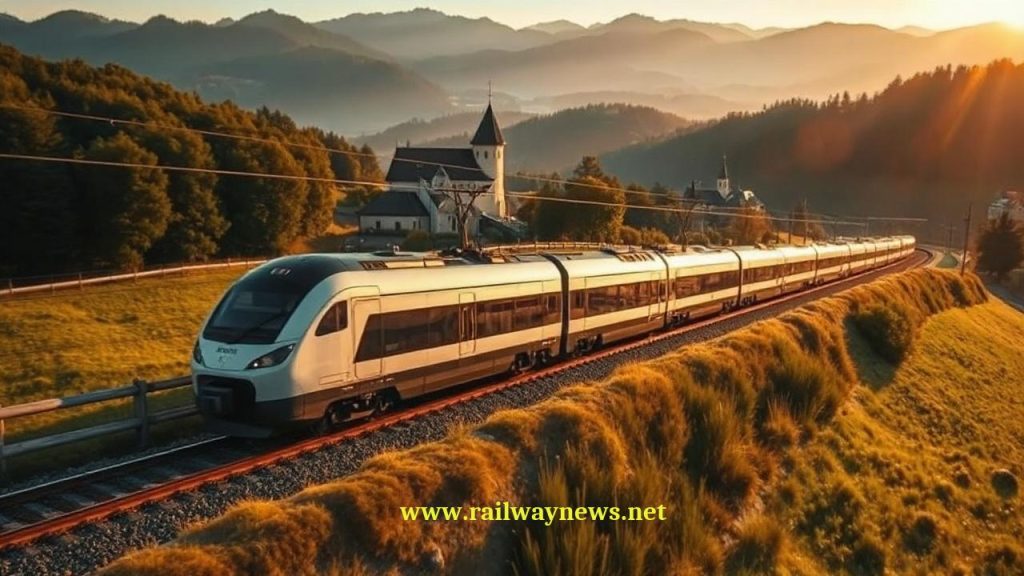
⚡ In Brief: Germany’s regional transport authorities VRR and NWL have expanded their contract with Spanish manufacturer CAF to 76 battery-powered regional trains, scheduled to begin passenger service on the Niederrhein–Münsterland network in December 2027.
NEUSS, GERMANY – Regional public transport authority Verkehrsverbund Rhein-Ruhr (VRR) has officially presented its new generation of 76 battery-powered multiple units (BMUs) manufactured by Spanish firm CAF on May 22, 2024, during the VRR Niederrhein Conference. The fleet expansion represents Germany’s largest procurement project for alternative-fuel passenger rail vehicles to date. The first of these zero-local-emission trains are scheduled to enter commercial service in December 2027 on the Niederrhein–Münsterland network.
What Does This Contract Cover?
The contract covers the supply, delivery, and 30-year maintenance of 76 battery-powered multiple units based on CAF’s Civity platform. The procurement was originally finalized in 2021 for 60 units but was subsequently expanded to 76 units to accommodate growing passenger volumes and regional route requirements. The order includes two distinct vehicle configurations: a shorter variant equipped with 122 seats and a higher-capacity version offering 160 seats. To support the long-term maintenance agreement, CAF is investing in dedicated local infrastructure by constructing a digitalized main maintenance depot in Gelsenkirchen-Bismarck, with construction starting in July 2025, alongside a supporting satellite depot in Neubeckum. The trains will feature a maximum design speed of 140 km/h, modernized passenger interiors, full accessibility for passengers with reduced mobility, and high-performance climate control systems.
Key Contract Data
| Parameter | Value |
|---|---|
| Contract Name | VRR/NWL Battery Multiple Unit (BMU) Procurement and Maintenance Contract |
| Total Value | Not disclosed |
| Parties Involved | Verkehrsverbund Rhein-Ruhr (VRR), Zweckverband Nahverkehr Westfalen-Lippe (NWL), and Construcciones y Auxiliar de Ferrocarriles (CAF) |
| Timeline / Completion | Deliveries starting gradually in December 2027, with maintenance services extending for 30 years |
| Country / Corridor | Germany / Niederrhein–Münsterland regional network (North Rhine-Westphalia) |
How Does This Compare to Similar Contracts?
At 76 units, the VRR-NWL procurement surpasses previous benchmark alternative-traction orders in Germany, such as Schleswig-Holstein’s landmark battery train contract. In 2019, local transport authority NAH.SH in Schleswig-Holstein placed a pioneering order for 55 Stadler FLIRT Akku battery-electric trains, which established the initial baseline for large-scale battery fleet transitions in Europe (Source: Stadler, 2019). The VRR-NWL contract’s expansion to 76 units represents a 38% increase in fleet size compared to that previous benchmark, illustrating the rapid scaling of battery-electric technology on non-electrified regional networks. Furthermore, the integration of a 30-year maintenance package is becoming the standard procurement model in Germany, mirroring Siemens Mobility’s long-term maintenance frameworks for regional battery networks such as the Ortenau network’s Mireo Plus B fleet (Source: Siemens Mobility, 2020). However, the exact total contract value for this VRR procurement remains undisclosed, leaving a gap in direct cost-per-seat financial comparison against competitor bids.
Editor’s Analysis
This massive commitment to battery-electric multiple units signals a decisive shift in German regional rail strategy, prioritizing long-term operational decarbonization over the capital-intensive physical electrification of secondary infrastructure. By bundling the rolling stock acquisition with a 30-year maintenance contract and dedicated depot investments, VRR and NWL are shifting technology-lifecycle risks back to the manufacturer. This approach aligns with a broader European trend highlighted in the InnoTrans 2026 outlook, where transport authorities increasingly leverage multi-year digital and maintenance contracts to ensure high fleet availability amidst rising operational costs (Source: InnoTrans, 2026).
FAQ
Q: Which routes will the new CAF battery trains operate on?
A: The new battery-electric multiple units will operate on the Niederrhein–Münsterland regional network in North Rhine-Westphalia, Germany. They are designed to run on both electrified and non-electrified sections to replace current diesel services.
Q: When will the first battery trains enter passenger service?
A: The first multiple units are scheduled to enter passenger service gradually starting in December 2027. Construction of the main maintenance depot in Gelsenkirchen-Bismarck is slated to begin in July 2025 to support this timeline.
Q: What is the total cost of the VRR and NWL contract with CAF?
A: The exact total contract value for the 76 battery-powered trains and the 30-year maintenance agreement has not been officially disclosed by the parties involved.

Railway infrastructure, rolling stock and transport technologies specialist focused on global rail industry developments, high-speed rail systems, signaling technologies and freight transportation. Covering railway investments, public transport modernization, rail operations and international mobility projects across Europe, Asia and North America.
RELATED POSTS

October 8, 2026 1:15 pm
Alstom secured a €1bn contract to build 13 automated trains,...

October 1, 2026 7:09 am
United States regulators confirmed a September 30 deadline for the...

October 8, 2026 12:18 pm
Siemens Mobility signed an agreement with VinSpeed to supply 350...

October 4, 2026 5:14 pm
Alstom secured a CA$4.7 billion order from VIA Rail Canada...

October 1, 2026 12:13 am
Illinois approved $1.5 billion annually for the Northern Illinois Transit...

October 5, 2026 6:12 pm
AECOM and Jacobs secured a contract in September 2026 to...