
Finland’s Tampere Extends Trams: 25% Capacity Boost Confirmed
Tampere extends trams by 10 meters, boosting capacity 25% to meet rising ridership demands. This modular approach combats network saturation, offering a scalable solution.
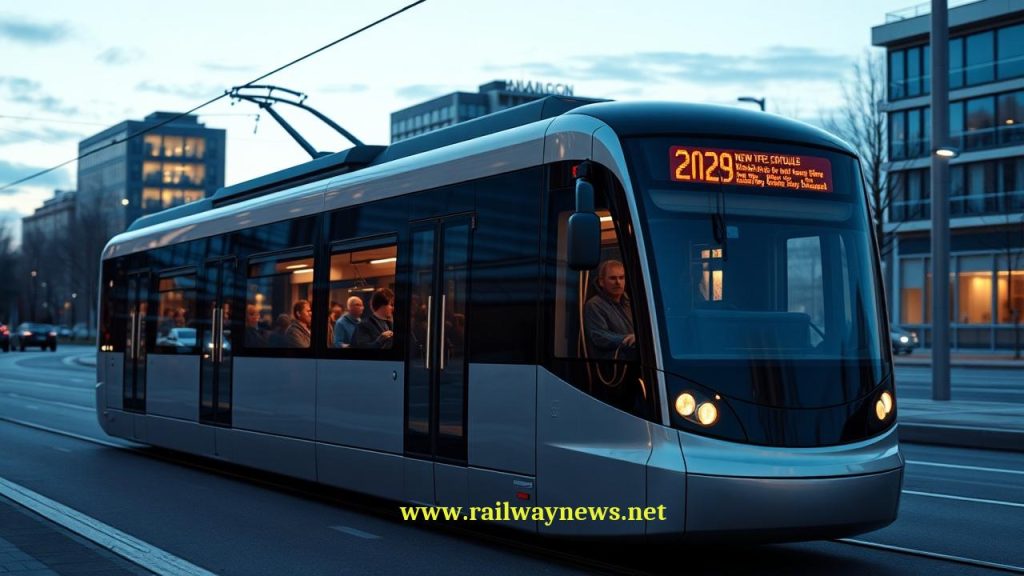
🛑 Key Takeaways:
- Tampere, Finland will lengthen 19 trams to increase passenger capacity as the network has reached its maximum service frequency.
- Each tram will be extended from 37m to 47m, boosting transport capacity by approximately 25% per vehicle.
- The project highlights a modular rolling stock strategy to overcome infrastructure bottlenecks, a growing issue for transit operators across Europe.
TAMPERE, FINLAND – Tampere’s public transport operator, Tampereen Raitiotie Oy, will increase its tram network’s capacity by 25% by physically extending its Škoda-built fleet. The move is a direct response to rising ridership and the inability to increase service frequency, which has already hit an operational ceiling of six-minute intervals. The project will see 19 trams lengthened with an additional 10-meter module ahead of a major route extension planned for 2028.
| Category | Specification / Detail |
|---|---|
| Project / Model | Tampere Tram Fleet Extension / Škoda ForCity Smart Artic X34 |
| Length Increase | From 37.3 meters to ~47 meters |
| Capacity Increase | ~25% per extended tram |
| Key Stakeholders | Tampereen Raitiotie Oy (Operator), Škoda Transtech (Manufacturer) |
| Timeline | Prototype testing summer 2024; fleet conversion complete by summer 2028 |
| Future Fleet Mix | 19 extended units, 16 standard-length units (by 2028) |
Operational & Technical Details
The extensions are possible because the Škoda trams were designed with modularity from inception. Manufacturer Škoda Transtech will add the new 10-meter sections at its Otanmäki factory. According to the operator, this will not affect the daily operation of the network. The prototype for the extended tram is scheduled for testing in Tampere this summer.
Critically, the extended trams will retain the same technical performance as the current fleet. All materials and components are designed to be compatible and interchangeable. This approach avoids the costs and complexities of introducing a new vehicle type. CEO Pekka Sirviö stated that with service frequency at its practical limit, “extending the trams was the only realistic solution to increase capacity.”
Market Impact Analysis
Tampere’s vehicle extension strategy provides a practical solution to a problem facing many European transport networks: infrastructure saturation. As demand for rail travel grows, operators are often unable to add more services due to track and station capacity limits. Instead of costly infrastructure overhauls, Tampere is increasing capacity on existing services.
For manufacturer Škoda Group, this project serves as a key case study. It validates their modular vehicle design philosophy, positioning it as a flexible, long-term solution for cities with growing transport demand. This adaptability could become a significant competitive advantage against manufacturers offering less flexible rolling stock, particularly in tenders for mid-sized European cities planning for future growth.
FAQ: Quick Facts
Why is Tampere extending its trams instead of adding more services?
The network has reached its maximum practical frequency of one tram every six minutes. Adding more services is not feasible and would lead to traffic congestion, making vehicle extension the only viable option to increase capacity.
When is the expected completion date?
The full fleet of 19 extended trams is scheduled to be in service by summer 2028, aligning with the opening of the new Pirkkala–Linnainmaa route section.

Railway infrastructure, rolling stock and transport technologies specialist focused on global rail industry developments, high-speed rail systems, signaling technologies and freight transportation. Covering railway investments, public transport modernization, rail operations and international mobility projects across Europe, Asia and North America.
RELATED POSTS

October 8, 2026 1:15 pm
Alstom secured a €1bn contract to build 13 automated trains,...

October 1, 2026 7:09 am
United States regulators confirmed a September 30 deadline for the...

October 8, 2026 12:18 pm
Siemens Mobility signed an agreement with VinSpeed to supply 350...

October 4, 2026 5:14 pm
Alstom secured a CA$4.7 billion order from VIA Rail Canada...

October 5, 2026 6:12 pm
AECOM and Jacobs secured a contract in September 2026 to...

October 1, 2026 12:13 am
Illinois approved $1.5 billion annually for the Northern Illinois Transit...