
Europe’s EN 15227: Boosting Rail Crashworthiness
Discover EN 15227, the vital standard defining railway vehicle crashworthiness. Learn how controlled energy absorption and survival space protect passengers and crew in collisions.
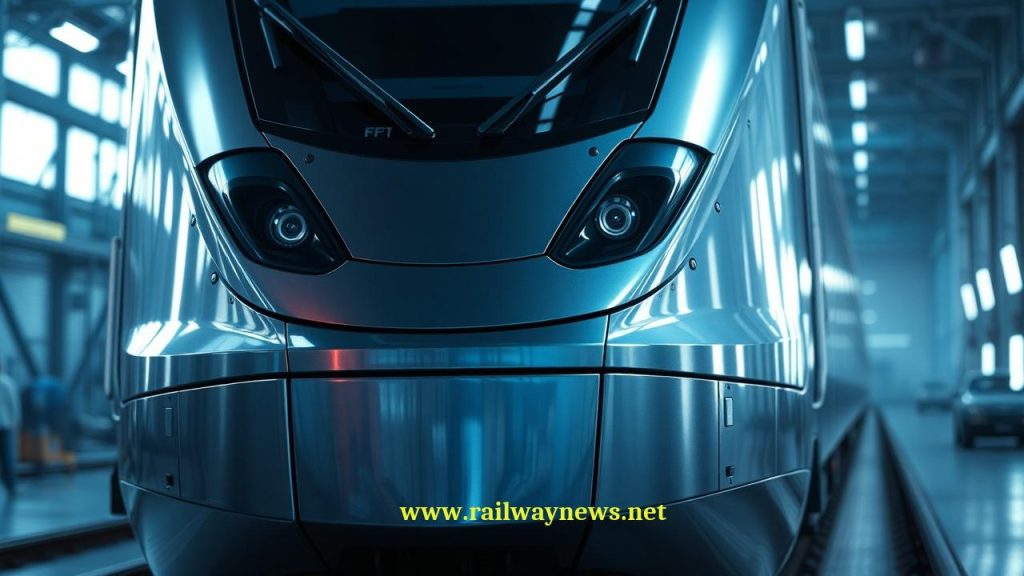
A Technical Guide to EN 15227: Crashworthiness Requirements for Railway Vehicle Bodies
EN 15227 is a crucial European standard that specifies the crashworthiness requirements for the bodies of new railway vehicles. Its primary objective is to enhance passenger and crew safety during collision events by ensuring predictable, controlled energy absorption and maintaining survival space within the occupied areas.
The standard establishes a framework for designing and validating rolling stock structures to minimize the consequences of accidents, such as collisions between trains, impacts with obstacles at level crossings, or impacts with buffer stops.
Core Principles of EN 15227
The philosophy of EN 15227 is built upon several key safety principles that guide the design of the vehicle body structure:
- Controlled Energy Absorption: The structure is designed with specific crumple zones, primarily at the vehicle ends, to absorb kinetic energy in a controlled and progressive manner during a collision.
- Maintaining Survival Space: Ensuring that the occupied areas for passengers and crew remain largely intact and free from significant structural intrusion during the design collision scenarios.
- Limiting Deceleration: Managing the deceleration forces experienced by occupants to survivable levels by controlling the rate of structural collapse.
- Preventing Override: Incorporating design features like anti-climbing devices to prevent one vehicle from climbing over another during a frontal collision, which could lead to catastrophic failure of the passenger compartments.
- Structural Integrity: Maintaining the overall structural integrity of the vehicle body to prevent collapse and ensure it can withstand post-accident rescue loads.
Crashworthiness Categories
EN 15227 classifies railway vehicles into different crashworthiness categories based on their type, mass, and operational environment. This categorization determines the specific collision scenarios and energy absorption requirements that must be met. The table below outlines these categories.
| Category | Typical Vehicle Type | Key Design Focus & Requirements |
|---|---|---|
| C-I | Locomotives, Power Cars, Driving Coaches | Designed for the highest collision energy scenarios. Must protect the rest of the train consist in a collision with heavy freight wagons or another train. Features robust front-end structures and significant energy absorption capacity. |
| C-II | Multiple Units (EMU/DMU), Passenger Coaches | These vehicles do not have the high mass of a locomotive. The requirements focus on collisions with identical or similar units. The entire trainset is designed to share the energy absorption load. |
| C-III | Light Rail Vehicles (LRV), Metro & Underground Vehicles operating on systems with low risk of collision with C-I or C-II vehicles. | Lower collision energy requirements compared to mainline trains due to lower operating speeds and segregated tracks. The focus is on impacts with similar light vehicles or road vehicles. |
| C-IV | Metro & Underground Vehicles operating on closed systems. | Designed for specific, system-defined collision scenarios. Often involves lower speeds and assumes no interaction with mainline or freight traffic. Requirements are typically the least stringent among the categories. |
Design Collision Scenarios
To ensure a vehicle meets its category requirements, EN 15227 defines a set of standardized design collision scenarios. The vehicle structure must be proven, typically through numerical simulation (Finite Element Analysis) and physical testing, to perform safely in these events.
Scenario 1: Frontal Impact with an Identical Train Unit
This is a primary scenario for most multiple units and coaches (Category C-II). It simulates a head-on collision between two identical trains. The goal is to verify that the energy absorption systems work collaboratively and that survival space is maintained in both units.
Scenario 2: Frontal Impact with a Freight Wagon
This scenario is critical for locomotives and power cars (Category C-I). It simulates an impact with a standardized 80-tonne freight wagon. The design must demonstrate that the locomotive’s front end can absorb the majority of the energy, protecting the trailing passenger carriages.
Scenario 3: Impact with a Large Road Vehicle
This simulates a collision with a large obstacle, such as a 15-tonne deformable obstacle representing a truck, typically at a level crossing. This test validates the strength of the front-end structure and its ability to resist penetration and derailment.
Scenario 4: Impact with a Small Obstacle
This scenario involves an impact with a smaller obstacle on the track, testing the integrity of the lower part of the cab structure and the obstacle deflector. The aim is to prevent derailment and damage to underframe equipment.
Technical Requirements and Verification Methods
Compliance with EN 15227 is a complex process involving advanced engineering and validation. Key technical elements include:
- Energy-Absorbing Structures: These are often called “crumple zones” or “sacrificial zones.” They are engineered to collapse in a predictable sequence, absorbing a defined amount of kinetic energy. This can involve honeycombs, collapsible tubes, or other deformable structures integrated into the vehicle’s front coupler and frame.
- Obstacle Deflectors: A robust structure at the very front of the train designed to clear smaller obstacles from the track without causing the train to derail.
- Anti-Climbing Devices: Interlocking profiles or energy absorbers located above the coupler that engage during a collision to create a vertical force, preventing one vehicle from overriding the other.
- Validation Process: Manufacturers must provide evidence of compliance. This is typically achieved through:
- Numerical Simulation: Highly detailed Finite Element Analysis (FEA) models are used to simulate the collision scenarios and analyze stress, strain, and deformation throughout the vehicle structure.
- Physical Testing: While full-scale crash tests are rare due to cost, key energy-absorbing components and structural sub-assemblies are physically tested under dynamic and static loads to validate the accuracy of the simulation models.
To summarize, EN 15227 represents a fundamental step forward in railway safety engineering. By standardizing the requirements for crashworthiness, it ensures that modern railway vehicles are designed with a holistic, system-level approach to occupant protection, significantly reducing the risks associated with collisions.

Railway infrastructure, rolling stock and transport technologies specialist focused on global rail industry developments, high-speed rail systems, signaling technologies and freight transportation. Covering railway investments, public transport modernization, rail operations and international mobility projects across Europe, Asia and North America.