
EN 16116-1: How Europe Ensures Rail Staff Safety
EN 16116-1 ensures railway staff safety by standardising steps and handrails on rolling stock. It prevents injuries, guarantees ergonomic access, and simplifies vehicle authorisation.
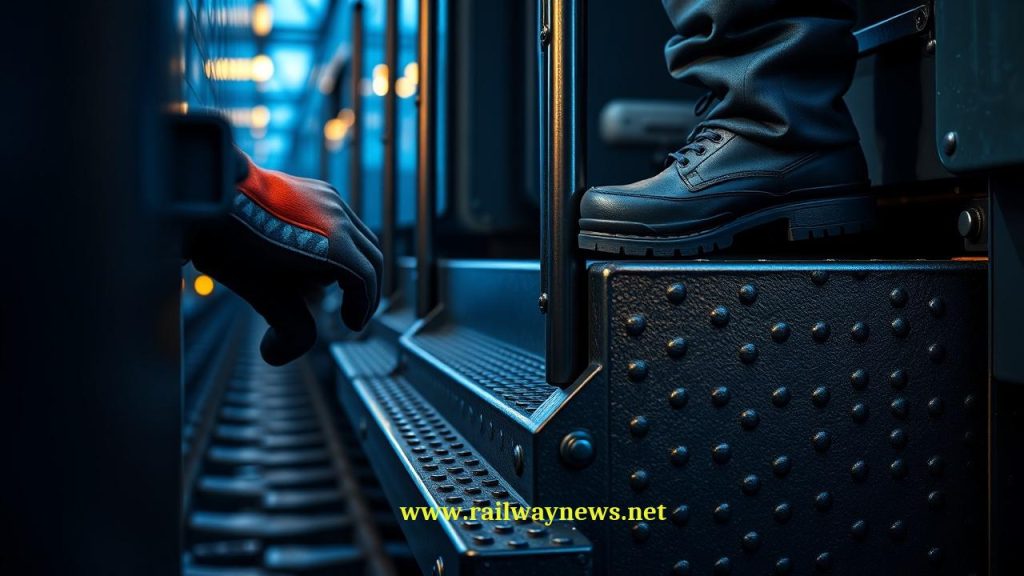
Understanding EN 16116-1: Design Requirements for Staff Access on Rolling Stock
EN 16116-1 is a key European Standard that specifies the design requirements for steps, handrails, and associated access points used by staff on railway vehicles. Its primary goal is to ensure safe, ergonomic, and consistent access for drivers, train crew, and maintenance personnel to perform their duties efficiently and without risk of injury.
This standard is Part 1 of a series and specifically applies to passenger rolling stock, including locomotives, multiple units, passenger coaches, and luggage vans. It forms a critical part of the vehicle design and authorisation process, ensuring that human factors are central to the construction of access systems.
Scope and Purpose of EN 16116-1
The fundamental purpose of EN 16116-1 is to standardise the design of access systems for operational and service staff. It does not cover access for passengers, which is detailed in other standards and regulations like the Technical Specifications for Interoperability for Persons with Reduced Mobility (TSI PRM).
The scope of the standard encompasses all physical interfaces that staff use to enter, exit, or move around the exterior of a vehicle, including:
- Access to the driver’s cab.
- Steps and handrails for shunting operations.
- Access to equipment compartments for maintenance.
- Walkways and gangways on the exterior of the vehicle.
By defining precise geometric, material, and performance criteria, the standard helps mitigate common risks such as slips, trips, and falls, which are significant concerns in the railway environment.
Core Design Principles and Technical Requirements
EN 16116-1 is built upon established ergonomic principles to ensure compatibility with the human body and the tasks being performed. The requirements can be broken down into several key technical areas.
Steps and Footsteps
Steps are one of the most critical components addressed. The standard provides detailed geometric constraints to ensure they are safe and usable under various operational conditions, including poor weather.
- Tread Depth: Steps must have a sufficient depth to allow for secure foot placement. The standard defines minimum values to prevent the foot from slipping off.
- Step Width: The width must be adequate to accommodate staff wearing work boots and to provide stability. Specific minimum widths are required depending on the step’s location and purpose (e.g., shunting steps vs. cab access).
- Riser Height: The vertical distance between consecutive steps is limited to ensure a natural and non-strenuous climbing motion.
- Slip Resistance: The surface of all steps must be slip-resistant. This is often achieved through perforated, embossed, or coated materials that provide grip even when wet, oily, or icy.
- Visibility: The leading edge of steps, especially the first and last in a series, must have good visual contrast with their surroundings to be easily identifiable in low-light conditions.
Handrails and Handholds
Handrails provide the necessary support for maintaining the “three-point contact” principle (two hands and one foot, or two feet and one hand), which is a cornerstone of safe climbing.
- Diameter and Profile: Handrails must have a specific diameter range that allows for a firm, ergonomic power grip. The profile should be free of sharp edges.
- Clearance: A critical requirement is the clearance around the handrail. There must be enough space for a gloved hand to grip the rail without obstruction from the vehicle body, known as “fist clearance.”
- Positioning: Handrails must be placed logically in relation to the steps they serve, providing continuous support throughout the entire motion of ascent or descent. Their height and orientation are carefully specified.
- Structural Integrity: All handrails and their fixings must be strong enough to withstand specified static and dynamic loads without permanent deformation, simulating the forces exerted by a person in service.
Comparison of Access Requirements for Different Functions
The standard recognises that access for a driver entering a cab is different from that for a shunter riding on the side of a vehicle. The requirements are therefore tailored to the specific task.
| Parameter | Driver’s Cab Access | Shunting Staff Steps |
|---|---|---|
| Primary Goal | Safe and comfortable entry/exit at the start/end of a shift, often from a platform. | Extremely robust and secure access for mounting/dismounting a moving vehicle at low speed. |
| Step Design | Often arranged as a staircase, may have a gentler slope. Treads are wide and deep for stability. | Typically vertical open-tread steps. Must be highly slip-resistant and self-cleaning (e.g., perforated) to shed mud and snow. |
| Handrail Configuration | Long, continuous handrails are provided along the staircase to guide the user. | Multiple, robust vertical and horizontal handholds are required to allow for secure three-point contact while the vehicle is in motion. |
| Clearance Requirements | Standard clearances apply, but design focuses on avoiding interference with platform infrastructure. | Generous clearances are essential to prevent clothing from snagging and to ensure a secure grip can be maintained under dynamic conditions. |
Interaction with TSIs and Harmonisation
EN 16116-1 is a “harmonised standard,” which means it provides a “presumption of conformity” with the essential requirements of relevant European legislation, primarily the Technical Specifications for Interoperability (TSIs). For rolling stock, the key TSIs are:
- LOC & PAS TSI: The TSI for Locomotives and Passenger Rolling Stock.
- PRM TSI: The TSI for Persons with Reduced Mobility (while this standard is for staff, some principles of safe access overlap).
By designing staff access systems in full compliance with EN 16116-1, manufacturers can demonstrate to regulatory bodies that their vehicles meet the relevant health and safety requirements of the TSIs, simplifying the vehicle authorisation and certification process across the European Union.
Conclusion
EN 16116-1 is more than just a set of dimensions; it is a detailed framework for mitigating operational risk by embedding safety and ergonomics into the fundamental design of railway vehicles. It ensures that the daily physical interactions of staff with their equipment are safe, predictable, and efficient. Compliance with this standard is essential for manufacturers to achieve regulatory approval and to provide a safe working environment for all railway personnel, ultimately contributing to a safer and more reliable railway network.
Frequently Asked Questions (FAQ)
What is the primary goal of EN 16116-1?
The primary goal is to ensure the safety of railway staff (such as drivers, shunters, and maintenance crew) by specifying clear, ergonomic, and robust design requirements for the steps, handrails, and access ways they use on locomotives and passenger rolling stock.
Does this standard apply to passenger access areas?
No, EN 16116-1 is exclusively for access systems intended for use by staff. Passenger access is covered by other standards and regulations, most significantly the TSI for Persons with Reduced Mobility (PRM).
What is the “three-point contact” principle mentioned in relation to EN 16116-1?
The “three-point contact” principle is a fundamental safety rule for climbing. It requires a person to have three of their four limbs in contact with the vehicle at all times (e.g., two feet and one hand, or one foot and two hands). The design of steps and handrails under EN 16116-1 is explicitly intended to facilitate this.
How does EN 16116-1 relate to the TSIs (Technical Specifications for Interoperability)?
EN 16116-1 is a harmonised European standard. This means that compliance with it provides a “presumption of conformity” with the relevant health and safety requirements of the TSIs, such as the LOC & PAS TSI. This simplifies the process for manufacturers to get their vehicles certified for use across the EU.
Are there specific material requirements in EN 16116-1?
The standard focuses on performance rather than prescribing specific materials. It requires that the materials used for steps and handrails are durable, resistant to corrosion, capable of withstanding specified mechanical loads, and provide sufficient slip resistance for the surfaces of steps under all expected environmental conditions.

Railway infrastructure, rolling stock and transport technologies specialist focused on global rail industry developments, high-speed rail systems, signaling technologies and freight transportation. Covering railway investments, public transport modernization, rail operations and international mobility projects across Europe, Asia and North America.